
Annika Büsing
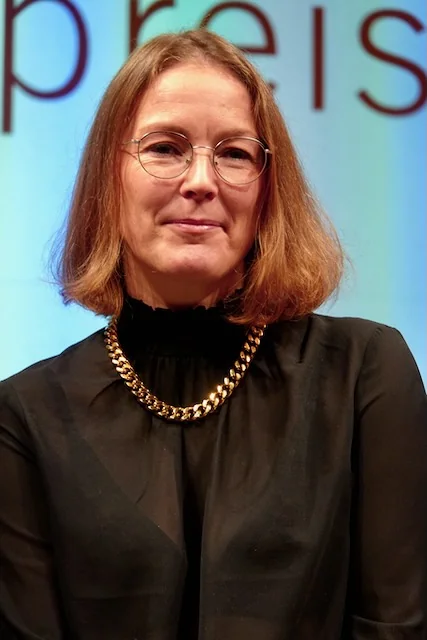
Image from Wikipedia
Image from Wikipedia
Annika Büsing – Precise Prose, Strong Characters, Presence in the Rhythm of Life
An author whose stories strike close to the pulse of reality
Annika Büsing, born in 1981, is one of the most prominent voices in contemporary German literature. Her novels revolve around love, vulnerability, and social realities – told with an unembellished, rhythmically dense language that draws readers immediately into the life worlds of her characters. After studying Protestant theology and German literature, she developed a clear literary style: laconic, allusive, dialogue-driven. With her debut novel “Nordstadt” (2022), she achieved significant breakthrough recognition; this was followed by awards, nominations, and a rapid increase in her literary presence. In 2023, her second novel “Koller” was published, and in 2025, the third, “Wir kommen zurecht” – an impressive body of work that marks Büsing's artistic development within just a few years.
Biography and Education: Foundations of a Precise Storyteller
Growing up in the Ruhr area and academically grounded by her studies in Protestant theology and German literature at the Technical University of Dortmund, Büsing combines cultural and social historical knowledge with a keen observation of everyday life. This combination shapes both her literary composition and character design: people on the threshold, people in motion, people who encounter adverse circumstances. Alongside her literary work, she taught as a German and Protestant religion teacher – a dual perspective that sharpens her sensitivity to language, generational experiences, and societal transitions, enhancing her narrative authenticity. While her music career may not be at the forefront, her appearances at readings possess a palpable stage presence: controlled in expression, nuanced in timing, secure in emphasizing dramatic focal points. This artistic discipline translates into her prose.
Debut “Nordstadt” (2022): A Breakthrough with Force and Tenderness
“Nordstadt” tells a raw love story beyond the kitschy – a couple's encounter rooted in urban everyday life that unfolds poetic strength precisely because of that. Formally, Büsing works with rapid scenes, reduced descriptions, and intense dialogues that sound like short riffs and propel the narrative forward. In content, she focuses on social topographies, on work and care, on disability and dignity, on closeness and distance. The novel immediately won over critics, receiving the Mara Cassens Prize, the German Youth Literature Prize (in the “New Talents” category), and the Literature Prize Ruhr; it was also shortlisted for several lists, including nominations for the Bavarian Book Prize and other debut awards. The success of “Nordstadt” established Büsing as an authority in the field of younger German narrative literature and opened the resonance space for future projects.
Awards and Authority: Prizes, Nominations, Resonance
Büsing’s award record is remarkable for a young phase of work. The Mara Cassens Prize traditionally honors the best novel debut in the German language, underscoring the literary quality of “Nordstadt.” The Literature Prize Ruhr visibly anchors the author in the cultural region she often explores thematically. The German Youth Literature Prize in the “New Talents” category signals relevance for younger audiences and a productive intersection between proximity to everyday life and literary ambition. Nominations – for example, for the Bavarian Book Prize – expand visibility in the feuilleton and publishing scene. These awards are not just labels; they attest to Büsing's consistency in composition, arrangement, and linguistic production, reinforcing her authority in literary discourse.
Second Novel “Koller” (2023): Road Novel, Relationship Chamber, Echo of Catastrophes
With “Koller,” Büsing consolidates her aesthetic signature while simultaneously expanding her thematic panorama. The narrative combines road motifs with a love story that spans from Leipzig to the Baltic Sea, through flooded landscapes and over internal fault lines. The prose remains focused, the sentences are concise, and the dialogues are acoustically discernible. Reviews highlighted the strong characterization through language; Büsing's arrangement intertwines individual biographies with social and ecological experiential spaces without ever tipping into a thesis-like approach. The novel was nominated for further awards, confirming the enduring quality of the author's voice. “Koller” acts like a variation on movement: on the map, in relationships, in the language itself – always in vibration, always in rhythm with the present.
Stage Adaptation: “Koller” at the Theater Oberhausen (Premiere March 27, 2025)
The stage adaptation of “Koller” at the Theater Oberhausen marks an important transfer of her prose into another medium. Directorial signature and scenic density meet Büsing's precise dialogue art – an alliance that illuminates the text performatively anew and enhances the stage presence of the characters. The premiere on March 27, 2025, documents how adaptable this literature is for collective experience: the composition of materials, the rhythmic economy of storytelling, and the concentrated psychology of the characters gain another dimension in the scenic implementation. Such adaptations function as resonance spaces for literature and thoroughly anchor Büsing's work in cultural life, far beyond the medium of the book.
Third Novel “Wir kommen zurecht” (2025): Family Configurations and Coming of Age
With “Wir kommen zurecht,” Büsing presents her third novel in 2025 – a concentrated, narratively tight study of family, responsibility, and self-determination. The tone remains unsentimental, the language clear, and the dramaturgy precise. In her character work, Büsing shifts perspectives on generational relationships without losing empathy for fractures and ambivalences. Media reviews emphasize the narrative reduction, which in the silence of her scenes tells much about the relationship between closeness, silence, and care. The timely release of this novel after “Koller” demonstrates Büsing's productive development dynamics: she expands her thematic motifs, sharpens rhythm and timing, and tests new nuances in voice and perspective – a convincing next step in a mature artistic evolution.
Style, Composition, Production: How Language Builds the World
Büsing's prose stands out for its conscious relationship between form and content. In composition, she relies on concise chapters, rapid scene changes, and the acoustic precision of dialogues; this creates momentum, gives contour to characters and spaces, and keeps the narrative trimmed to economy. In “production” – in the literary sense of material selection, perspective guidance, and linguistic condensation – she connects everyday observations with poetic conciseness. Her sentences possess the elasticity with which musical grooves operate: syncopations, pauses, repetitions. This results in a rhythmic cadence that interlinks memories and the present, traumas and desires. Büsing's artistic development can be read from book to book as a finely tuned expansion of her stylistic means – always with an eye on social and emotional realities.
Critical Reception and Contextualization: Between Contemporary Diagnosis and Tenderness
The reception of “Nordstadt” and “Koller” repeatedly emphasizes how Büsing balances empathy and hardness: characters without pathos, themes without sententia. Reviews highlight the “robust sensitivity” and the “quick, raw” tone that still allows space for tenderness. This explains the resonance in the press, juries, and readings – Büsing's literature feels immediate, without relying on effects. In the literary historical field, she stands in a tradition of realistic contemporary narratives that have increasingly taken up voices from the world of work, periphery, and care work since the 2010s. Her authority stems from precision, linguistic discipline, and recurring quality in character development – traits that both critics and theaters appreciate.
Readings, Public Appearances, and Mediated Experience
As a teacher and author, Büsing operates at the intersections of everyday life and literature outreach. Readings are not merely lecture formats for her but dramaturgically well-placed storytelling spaces where voice, rhythm, and pauses make the prose structure audible. This stage presence shapes the musicality of her language in direct contact with the audience and sharpens the focus on timing, metric, and resonance. The interplay of text, presentation, and discussion strengthens the bond with readerships and situates her works in the cultural exchange of cities and festivals, on stages and in libraries. This practice extends the impact of her books beyond mere reading and supports her status as a reliable narrator of social present.
Conclusion: Why Annika Büsing Must Be Read Now
Annika Büsing combines narrative precision with empathetic accuracy. Her novels depict people who provide support to one another without offering simple solutions. Stylistically, she works economically, rhythmically, and image-consciously – literature that stays in the ear and takes the present seriously. Those wanting to understand how contemporary German prose can sound should read “Nordstadt,” travel with “Koller,” and let “Wir kommen zurecht” guide them through the fine cracks of family stories. The appeal is clear: experience this author live – at readings, on stages, in conversation – because her spoken language unfolds an own, quiet power.
Official Channels of Annika Büsing:
- Instagram: No official profile found
- Facebook: No official profile found
- YouTube: No official profile found
- Spotify: No official profile found
- TikTok: No official profile found
Sources:
- Wikipedia – Annika Büsing
- Steidl Verlag – Author page Annika Büsing
- Theater Oberhausen – Koller (after the novel by Annika Büsing), Premiere March 27, 2025
- WDR/ARD Mediathek – Westart: Portrait of the writer Annika Büsing (March 22, 2025)
- BuchMarkt – Literature Prize Ruhr goes to Annika Büsing (“Nordstadt”)
- Deutschlandfunk Nova – “Wir kommen zurecht” (2025)
- Radio Bochum – Portrait/Interview, awards, and teaching activity
- Wikipedia: Image and text source
Upcoming Events
Reading with Annika Büsing at the Town Hall Clubbing
Town Hall Clubbing: Reading with Annika Büsing
Town Hall Clubbing: Reading with Annika Büsing – We're Doing Just Fine