Volunteering in Landshut: Engagement That Makes a Difference
Volunteering & Volunteer Work in Landshut (2026/2027): How You Will Be Able to Get Involved
This guide looks ahead: Which fields of engagement you are likely to find in Landshut in the coming months, how your entry can proceed, and which recognition (e.g., the Bavarian Volunteer Card) will become relevant for you in perspective.
For whom: People who want to start volunteering in Landshut from 2026/2027 (new to the city, employed, in training/studies, retired).
Why Your Entry in the Coming Months Will Be Sensible
If you get involved in Landshut in the coming weeks or months, you will not only take on tasks but also build relationships: in teams, in projects, and with people who need concrete support. Especially a "step-by-step" entry (e.g., 2–3 hours per month to start) will likely help you stick with it without overwhelming yourself.
You will typically gain two things:
- Impact in Everyday Life: Your time will become immediately noticeable for others (e.g., companionship, learning support, listening, organization).
- Skills & Network: You will often train skills that will also be useful outside of volunteering (communication, structure, teamwork, intercultural sensitivity).
How You Will Find a Suitable Placement
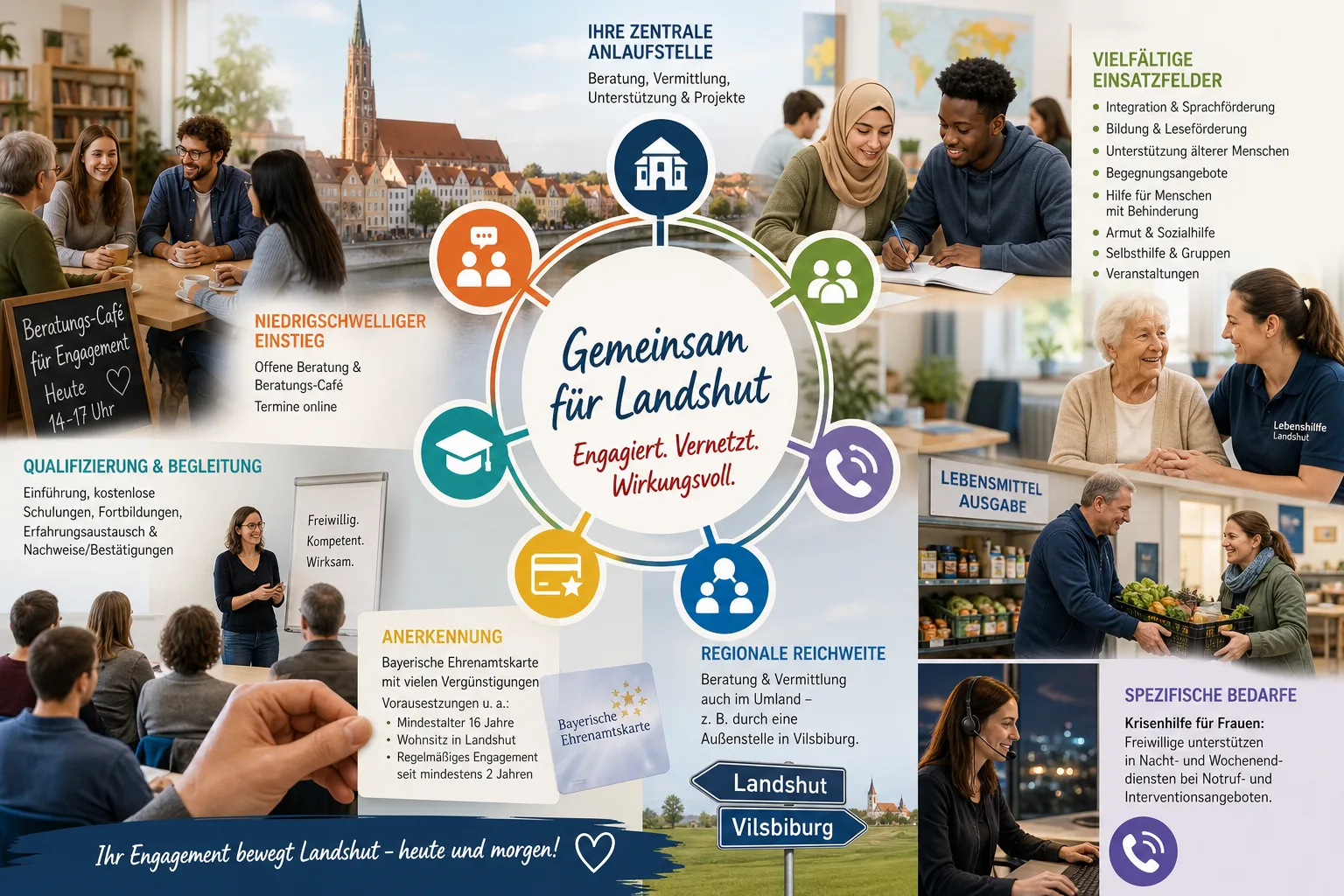
So that you don't just "end up" somewhere by chance, it is best to look for a placement or advisory structure that will specifically connect you with suitable organizations. In Landshut, you will usually come across central contact points, sponsors, and associations that coordinate engagement and offer initial interviews.
What You Will Clarify in a First Conversation
- Time budget: one-off, project-based, weekly or monthly
- Framework: daytime/evening/weekends, remote or on-site
- Role: work directly with people or help more organizationally
- Comfort zone: prefer 1:1 contact (mentoring) or team tasks (café/event)
- Requirements: possibly training, extended police clearance certificate, language skills, data protection/confidentiality
If you prepare like this, placement will proceed much faster and more accurately.
Fields of Activity You Will Likely Enter in 2026/2027
In Landshut, you will typically be able to choose between several fields of engagement. The following areas are particularly common in experience.
Integration & Language Practice
If you support people in arriving, you will often be needed in low-threshold formats where trust and everyday suitability count.
- Conversation groups for everyday language practice
- Accompanying to appointments (e.g., school, counseling, authorities – depending on project rules)
- Orientation in everyday life (routes, procedures, offers)
You will usually receive clear agreements about what you are allowed to take on and what not, so that help remains reliable and safe.
Education, Reading Promotion & Mentoring
If you like explaining, listening, or motivating, you will likely be able to make a very concrete contribution in learning and reading mentorships. It will often be about regularity (e.g., 45–90 minutes per week or every two weeks).
- Reading aloud, reading training, language games
- Homework support in fixed time slots
- Mentoring formats for transitions (e.g., school → training)
Companionship for Older People
If you open up to intergenerational encounters, you will often end up in visiting services or accompanied leisure formats. It will mostly be about time, attention, and reliability.
- Visits, conversations, walks
- Accompanying to appointments, if the project provides for it
- Support with group offers (games, reading aloud, small excursions)
Inclusive Leisure & Support for People with Disabilities
If you think inclusively and are hands-on, you will often be needed in leisure and cultural offerings. You will typically start alongside professionals or experienced volunteers.
- Accompanying on excursions, sports or culture
- Support at inclusive events
- Everyday assistance within clear agreements
Poverty-Related Aid & Practical Support
If you are organizationally strong and like to help "hands-on," you will often find tasks that work in the background but are crucial at the front: sorting, distributing, creating structure.
- Sorting/packing/distribution as part of aid offers
- Reception, guidance, short conversations (depending on the offer)
- Helping with logistics and process (setup, order, hygiene rules)
Meeting Cafés, Neighborhood & Events
If you network quickly, meeting formats will be a good "entry ramp." You will often work in teams here and get clear tasks.
- Preparing rooms, catering in a team
- Welcome roles, conversation offers, moderation help
- Support for cultural and neighborhood activities
Crisis Assistance (Sensitive Area)
If you plan to get involved in crisis assistance (e.g., support offers for women), you will very likely go through a structured selection and training concept before taking on responsibility. In this field, boundaries, on-call duties, and supervision are particularly important.
This Is How Your Entry Will Typically Proceed
- Making Contact: You will write/call a contact point or organization and briefly describe what you are looking for.
- Initial Interview: You will clarify time, interests, possible limits, and framework conditions.
- Matching: You will get 1–3 suggestions that may fit your profile.
- Getting to Know: You will observe or do a trial session before committing.
- Start with Plan: You will receive a start date, contact persons, and rules (data protection, dealing with risks, substitution).
- Routines & Feedback: Ideally, after a few weeks, you will have a feedback conversation to adjust tasks.
If you are aware of these steps in advance, you will find an engagement more quickly that will fit your everyday life in the long term.
Qualification, Support & Safety: What You Will Clarify in Advance
Training & Induction
Depending on the field of activity, you will likely receive an introduction in the coming months (e.g., conversation skills, understanding of roles, child protection basics in child-related projects, intercultural sensitivity). The goal will be for you to act safely and not feel left alone.
Insurance, Data Protection, Boundaries
Before you start, you will clarify these points bindingly (and have them given to you in writing if in doubt):
- Insurance coverage: whether and how accident/liability will be regulated
- Expense reimbursement: whether travel costs or expenses can be reimbursed
- Data protection & confidentiality: what you are allowed to document and what must remain confidential
- Emergency procedures: whom you will contact in case of incidents (contact person, on-call, clear escalation)
Proof for Training/Job
If you wish, you will often be able to receive a certificate of activity or proof of engagement. This will be especially helpful if you want to apply in 2026/2027 or make skills acquisition visible.
Recognition: How the Bavarian Volunteer Card Can Become Relevant for You
If you volunteer regularly over a longer period, you will be able to apply for a Bavarian Volunteer Card in Bavaria under certain conditions. Depending on the acceptance points, it will grant you discounts (e.g., in leisure, culture, or education).
What You Will Likely Have to Prove
The requirements are described in the official guidelines. In practice, you will typically have to prove that your engagement:
- will take place regularly and over a longer period,
- will be performed at a suitable organization,
- and can be confirmed by the placement.
How You Will Prepare Early
- You will note a contact person in the organization at the beginning.
- You will (if offered) document hours/times in a traceable way.
- Before applying, you will check the current info page of the responsible office to submit according to the latest criteria.
Checklist for Your Next Steps
- You will realistically set your time budget (e.g., 2 hours/month to start).
- You will select 2–3 topics that really interest you (e.g., education, seniors, integration).
- You will formulate a short profile (What can you do? What do you not want?).
- You will arrange an initial interview and specifically ask about insurance/training/contact person.
- You will only commit after an observation period.
- You will get brief feedback after 6–8 weeks and adjust the task.