Urban Transformation in Landshut: New Neighborhoods & Housing
Urban Transformation in Landshut: New Neighborhoods & Projects Coming Up Next
Landshut is growing and changing — often quietly, but noticeably. In the coming years, new neighborhoods are being planned, existing settlements further developed, and formerly infrastructure-dominated areas gradually transformed into urban building blocks with housing, green spaces, and everyday amenities.
This overview focuses exclusively on projects and development directions that, as of today (as of 2026), are planned for the future: Which guidelines shape urban development, which areas are particularly in focus, and what this means for residents, commuters, visitors, and the local economy.
Future Neighborhood Between Lurzenhof and Auloh: More Housing, Higher Quality of Open Spaces
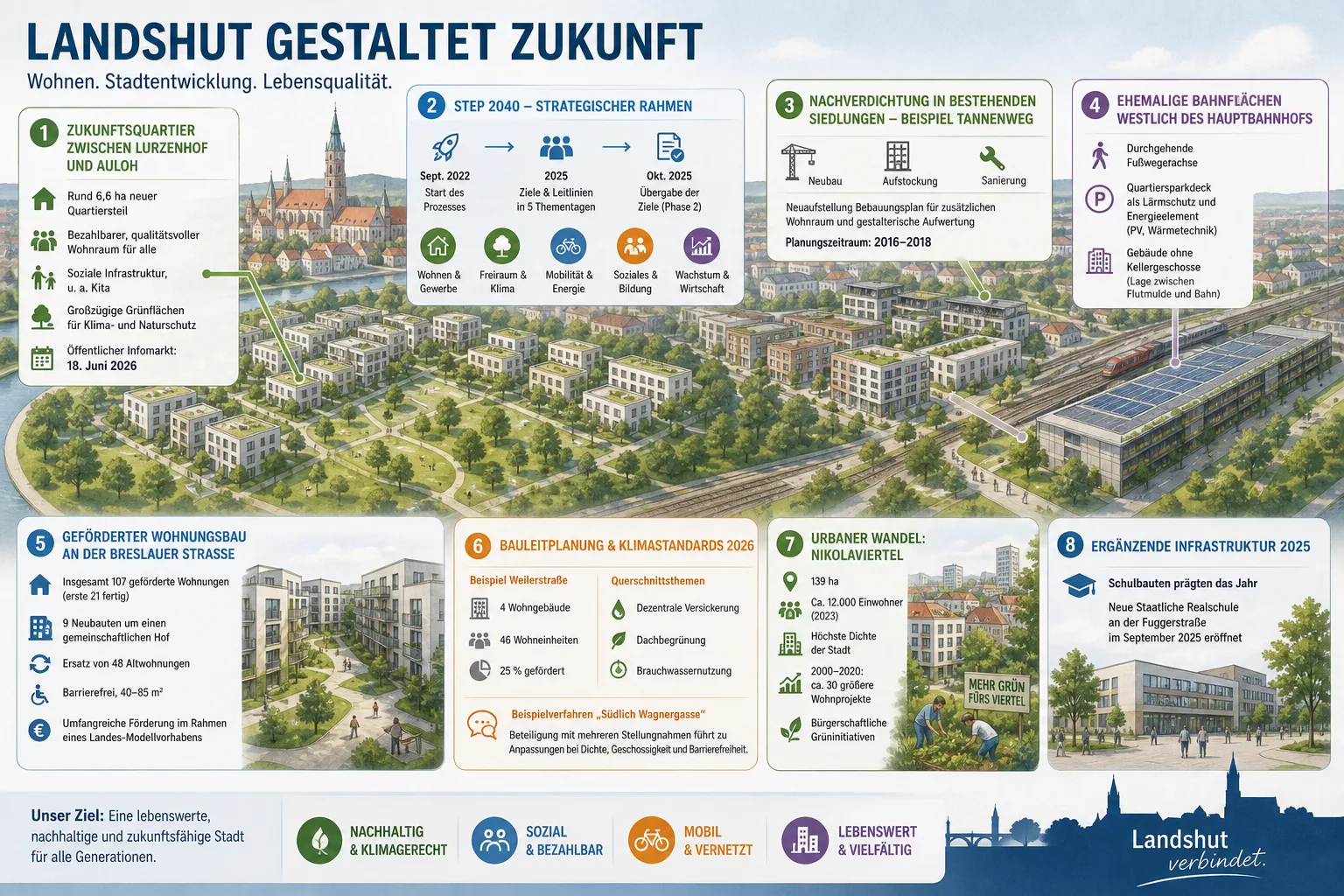
A new neighborhood is being considered as a future project between Lurzenhof and Auloh. In further planning, it is intended to serve as an example of how Landshut wants to combine housing, social mix, and open space design: with different types of housing, additional everyday amenities, and an open space structure that supports recreation, encounters, and climate adaptation at the same time.
What Will Be Especially Important in This Neighborhood
- Mix Instead of Monostructure: The goal is a mix of housing options for different life stages and household sizes.
- Green as Functional Infrastructure: Open spaces should not only be "nice" but also cool, provide shade, promote biodiversity, and absorb rainwater.
- Short Distances: Future everyday routes (daycare, local supply, stops, play and recreation areas) should be accessible within the neighborhood or in direct proximity.
Especially on the outskirts, the balance will be crucial in the next planning steps: new apartments and facilities on the one hand — preservation of open space quality, good traffic management, and compatible transitions to the existing neighborhood on the other.
Inside Before Outside: Densification & Reuse of Existing Structures
A key focus in the coming years is on internal development: Additional housing should preferably be created where streets, public transport connections, schools, and amenities already exist. For this, existing structures in various areas are being reviewed and carefully further developed — for example, through supplementary buildings, additional stories, conversions, or urban reorganization of individual sub-areas.
For densification to be perceived as a gain in the future, three points must fit together:
- Design & Scale: New buildings should fit into the surroundings in terms of height, grain, and open space design.
- Open Space & Everyday Life: Density needs compensation: play, recreation, shade, seating, and safe routes.
- Mobility: If more people live in the neighborhood, the share of walking, cycling, and public transport must realistically be able to increase — otherwise, parking pressure will rise.
Former Railway Areas West of the Main Station: A New City Entrance in Planning
A particularly defining future topic is the redesign of former railway-related areas near the station. Such areas can become urban neighborhoods in the coming years, combining housing, quality of stay, and good transfer options — thus redefining "arriving in Landshut."
What Matters at the Station Location
- Route Connections: A clear, continuous pedestrian and bicycle connection towards the city center and into adjacent neighborhoods is central.
- Noise Protection & Health: Along railway tracks, building arrangement, layouts, and open spaces must be planned so that quiet residential and recreation areas remain possible.
- Climate Resilience: In sensitive locations (e.g., near bodies of water or retention areas), construction must be prepared for heavy rain, groundwater, and heat.
- Mobility Without Increased Traffic: A neighborhood near the station can only function in the long term if the planning actually utilizes the public transport advantage (bicycle infrastructure, sharing, short distances, limited car traffic).
For visitors and commuters, such developments can bring a noticeable plus in the future: better orientation, more attractive route connections, and a city edge that does not feel like a backside, but like an inviting transition to the city center.
Affordable Housing & Social Mix: What Landshut Needs to Pay Attention to in the Future
Affordable housing will remain a key factor for social stability in the coming years. Urban development here is not just a question of additional apartments, but also of composition: If new neighborhoods are predominantly high-priced, displacement pressure and commuting distances increase. If subsidized and privately financed options are sensibly mixed, neighborhoods benefit in the long term from diversity and neighborhood structures.
For future projects, the following points are particularly relevant:
- Planning Safeguards: In development plans and urban development contracts, shares for subsidized housing or socially oriented concepts can be anchored.
- Barrier-Free Layouts: With regard to demographics and life realities, barrier-free construction is becoming increasingly important.
- Everyday-Friendly Neighborhood Centers: Affordable housing works best when it is not isolated, but connected to open spaces, mobility, and amenities.
For the urban society, this means in perspective: Anyone who works, studies, or retires in Landshut should continue to have realistic chances of finding suitable housing within the city — without everyday life failing due to long distances or lack of infrastructure.
Green, Climate, Education: What Makes New Neighborhoods Livable
The quality of future neighborhoods is not determined by the number of buildings, but by their performance in everyday life — especially in summer heat, heavy rain, and the daily organization of childcare, school, and leisure. For Landshut, such measures are therefore increasingly coming to the fore in upcoming projects:
1) Climate Resilience in the Neighborhood
- Shade Providers: Tree planting and heat-resistant greenery along paths and squares.
- Rainwater On Site: Where possible, infiltration, retention, and delayed drainage instead of rapid discharge into sewers.
- Green Roofs and Facades: As a contribution to cooling, biodiversity, and fine dust binding.
2) Open Spaces That Enable Encounters
Future open spaces must serve several target groups at once: children and young people (play, sports), adults (recreation, routes), seniors (seating, accessibility), and the entire neighborhood (meeting points, quiet zones). Good open space planning reduces conflicts — and increases acceptance of new buildings.
3) Let Social Infrastructure Grow Alongside
New apartments create demand: daycares, school rooms, all-day offers, sports areas, and reliable accessibility by bus, bike, and on foot. Future planning will therefore increasingly consider how education and care are integrated spatially, temporally, and in terms of transport, so that new neighborhoods do not become mere dormitory areas.
Get Involved Instead of Just Watching: What the Transformation Means for You
Urban development in Landshut will continue to be strongly accompanied by formal and informal participation in the coming years. Those who want to get involved typically have several starting points: early information formats (e.g., design and dialogue events), participation in the land-use planning process (statements during public display), as well as locally anchored initiatives that advance specific topics such as green spaces, traffic safety, or quality of stay.
Practical Tips for Constructive Participation
- Name Specific Situations: Where are safe crossings missing? Where does rain accumulate? Where does it get particularly hot in summer?
- Consider Alternatives: Criticism is more effective when combined with feasible suggestions (e.g., routing, trees, recreation zones, delivery traffic).
- Consider the Time Horizon: Many decisions are made early — the earlier you inform yourself, the greater your influence.
For the local economy, future projects mean both opportunities and requirements: demand for crafts, planning, construction, and neighborhood services may increase — at the same time, the importance of sustainable standards, efficient construction site logistics, and durable material and energy concepts is growing.