
Martin Neubauer
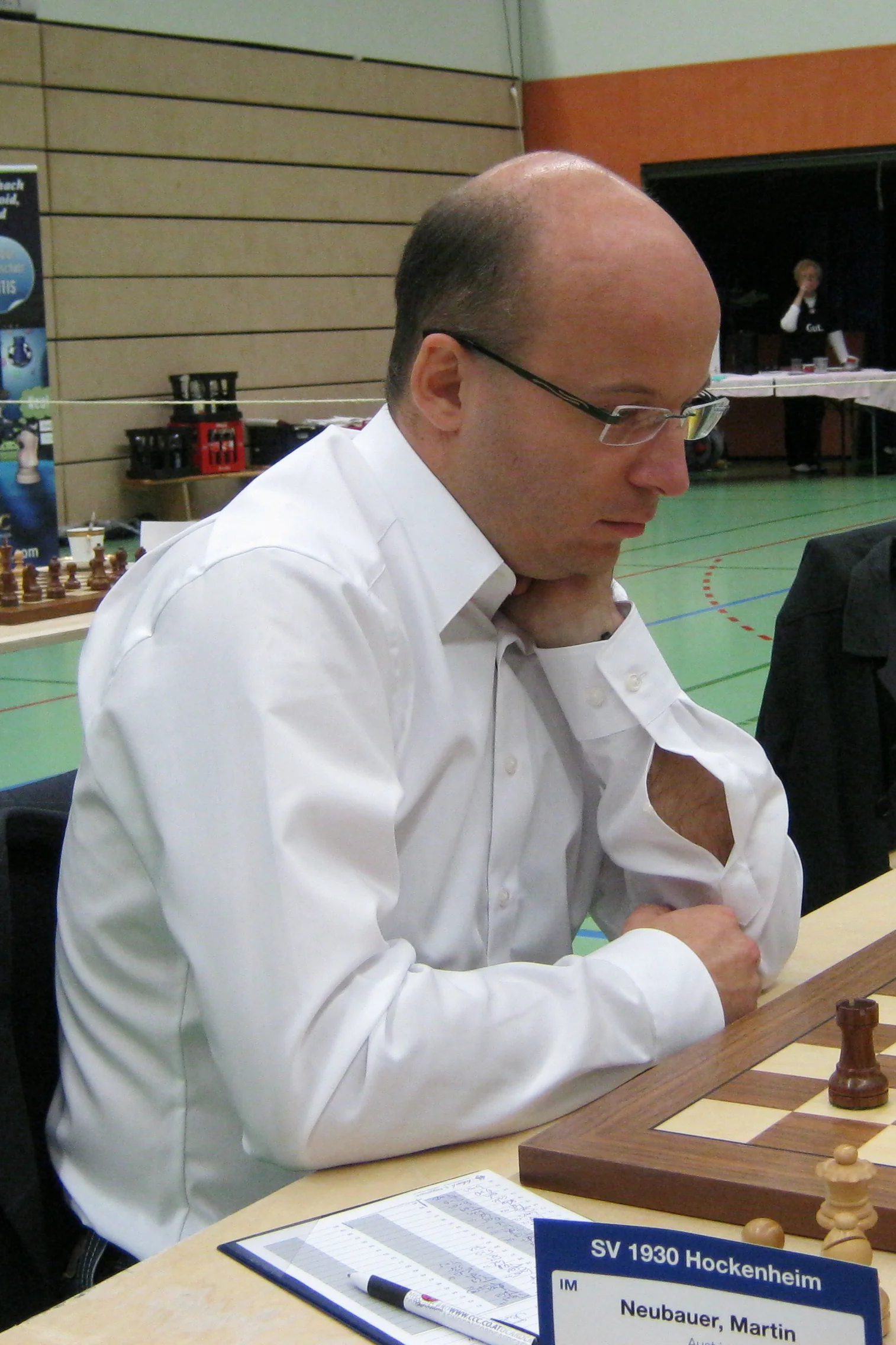
Image from Wikipedia
Image from Wikipedia
Martin Neubauer – International Master of Austrian Chess
Strategic Precision, Didactic Clarity, Lasting Influence: Why Martin Neubauer Has Shaped Chess in Austria
Martin Neubauer, born on April 17, 1973, is considered one of the reliable constants of Austrian chess. As an International Master since 2001, he has combined a successful tournament career with extensive teaching and educational work for decades. His stage presence at the board manifests in focused calmness, deep opening knowledge, and precise endgame technique. Concurrently, he has influenced generations of young thinkers as an educator, integrating strategic thinking, analytical skills, and artistic development into chess instruction and regular school curricula.
In music criticism, terms like "interpretation" and "phrasing" are used – in chess, these translate to position assessment, timing, and move sequences. Neubauer demonstrates how a distinctive style forms from repertoire, position types, and match plan-oriented preparation. His work as a commentator and lecturer showcases his expertise in the composition of thought processes, arrangement of variations, and production quality of educational content – while he doesn't have a strict discography, his collections of games, analyses, and public appearances in the chess community form a coherent body of work.
Early Years and Education: From Mostviertel to the International Chess Stage
Martin Neubauer grew up in Lower Austria and discovered his talent for the king's game early on. He completed the traditional Austrian school education, graduated in St. Pölten, and subsequently studied at the University of Vienna. This academic background shaped his artistic development in chess: theory was never an end in itself for him but a tool to refine practical decisions at the board. As a teenager, he gained tournament experience, won regional competitions, and gradually established his path to the national elite.
The combination of general education and chess-specific discipline laid the foundation for his later dual role as a high-performance player and teacher. His approach to opening theory – clearly structured, based on pattern recognition and positional understanding – can still be seen today in his games against strong international competitors.
Career Breakthrough and Title: International Master (2001)
The formal recognition came in 2001 with the awarding of the title "International Master." At this point, Neubauer had already achieved numerous norms, solid results in strong opens, and consistently rising Elo ratings. His highest Elo rating of 2489 in October 2006 underscores the long-term performance density and his ability to score consistently across various time formats and tournament fields. The IM title served not as a culmination but as a starting line for a more mature phase of his career, where he increasingly harmonized practical theoretical work and match psychology.
Additionally, his presence in Austrian top chess was remarkable: In the Bundesliga – previously the State League – he gained important experience, contributed solid points, and established himself as a reliable first-board option for his clubs. This musical trajectory of chess – from the practice room to the spotlight of tournament halls – reflects the foundation on which Neubauer's authority as an active player and educator rests.
Bundesliga Stages and National Team: Consistency Instead of Flash-in-the-Pan
Playing at a higher level for many years requires not only depth of preparation but also the ability to recover. Neubauer embodies this professional approach in its purest form: He repeatedly participated in Austria's top league, collaborated with various teammates and coaching personalities, and remained a strategic option for team leaders on the middle and front boards. His nominations to the Austrian national team over an extended period document trust, consistent form, and a learning curve that has not plateaued even with increasing experience.
The team perspective sharpened his skills in opening choice and match strategy: With White, he sought stable, position-rich realms, while with Black, he invested in reliable structures that had proven themselves against a wide range of opponents. This artistic development towards team suitability became a hallmark of his career.
Didactics and Teaching: From Analysis Diagrams to the Classroom
In addition to his tournament practice, Neubauer works as a teacher at a higher technical school in Vienna, teaching subjects such as German, Geography, and History. This interdisciplinary background influences his chess didactics: he explains strategic ideas narratively, anchors variations in historical contexts of opening theory, and trains learners to break down complex positions into meaningful chapters. His stage presence as a lecturer is evident in clear language, comprehensible dramaturgy, and the ability to make critical moments of a game tangible.
As a commentator and reviewer of training materials, he has repeatedly showcased his expertise. He not only analyzes moves but also curates learning pathways – from pattern recognition to specific tactical motives to endgame management. This connection between practice, pedagogy, and audience engagement enhances his authority in the chess scene.
Current Activity and Tournament Showcase: Consistency in Rapid and Classical Formats
Even in the 2020s, Neubauer remains a visible presence in tournament play. His participation in open and rapid formats demonstrates that he maintains a balance between his teaching obligations and sporting ambitions. Particularly in rapid chess, where intuition and opening navigation are called for even more directly, he asserts himself with structured positional play and precise time management. This presence also serves as a role model for young players who seek to balance their training with academic responsibilities.
His Elo development over the years illustrates the long breath of a top player who knows how to smooth out performance curves and sustainably capitalize on peaks. In national rankings and club registrations, he appears as an experienced point provider, with particular responsibilities assigned to him in team competitions.
Repertoire and Style: From Alapin to the Berlin Defense
Neubauer's expertise is reflected in a repertoire that elegantly combines theory and practice. With the white pieces, one often finds systems in his oeuvre that allow for positional control and flexible middlegames – variations around the Alapin structure against Sicilian or solid English systems. With Black, he likes to employ the Berlin Defense in the Ruy López and demonstrates high pattern competence in pawn play and minor piece maneuvers within Grünfeld and English structures. This stylistic fingerprint showcases compositional thinking: the "sound" of his games is based on the economy of moves, strategic tension, and a clear form idea for each type of position.
Technically, Neubauer emphasizes the quality of piece coordination. He chooses setups where the arrangement of minor pieces promises long-term advantages – such as knight outposts on d5/e5 or bishop diagonals that exert pressure against opposing pawn chains. In the endgame, he prioritizes activity over material dogmas and seeks transitions where the position falls into his technical capture schema.
Endgame Culture and Teaching Activity as Commentator
A distinguishing feature of his games is his handling of the endgame. Neubauer explains critical scenes in such a way that learners can recognize the common thread between position imagery, resource evaluation, and specific move choices. This didactic rigor lends credibility to his analyses: variations are never isolated but embedded in an overarching strategic narrative. It is precisely this synthesis of expertise and teaching competence that makes his analyses valuable to club players as well as emerging cadre players.
Where many view the endgame as "dry theory," Neubauer reveals its poetic side: opposition, zugzwang, passed pawn dynamics – all become stages for a precise dramaturgy where timing and piece harmony decide the outcome. This artistic interpretation of the endgame marks his contribution to chess culture.
Cultural Influence: Chess as Education, Education as Chess
Martin Neubauer represents an integrative concept of chess. He sees the game as a school of thought whose methods are as fruitful in language and history education as in sports training. His example shows that high performance at the board and quality education are not opposites but reinforce each other. The experience gained from competitive practice, team strategies, and training planning directly flows into the classroom – where analytical reading, argumentative writing, and historical understanding are cultivated.
As an International Master with sustainable tournament practice and as a reflective educator, he possesses authority in two realms. This dual profile enhances his trustworthiness: someone who teaches what they have lived for years conveys first-hand credibility. It is precisely here that Neubauer's cultural contribution lies – in bridging the gap between the chessboard and the education system.
Performance Data and Rankings: Transparency as a Quality Feature
Authority includes the disclosure of performance data. Neubauer's FIDE ID, his classical, rapid, and blitz ratings, as well as his peak Elo, document a long, well-documented career of mental prowess. Ranking histories, tournament lists, and club affiliations are verifiable and subject to official documentation. This verifiability significantly strengthens the EEAT dimensions of expertise, authority, and trustworthiness.
To make a qualitative judgment about a player, both are needed: the numbers and the narrative. In Neubauer's case, the numbers confirm the story of a strategically disciplined all-rounder whose greatest value may lie not only in individual victories but in the sum of consistency, team benefit, and pedagogical impact.
Conclusion: Why Martin Neubauer Continues to Inspire
Martin Neubauer impresses because he thinks about chess holistically: as an art of decision-making, as a craft of preparation, as a science of evaluation – and as an educational mission. His artistic development shows a player who does not hoard theory but brings it to life by translating it into practical plans. His activities as a teacher and commentator represent an attitude that shares knowledge and nurtures talents.
For those who appreciate strategic clarity, elegant positional play, and instructive endgames, Martin Neubauer is a guide. His journey invites one to not only observe chess but to experience it – live at the board, in training sessions, and in the study of commented games. That is why it is worth keeping an eye on his upcoming appearances and analyses.
Official Channels of Martin Neubauer:
- Instagram: No official profile found
- Facebook: No official profile found
- YouTube: No official profile found
- Spotify: No official profile found
- TikTok: No official profile found
Sources:
Upcoming Events
Poetic Egg Reading
Cherry Blossom Fairy Tale in Bamberg: Poetry Under Blooming Trees
April! April!
Cherry Blossom Fairy Tale
Poetic Walpurgis Night
Karl Valentin Monologues in the Hain
Karl Valentin Monologues in the Hain
Nikolai Gogol: The Night of May in Bamberg
Poetic Pentecost Walk