
Albrecht Dürer
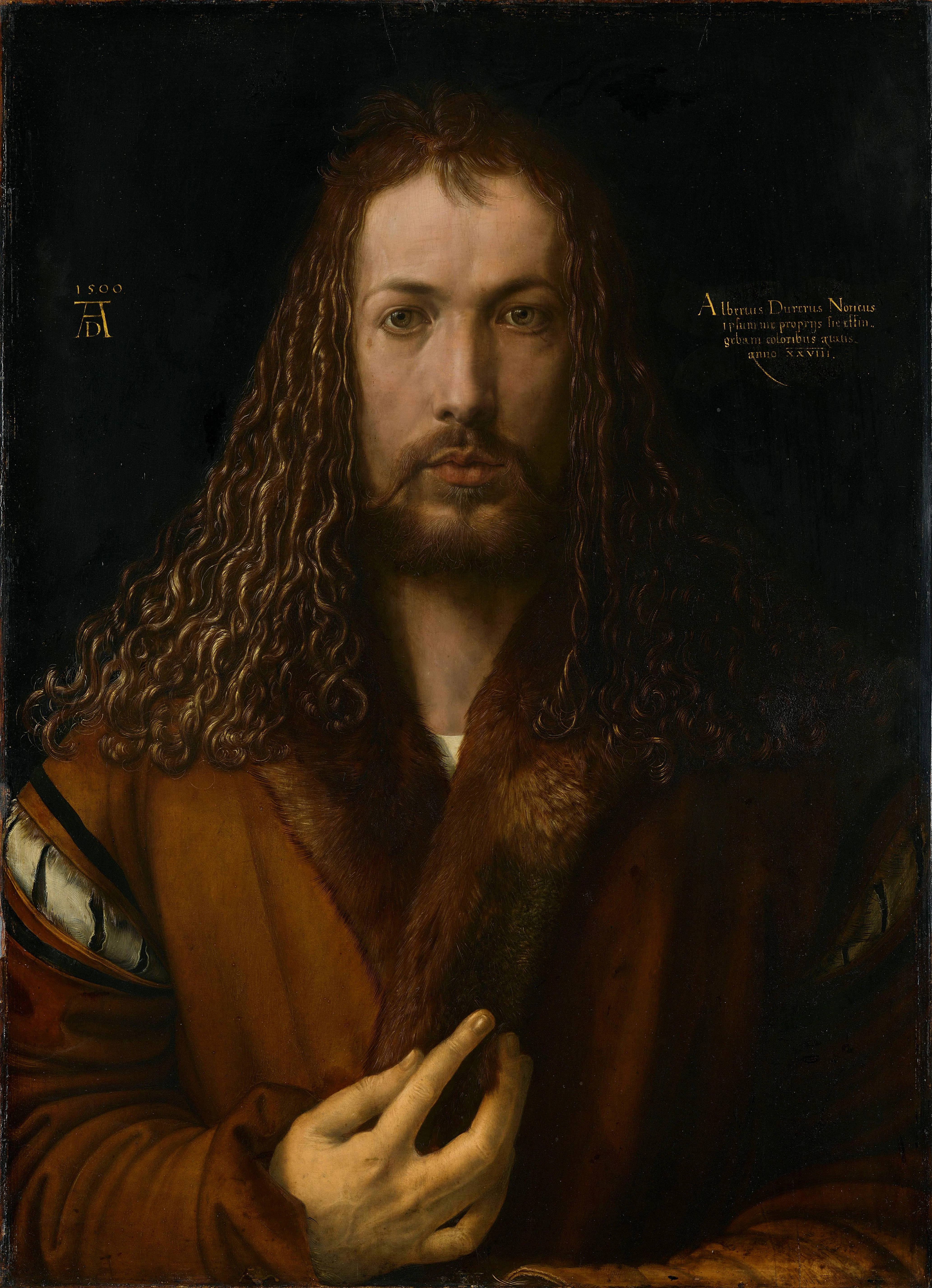
Image from Wikipedia
Image from Wikipedia
Albrecht Dürer (1471–1528) – Master of the German Renaissance, Innovator of Printmaking, Visionary of Image Science
From the Son of a Goldsmith in Nuremberg to a European Art Star: How Albrecht Dürer Prepared for Modernity with Engraving, Woodcut, and Groundbreaking Theory
Albrecht Dürer the Younger was born on May 21, 1471, in Nuremberg and died there on April 6, 1528. As a painter, graphic artist, mathematician, and art theorist, he shaped the Renaissance north of the Alps like few others. His signed paintings, engravings, and woodcuts, which circulated throughout Europe, made him famous even during his lifetime. He underwent an artistic development early on that combined observation of nature, technical precision, and intellectual curiosity into a unique visual language—a foundation upon which art history, printmaking, and image theory are built to this day.
Biographical Beginnings: Training, Workshop, Early Travels
As the son of a goldsmith, Dürer initially trained in drawing discipline, material knowledge, and precision thinking—keys to his later mastery in engraving. After an apprenticeship with Michael Wolgemut, he tested his stage presence as a visual storyteller in large-format woodcuts. Around 1494/95, a trip to Italy exposed him to Venetian color, humanism, and the idea of the artist as a scholar. This experience deepened his understanding of composition, proportion, and perspective, paving the way for a production of images that connected craftsmanship, science, and market.
Breakthrough in the Print Medium: Woodcut Cycles as the "Series Format" of the Renaissance
With cycles such as the Apocalypse (1498), the Life of Mary (around 1502/03; published in 1511), as well as the Great and Little Passion, Dürer developed serial storytelling as a dramaturgically coherent format. He technically optimized the woodcut—from line flow to chiaroscuro presentation—and turned it into a mass medium for spiritual content. His artistic evolution is seen in sharply defined contours, complex arrangements, and the ability to transform theological, natural history, and political ideas into iconic pictorial signs. These prints spread across Europe, strengthened his authority, and professionalized the art markets north of the Alps.
Engraving and the Icons of Image Culture
Between 1504 and 1514, Dürer created engravings of canonical significance. Adam and Eve (1504) combines classical anatomy with crystalline line work. Knight, Death, and the Devil (1513), St. Jerome in His Study (1514), and Melencolia I (1514) form a trilogy of existential symbols that encompass philosophical, scientific, and spiritual dimensions. In their composition, repertoire of symbols, and outstanding technical production, these sheets set standards in printmaking to this day. They demonstrate Dürer’s expertise in engraving, tonal gradations, and spatial illusion—a virtuosity that was already deemed unmatched by his contemporaries.
Painting, Nature Studies, and Icons of Observation
Dürer's panel paintings—from portraits to altarpieces—combine Italian colorfulness with northern precision. Simultaneously, groundbreaking nature studies in watercolor and drawing emerged: The Young Hare (1502) and the Meadow Pieces mark a new closeness to nature, in which botanical and zoological precision appears artistically sublimated. The Praying Hands (around 1508) have become a devotional image in their own right, initially created as a study sheet for practices of devotion. The Rhinoceros (1515)—despite being based on indirect observation—shows Dürer's ability to synthesize reports, imagination, and systematic form finding, creating a type of image that shaped knowledge transmission for centuries.
Artistic Development and Theory: Perspective, Proportion, Instruction
Dürer anchored artistic practice in scholarly thought. With the "Instruction on Measurement" (1525), he presented a standard work on the geometry of images—a compendium of line, surface, body, perspective, and instrumentation. The "Four Books on Human Proportion" (1528) systematize standard and variant proportions of the human body and derive rules for composition and ideal figures. These publications showcase Dürer’s discipline akin to a musical career in theory and practice: just as a composer reflects on form, meter, and arrangement, he developed a grammar of seeing—from the construction to the execution of an "image set."
Networks, Patrons, Court, and Public
Nuremberg provided Dürer with the infrastructure for art production and distribution as a center for trade and knowledge. Humanist circles, printers, publishers, and patrons—among them Willibald Pirckheimer—supported his authority. Contacts with the court of Emperor Maximilian I connected artistic innovation with representation, propaganda, and the new medium of printed image series. Dürer's presence as the author of his works—signed with the famous monogram—shaped a modern image of the artist: the artist as a brand, as an entrepreneur, and as an intellectual producer who strategically publishes and protects his oeuvre.
Travel, Exchange, and Stylistic Hybrids
Between Nuremberg, Venice, and the Netherlands, Dürer developed a transalpine aesthetic. From Italy, he acquired knowledge of perspective, anatomy, and classical ideals; in the North, he intensified textural studies, light control, and microscopic attention to detail. His compositions balance rigor and expressiveness, clearly establishing viewpoints and narrative focal points. The high-quality engraving translates this precision into a reproducible form, making Dürer function like a "label," whose quality shaped reception in workshops, collections, and courts.
Reception, Influence, and Cultural Historical Classification
Dürer's work was collected and scientifically commented on early. As the "greatest German Renaissance artist," he shaped iconographies, methods, and standards that structured painting and printmaking in Europe. His discography in the broader sense—the catalog of paintings, prints, and woodcuts—shows continuous innovation: from series formats to portrait art and the visual philosophy of melancholy. Museums worldwide—from Nuremberg to New York and London—preserve key works and explore his production in the context of the Reformation, scientific revolution, and media history of the early modern period.
Current Research, Exhibitions, and Memory Culture
The Albrecht Dürer House in Nuremberg has been conveying the life and work of the artist since the 19th century and is continuously being renewed—most recently with new presentations and programs in 2025. Research on Dürer's role during the Reformation, his network, and the technical production of his prints deepens the understanding of his work processes, legacy, and impact history. The work of these institutions strengthens the credibility of the preserved facts, opens archives, and makes Dürer’s artistic development comprehensible for today’s audience.
Works and Milestones – A Curated Overview
Apocalypse (Woodcut Series, 1498): visual dramaturgy that condenses the woodcut medium into a theologically-political stage. Adam and Eve (Engraving, 1504): a canonical lesson on anatomy, proportion, and classical pose. The Young Hare (Watercolor, 1502): an icon of nature observation. Knight, Death, and the Devil (Engraving, 1513), St. Jerome in His Study (1514), Melencolia I (1514): an existential trilogy between action, contemplation, and skepticism of knowledge. Praying Hands (Drawing/Study, around 1508): devotion in concentrated line work. Rhinoceros (Woodcut, 1515): a paradigmatic image of knowledge. Instruction on Measurement (1525) and Four Books on Human Proportion (1528): theoretical foundations for perspective, geometry, and figuration.
Technique, Composition, Production – Why Dürer Still Appears Modern Today
Dürer combined artistic craftsmanship with analytical rigor. His engravings use modulated hatching to compose spatial depth, atmosphere, and materiality; his woodcuts organize light-dark rhythms like musical measures. He professionalized production chains—from drawing to printing plate to edition—and defined quality standards for editions that shaped the European market. This blend of expertise, authority, and methodological transparency makes his oeuvre a model case of reliable visual communication.
Conclusion: Why Albrecht Dürer Fascinates – Yesterday, Today, Tomorrow
Dürer combines experiential closeness with erudition: nature studies as empirical evidence, theoretical works as reflection, printmaking as media innovation. He brings the Renaissance north of the Alps to life and shows how images carry knowledge, spark debates, and condense beauty. Those who experience his works in their originals feel the precision of the line, the clarity of composition, and the intellectual energy of an artist who has measured his age. Recommendation: Use exhibitions and museum tours to directly experience Dürer’s stage presence in space—from sheet to panel.
Official Channels of Albrecht Dürer:
- Instagram: No official profile found
- Facebook: No official profile found
- YouTube: No official profile found
- Spotify: No official profile found
- TikTok: No official profile found
Sources:
- Wikipedia – Albrecht Dürer
- Encyclopaedia Britannica – Albrecht Dürer (Biography)
- The Metropolitan Museum of Art – Heilbrunn Timeline: Albrecht Dürer
- Museen der Stadt Nürnberg – Albrecht-Dürer-Haus
- Museen der Stadt Nürnberg – Press Material New Permanent Presentation (2025)
- City of Nuremberg – Dürer Lectures 2025
- ARTinWORDS – Albrecht Dürer: Biography
- Wikipedia: Image and Text Source
Upcoming Events
smART Lunch: Dürer's Jakob Fugger at Schaezlerpalais
So Close to Heaven: Clouds in Art
So Close to the Sky. Clouds in Art
Close to the Sky: Clouds in Art
From Dürer to Piranesi – Printmaking from the Mannheim Collection of Anton von Klein (1746 – 1810)
In Focus: From Dürer to Rembrandt - Masterpieces of Painting
From Dürer to Piranesi – Printmaking from the Mannheim Collection of Anton von Klein (1746 – 1810)
Tour “Expressive! Graphics from Dürer to Schlichter”
From Dürer to Piranesi – Printmaking from the Mannheim Collection of Anton von Klein (1746 – 1810)