
Hagengasse 1, Landshut
Hagengasse 1, 84036 Landshut, Germany
St. Margaret Landshut | Services & History
The parish church of St. Margaret in Landshut-Achdorf is a place where faith, architecture, and urban life meet in a special way. The city of Landshut lists the church at Hagengasse 1 in 84036 Landshut, while the Archdiocese of Munich and Freising describes it as an impressive neo-baroque parish church with a significant spatial impact. This combination of a clear address, strong appearance, and vibrant use makes St. Margaret a destination relevant for both believers and culturally interested visitors. Those who come here find not an anonymous large church, but a sacred house with character, a distinct architectural profile, and an active parish community in the parish association of Achdorf-Kumhausen. The place is visible, audible, and present, which explains why the church frequently appears in searches related to services, history, livestreams, directions, and dates. ([landshut.de](https://landshut.de/node/1969))
Services, Livestream, and Current Parish Dates
Those searching for St. Margaret Landshut often mean not only the church as a building but also its current everyday life. On the parish page of the archdiocese, the services and parish news of the parish association Achdorf-Kumhausen are provided as a PDF, allowing visitors and community members to quickly access the latest information. Additionally, there is a livestream from St. Margaret, broadcast on weekends, Saturdays at 5:30 PM and Sundays at 10:30 AM. This makes the church not only present on-site but also digitally. It is particularly important to note from the parish that after the renovation, services will again take place in the parish church. This is relevant for all who wonder whether the church is currently open and used liturgically. The answer is: yes, regularly, visibly, and in a form that appeals to both traditional churchgoers and online viewers. ([erzbistum-muenchen.de](https://www.erzbistum-muenchen.de/pfarrei/pv-achdorf-kumhausen/cont/67919))
This digital and pastoral accessibility is a real search topic because it distinguishes St. Margaret from many other churches that, while architecturally interesting, rarely make current information publicly available. Here, several advantages come together: current schedule overviews, direct contact details of the parish office, and the livestream as a bridge for people who cannot come in person. The parish page lists as a contact among others Veldener Str. 13 in 84036 Landshut, as well as the phone and email of the parish. Thus, a classic parish church becomes a well-organized center of community life. The search queries for services, dates, programs, or live broadcasts are not only answered but placed within a reliable organizational framework. This is particularly helpful for families, seniors, travelers, or spontaneous visitors because one experiences the church not just as a monument but as a functioning place of pastoral care. ([erzbistum-muenchen.de](https://www.erzbistum-muenchen.de/pfarrei/pv-achdorf-kumhausen/cont/67919))
Neo-baroque Architecture and Bright Interior
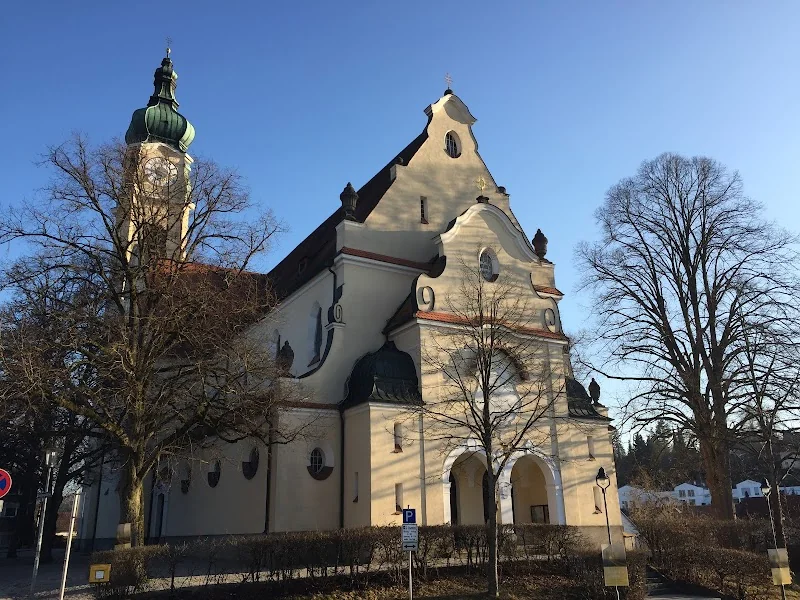
Architecturally, St. Margaret is one of the most impressive churches in the Landshut area. The city of Landshut describes it as a neo-baroque parish church built between 1909 and 1911 and consecrated in 1922. The Archdiocese adds that it was constructed according to the plans of Regensburg architect Heinrich Hauberrisser and thus belongs to the last examples of a historicist building style that still clearly orients itself to Western building traditions. The building appears spacious, clearly structured, and representative: a nave with four bays, a wide transept, choir area, and a tower on a square floor plan in four stories with a characteristic baroque dome. Even from the outside, it creates an impression of stability and dignity without the heaviness that some monumental buildings possess. St. Margaret appears rather as a house that is both solemn and open. ([landshut.de](https://landshut.de/node/1969))
Inside, the official description emphasizes brightness, spaciousness, and uniformity of the furnishings. Column pilasters with composite capitals, multiple stepped cornices, and the vaulted belts give the space structure without visually dividing it. The high altar, created in 1913/14 according to Hauberrisser's design by Regensburg sculptor G. Schreiner, is a central highlight. It is flanked by two bright red marble columns, above which rests a projecting arch cover; the structure is crowned by a relief of the Archangel Michael with an uplifted sword as the conqueror of Lucifer. The altar painting depicts St. Margaret as the protector of Achdorf, thereby directly connecting dedication, place, and community identity. Added to this are the side altars created in 1930 by Jakob Adlhard, the pulpit with its gilded reliefs, the organ loft featuring early Art Nouveau elements, and the organ built in 1937 by Hans Haas in Munich. These details are not merely decorative; they show that the church was conceived as a designed total space in which light, material, and symbolism intertwine. Those searching for seating, floor plans, or spatial effects ultimately refer to the perception of this open, clearly structured church space. ([erzbistum-muenchen.de](https://www.erzbistum-muenchen.de/pfarrei/pv-achdorf-kumhausen/cont/67931))
History and Evolved Tradition in Achdorf
Even though the current parish church dates from the early 20th century, St. Margaret stands in a significantly older religious and regional tradition. The historical account of the archdiocese refers to the typical Landshut construction history, to older layers of furnishings, and to the way the house of worship has developed over generations. Particularly interesting is the idea that churches do not simply arise in a single construction act, but are shaped by renovations, additions, and liturgical needs. This way of thinking also applies to St. Margaret: the church is not only a modern parish church but also carries in its furnishings and local veneration the memory of earlier forms of church life in Achdorf. The altar painting with St. Margaret as the protector of Achdorf is a beautiful example of this, as it makes the connection between patroness, place, and community particularly visible. ([erzbistum-muenchen.de](https://www.erzbistum-muenchen.de/pfarrei/pv-achdorf-kumhausen/cont/67955))
The history of the parish is also closely linked to the development of the wider Landshut area. The archdiocese recalls in its historical account very early border and parish constellations around the turn of the millennium and makes it clear that the ecclesiastical landscape in present-day Landshut did not only emerge with the new construction of the 20th century. This is interesting for visitors because St. Margaret is more than a single building: it is a hub in a developed religious landscape that thrives on historical continuity, local places of remembrance, and changing construction phases. In the church itself, these connections are reflected in the mix of sacred representation and down-to-earth use. The space is large, bright, and festive, but it remains a parish church for everyday life. This is an important part of its historical quality: it preserves tradition not only in a museum sense but in vibrant use. So, those searching for history do not find a dry chronicle here but a church whose architecture, patronage, and community life make the past readable to this day. ([erzbistum-muenchen.de](https://www.erzbistum-muenchen.de/pfarrei/pv-achdorf-kumhausen/cont/67955))
Directions, Address, and Parking at Hagengasse
For practical searches, the address is the first and most important point of reference: St. Margaret is located at Hagengasse 1 in 84036 Landshut. The city of Landshut has recorded the church as its own location with coordinates and contact information in the city portal, which significantly facilitates orientation. There is also parking information included, and the church entry indicates available parking spaces. This is valuable for visitors arriving by car who want to know what parking options are available around the church before their visit. The location page shows that St. Margaret is not only a liturgical but also a well-anchored urban place. Due to its location in Achdorf, the church is clearly situated within the urban structure of Landshut and is easily accessible for all who are looking for a specific meeting point. ([landshut.de](https://landshut.de/node/1969))
The practical service of the parish also helps with planning. The parish office is listed on the official pages with Veldener Str. 13 in 84036 Landshut, along with phone and email. This allows visitors to direct questions about services, parish news, or special dates directly to the community. For inquiries about directions or parking, it is also important that the city of Landshut generally structures its tourism offerings with areas for arrival and parking, parking options, public transport, and cycling routes. Even if St. Margaret does not have its own large-scale event infrastructure like a hall, the visit is well-planned through this official location and traffic logic. Whether arriving on foot, by bicycle, or by car, visitors find the church in an urban environment that emphasizes clear orientation. This is a real advantage, especially during services, holidays, or concerts, as the visit becomes not only aesthetically pleasing but also logistically comfortable. ([erzbistum-muenchen.de](https://www.erzbistum-muenchen.de/pfarrei/pv-achdorf-kumhausen/cont/67919))
Concerts, Hofmusiktage, and Cultural Highlights
St. Margaret is not only a place of worship but also a stage for special cultural events. The Landshut Hofmusiktage 2026, described by the city portal as one of the most significant festivals of its kind in Germany, will use the church on June 14, 2026, as a performance venue for Georg Friedrich Handel's Messiah. The work will be presented there as a large participatory project with talented amateurs and professional musicians. This information is more than just a date note: it shows that the church, with its acoustics, size, and atmospheric presence, is also suitable for large musical formats. The connection between sacred space and concert culture is traditionally strong in Landshut, and St. Margaret stands in this context as a place where art does not stand alongside faith but works together with it. ([erleben.landshut.de](https://erleben.landshut.de/news/landshuter-hofmusiktage-2026/))
For inquiries about events, programs, or special highlights, this point is crucial. Those who view the church not only as a parish church but as a cultural venue quickly recognize that it is part of a vibrant network of city, church music, and regional identity. The Hofmusiktage exemplify this, as different formats from classical concerts to participatory projects intertwine there. Additionally, the parish community itself regularly communicates, remaining visible for smaller church programs and celebrations. Thus, St. Margaret is not a space that only exists on Sundays and holidays. It is a place where liturgical practice, musical design, and urban culture overlap. This multifaceted use makes the location SEO-relevant for topics such as events, programs, organ, services, and special dates. ([erleben.landshut.de](https://erleben.landshut.de/news/landshuter-hofmusiktage-2026/))
Parish Association, Service, and Helpful Practical Info
The official classification of the church helps with target audience engagement: St. Margaret belongs to the parish association Achdorf-Kumhausen in the deanery of Landshut. This means that the church does not operate in isolation but is part of a larger pastoral network. For visitors searching for parish association, contact, dates, or parish news, this is crucial because it embeds the church within a clear organizational structure. The official pages of the archdiocese provide current information, contacts, and ongoing content for this purpose. In the interplay of parish office, service overview, livestream, and cultural use, a very complete picture of a church that functions both on-site and digitally emerges. ([erzbistum-muenchen.de](https://www.erzbistum-muenchen.de/ueber-das-erzbistum/struktur-und-organisation/dekanate-pfarrverbaende-pfarreien/dekanat-landshut?utm_source=openai))
The architectural and liturgical details are also useful for visitor planning. The official description mentions the bright interior, the clear spaciousness of the nave, the organ loft, and the distinct furnishings with the high altar, side altars, pulpit, baptismal font, and Stations of the Cross. These are exactly the elements that make a visit tangible and transform the church from a mere address into a true place of encounter. So, those searching for St. Margaret Landshut are usually looking for a mix of information and orientation: When is the service, how do I get there, where can I park, what is architecturally special, and what role does the church play in the life of the community? The official data provides clear answers to all these questions. St. Margaret is a neo-baroque parish church with a strong presence, reliable communication, and a program that remains versatile between liturgy, community, and culture. ([erzbistum-muenchen.de](https://www.erzbistum-muenchen.de/pfarrei/pv-achdorf-kumhausen/cont/67931))
Sources:
Mehr anzeigenWeniger anzeigen
St. Margaret Landshut | Services & History
The parish church of St. Margaret in Landshut-Achdorf is a place where faith, architecture, and urban life meet in a special way. The city of Landshut lists the church at Hagengasse 1 in 84036 Landshut, while the Archdiocese of Munich and Freising describes it as an impressive neo-baroque parish church with a significant spatial impact. This combination of a clear address, strong appearance, and vibrant use makes St. Margaret a destination relevant for both believers and culturally interested visitors. Those who come here find not an anonymous large church, but a sacred house with character, a distinct architectural profile, and an active parish community in the parish association of Achdorf-Kumhausen. The place is visible, audible, and present, which explains why the church frequently appears in searches related to services, history, livestreams, directions, and dates. ([landshut.de](https://landshut.de/node/1969))
Services, Livestream, and Current Parish Dates
Those searching for St. Margaret Landshut often mean not only the church as a building but also its current everyday life. On the parish page of the archdiocese, the services and parish news of the parish association Achdorf-Kumhausen are provided as a PDF, allowing visitors and community members to quickly access the latest information. Additionally, there is a livestream from St. Margaret, broadcast on weekends, Saturdays at 5:30 PM and Sundays at 10:30 AM. This makes the church not only present on-site but also digitally. It is particularly important to note from the parish that after the renovation, services will again take place in the parish church. This is relevant for all who wonder whether the church is currently open and used liturgically. The answer is: yes, regularly, visibly, and in a form that appeals to both traditional churchgoers and online viewers. ([erzbistum-muenchen.de](https://www.erzbistum-muenchen.de/pfarrei/pv-achdorf-kumhausen/cont/67919))
This digital and pastoral accessibility is a real search topic because it distinguishes St. Margaret from many other churches that, while architecturally interesting, rarely make current information publicly available. Here, several advantages come together: current schedule overviews, direct contact details of the parish office, and the livestream as a bridge for people who cannot come in person. The parish page lists as a contact among others Veldener Str. 13 in 84036 Landshut, as well as the phone and email of the parish. Thus, a classic parish church becomes a well-organized center of community life. The search queries for services, dates, programs, or live broadcasts are not only answered but placed within a reliable organizational framework. This is particularly helpful for families, seniors, travelers, or spontaneous visitors because one experiences the church not just as a monument but as a functioning place of pastoral care. ([erzbistum-muenchen.de](https://www.erzbistum-muenchen.de/pfarrei/pv-achdorf-kumhausen/cont/67919))
Neo-baroque Architecture and Bright Interior
Architecturally, St. Margaret is one of the most impressive churches in the Landshut area. The city of Landshut describes it as a neo-baroque parish church built between 1909 and 1911 and consecrated in 1922. The Archdiocese adds that it was constructed according to the plans of Regensburg architect Heinrich Hauberrisser and thus belongs to the last examples of a historicist building style that still clearly orients itself to Western building traditions. The building appears spacious, clearly structured, and representative: a nave with four bays, a wide transept, choir area, and a tower on a square floor plan in four stories with a characteristic baroque dome. Even from the outside, it creates an impression of stability and dignity without the heaviness that some monumental buildings possess. St. Margaret appears rather as a house that is both solemn and open. ([landshut.de](https://landshut.de/node/1969))
Inside, the official description emphasizes brightness, spaciousness, and uniformity of the furnishings. Column pilasters with composite capitals, multiple stepped cornices, and the vaulted belts give the space structure without visually dividing it. The high altar, created in 1913/14 according to Hauberrisser's design by Regensburg sculptor G. Schreiner, is a central highlight. It is flanked by two bright red marble columns, above which rests a projecting arch cover; the structure is crowned by a relief of the Archangel Michael with an uplifted sword as the conqueror of Lucifer. The altar painting depicts St. Margaret as the protector of Achdorf, thereby directly connecting dedication, place, and community identity. Added to this are the side altars created in 1930 by Jakob Adlhard, the pulpit with its gilded reliefs, the organ loft featuring early Art Nouveau elements, and the organ built in 1937 by Hans Haas in Munich. These details are not merely decorative; they show that the church was conceived as a designed total space in which light, material, and symbolism intertwine. Those searching for seating, floor plans, or spatial effects ultimately refer to the perception of this open, clearly structured church space. ([erzbistum-muenchen.de](https://www.erzbistum-muenchen.de/pfarrei/pv-achdorf-kumhausen/cont/67931))
History and Evolved Tradition in Achdorf
Even though the current parish church dates from the early 20th century, St. Margaret stands in a significantly older religious and regional tradition. The historical account of the archdiocese refers to the typical Landshut construction history, to older layers of furnishings, and to the way the house of worship has developed over generations. Particularly interesting is the idea that churches do not simply arise in a single construction act, but are shaped by renovations, additions, and liturgical needs. This way of thinking also applies to St. Margaret: the church is not only a modern parish church but also carries in its furnishings and local veneration the memory of earlier forms of church life in Achdorf. The altar painting with St. Margaret as the protector of Achdorf is a beautiful example of this, as it makes the connection between patroness, place, and community particularly visible. ([erzbistum-muenchen.de](https://www.erzbistum-muenchen.de/pfarrei/pv-achdorf-kumhausen/cont/67955))
The history of the parish is also closely linked to the development of the wider Landshut area. The archdiocese recalls in its historical account very early border and parish constellations around the turn of the millennium and makes it clear that the ecclesiastical landscape in present-day Landshut did not only emerge with the new construction of the 20th century. This is interesting for visitors because St. Margaret is more than a single building: it is a hub in a developed religious landscape that thrives on historical continuity, local places of remembrance, and changing construction phases. In the church itself, these connections are reflected in the mix of sacred representation and down-to-earth use. The space is large, bright, and festive, but it remains a parish church for everyday life. This is an important part of its historical quality: it preserves tradition not only in a museum sense but in vibrant use. So, those searching for history do not find a dry chronicle here but a church whose architecture, patronage, and community life make the past readable to this day. ([erzbistum-muenchen.de](https://www.erzbistum-muenchen.de/pfarrei/pv-achdorf-kumhausen/cont/67955))
Directions, Address, and Parking at Hagengasse
For practical searches, the address is the first and most important point of reference: St. Margaret is located at Hagengasse 1 in 84036 Landshut. The city of Landshut has recorded the church as its own location with coordinates and contact information in the city portal, which significantly facilitates orientation. There is also parking information included, and the church entry indicates available parking spaces. This is valuable for visitors arriving by car who want to know what parking options are available around the church before their visit. The location page shows that St. Margaret is not only a liturgical but also a well-anchored urban place. Due to its location in Achdorf, the church is clearly situated within the urban structure of Landshut and is easily accessible for all who are looking for a specific meeting point. ([landshut.de](https://landshut.de/node/1969))
The practical service of the parish also helps with planning. The parish office is listed on the official pages with Veldener Str. 13 in 84036 Landshut, along with phone and email. This allows visitors to direct questions about services, parish news, or special dates directly to the community. For inquiries about directions or parking, it is also important that the city of Landshut generally structures its tourism offerings with areas for arrival and parking, parking options, public transport, and cycling routes. Even if St. Margaret does not have its own large-scale event infrastructure like a hall, the visit is well-planned through this official location and traffic logic. Whether arriving on foot, by bicycle, or by car, visitors find the church in an urban environment that emphasizes clear orientation. This is a real advantage, especially during services, holidays, or concerts, as the visit becomes not only aesthetically pleasing but also logistically comfortable. ([erzbistum-muenchen.de](https://www.erzbistum-muenchen.de/pfarrei/pv-achdorf-kumhausen/cont/67919))
Concerts, Hofmusiktage, and Cultural Highlights
St. Margaret is not only a place of worship but also a stage for special cultural events. The Landshut Hofmusiktage 2026, described by the city portal as one of the most significant festivals of its kind in Germany, will use the church on June 14, 2026, as a performance venue for Georg Friedrich Handel's Messiah. The work will be presented there as a large participatory project with talented amateurs and professional musicians. This information is more than just a date note: it shows that the church, with its acoustics, size, and atmospheric presence, is also suitable for large musical formats. The connection between sacred space and concert culture is traditionally strong in Landshut, and St. Margaret stands in this context as a place where art does not stand alongside faith but works together with it. ([erleben.landshut.de](https://erleben.landshut.de/news/landshuter-hofmusiktage-2026/))
For inquiries about events, programs, or special highlights, this point is crucial. Those who view the church not only as a parish church but as a cultural venue quickly recognize that it is part of a vibrant network of city, church music, and regional identity. The Hofmusiktage exemplify this, as different formats from classical concerts to participatory projects intertwine there. Additionally, the parish community itself regularly communicates, remaining visible for smaller church programs and celebrations. Thus, St. Margaret is not a space that only exists on Sundays and holidays. It is a place where liturgical practice, musical design, and urban culture overlap. This multifaceted use makes the location SEO-relevant for topics such as events, programs, organ, services, and special dates. ([erleben.landshut.de](https://erleben.landshut.de/news/landshuter-hofmusiktage-2026/))
Parish Association, Service, and Helpful Practical Info
The official classification of the church helps with target audience engagement: St. Margaret belongs to the parish association Achdorf-Kumhausen in the deanery of Landshut. This means that the church does not operate in isolation but is part of a larger pastoral network. For visitors searching for parish association, contact, dates, or parish news, this is crucial because it embeds the church within a clear organizational structure. The official pages of the archdiocese provide current information, contacts, and ongoing content for this purpose. In the interplay of parish office, service overview, livestream, and cultural use, a very complete picture of a church that functions both on-site and digitally emerges. ([erzbistum-muenchen.de](https://www.erzbistum-muenchen.de/ueber-das-erzbistum/struktur-und-organisation/dekanate-pfarrverbaende-pfarreien/dekanat-landshut?utm_source=openai))
The architectural and liturgical details are also useful for visitor planning. The official description mentions the bright interior, the clear spaciousness of the nave, the organ loft, and the distinct furnishings with the high altar, side altars, pulpit, baptismal font, and Stations of the Cross. These are exactly the elements that make a visit tangible and transform the church from a mere address into a true place of encounter. So, those searching for St. Margaret Landshut are usually looking for a mix of information and orientation: When is the service, how do I get there, where can I park, what is architecturally special, and what role does the church play in the life of the community? The official data provides clear answers to all these questions. St. Margaret is a neo-baroque parish church with a strong presence, reliable communication, and a program that remains versatile between liturgy, community, and culture. ([erzbistum-muenchen.de](https://www.erzbistum-muenchen.de/pfarrei/pv-achdorf-kumhausen/cont/67931))
Sources:
St. Margaret Landshut | Services & History
The parish church of St. Margaret in Landshut-Achdorf is a place where faith, architecture, and urban life meet in a special way. The city of Landshut lists the church at Hagengasse 1 in 84036 Landshut, while the Archdiocese of Munich and Freising describes it as an impressive neo-baroque parish church with a significant spatial impact. This combination of a clear address, strong appearance, and vibrant use makes St. Margaret a destination relevant for both believers and culturally interested visitors. Those who come here find not an anonymous large church, but a sacred house with character, a distinct architectural profile, and an active parish community in the parish association of Achdorf-Kumhausen. The place is visible, audible, and present, which explains why the church frequently appears in searches related to services, history, livestreams, directions, and dates. ([landshut.de](https://landshut.de/node/1969))
Services, Livestream, and Current Parish Dates
Those searching for St. Margaret Landshut often mean not only the church as a building but also its current everyday life. On the parish page of the archdiocese, the services and parish news of the parish association Achdorf-Kumhausen are provided as a PDF, allowing visitors and community members to quickly access the latest information. Additionally, there is a livestream from St. Margaret, broadcast on weekends, Saturdays at 5:30 PM and Sundays at 10:30 AM. This makes the church not only present on-site but also digitally. It is particularly important to note from the parish that after the renovation, services will again take place in the parish church. This is relevant for all who wonder whether the church is currently open and used liturgically. The answer is: yes, regularly, visibly, and in a form that appeals to both traditional churchgoers and online viewers. ([erzbistum-muenchen.de](https://www.erzbistum-muenchen.de/pfarrei/pv-achdorf-kumhausen/cont/67919))
This digital and pastoral accessibility is a real search topic because it distinguishes St. Margaret from many other churches that, while architecturally interesting, rarely make current information publicly available. Here, several advantages come together: current schedule overviews, direct contact details of the parish office, and the livestream as a bridge for people who cannot come in person. The parish page lists as a contact among others Veldener Str. 13 in 84036 Landshut, as well as the phone and email of the parish. Thus, a classic parish church becomes a well-organized center of community life. The search queries for services, dates, programs, or live broadcasts are not only answered but placed within a reliable organizational framework. This is particularly helpful for families, seniors, travelers, or spontaneous visitors because one experiences the church not just as a monument but as a functioning place of pastoral care. ([erzbistum-muenchen.de](https://www.erzbistum-muenchen.de/pfarrei/pv-achdorf-kumhausen/cont/67919))
Neo-baroque Architecture and Bright Interior
Architecturally, St. Margaret is one of the most impressive churches in the Landshut area. The city of Landshut describes it as a neo-baroque parish church built between 1909 and 1911 and consecrated in 1922. The Archdiocese adds that it was constructed according to the plans of Regensburg architect Heinrich Hauberrisser and thus belongs to the last examples of a historicist building style that still clearly orients itself to Western building traditions. The building appears spacious, clearly structured, and representative: a nave with four bays, a wide transept, choir area, and a tower on a square floor plan in four stories with a characteristic baroque dome. Even from the outside, it creates an impression of stability and dignity without the heaviness that some monumental buildings possess. St. Margaret appears rather as a house that is both solemn and open. ([landshut.de](https://landshut.de/node/1969))
Inside, the official description emphasizes brightness, spaciousness, and uniformity of the furnishings. Column pilasters with composite capitals, multiple stepped cornices, and the vaulted belts give the space structure without visually dividing it. The high altar, created in 1913/14 according to Hauberrisser's design by Regensburg sculptor G. Schreiner, is a central highlight. It is flanked by two bright red marble columns, above which rests a projecting arch cover; the structure is crowned by a relief of the Archangel Michael with an uplifted sword as the conqueror of Lucifer. The altar painting depicts St. Margaret as the protector of Achdorf, thereby directly connecting dedication, place, and community identity. Added to this are the side altars created in 1930 by Jakob Adlhard, the pulpit with its gilded reliefs, the organ loft featuring early Art Nouveau elements, and the organ built in 1937 by Hans Haas in Munich. These details are not merely decorative; they show that the church was conceived as a designed total space in which light, material, and symbolism intertwine. Those searching for seating, floor plans, or spatial effects ultimately refer to the perception of this open, clearly structured church space. ([erzbistum-muenchen.de](https://www.erzbistum-muenchen.de/pfarrei/pv-achdorf-kumhausen/cont/67931))
History and Evolved Tradition in Achdorf
Even though the current parish church dates from the early 20th century, St. Margaret stands in a significantly older religious and regional tradition. The historical account of the archdiocese refers to the typical Landshut construction history, to older layers of furnishings, and to the way the house of worship has developed over generations. Particularly interesting is the idea that churches do not simply arise in a single construction act, but are shaped by renovations, additions, and liturgical needs. This way of thinking also applies to St. Margaret: the church is not only a modern parish church but also carries in its furnishings and local veneration the memory of earlier forms of church life in Achdorf. The altar painting with St. Margaret as the protector of Achdorf is a beautiful example of this, as it makes the connection between patroness, place, and community particularly visible. ([erzbistum-muenchen.de](https://www.erzbistum-muenchen.de/pfarrei/pv-achdorf-kumhausen/cont/67955))
The history of the parish is also closely linked to the development of the wider Landshut area. The archdiocese recalls in its historical account very early border and parish constellations around the turn of the millennium and makes it clear that the ecclesiastical landscape in present-day Landshut did not only emerge with the new construction of the 20th century. This is interesting for visitors because St. Margaret is more than a single building: it is a hub in a developed religious landscape that thrives on historical continuity, local places of remembrance, and changing construction phases. In the church itself, these connections are reflected in the mix of sacred representation and down-to-earth use. The space is large, bright, and festive, but it remains a parish church for everyday life. This is an important part of its historical quality: it preserves tradition not only in a museum sense but in vibrant use. So, those searching for history do not find a dry chronicle here but a church whose architecture, patronage, and community life make the past readable to this day. ([erzbistum-muenchen.de](https://www.erzbistum-muenchen.de/pfarrei/pv-achdorf-kumhausen/cont/67955))
Directions, Address, and Parking at Hagengasse
For practical searches, the address is the first and most important point of reference: St. Margaret is located at Hagengasse 1 in 84036 Landshut. The city of Landshut has recorded the church as its own location with coordinates and contact information in the city portal, which significantly facilitates orientation. There is also parking information included, and the church entry indicates available parking spaces. This is valuable for visitors arriving by car who want to know what parking options are available around the church before their visit. The location page shows that St. Margaret is not only a liturgical but also a well-anchored urban place. Due to its location in Achdorf, the church is clearly situated within the urban structure of Landshut and is easily accessible for all who are looking for a specific meeting point. ([landshut.de](https://landshut.de/node/1969))
The practical service of the parish also helps with planning. The parish office is listed on the official pages with Veldener Str. 13 in 84036 Landshut, along with phone and email. This allows visitors to direct questions about services, parish news, or special dates directly to the community. For inquiries about directions or parking, it is also important that the city of Landshut generally structures its tourism offerings with areas for arrival and parking, parking options, public transport, and cycling routes. Even if St. Margaret does not have its own large-scale event infrastructure like a hall, the visit is well-planned through this official location and traffic logic. Whether arriving on foot, by bicycle, or by car, visitors find the church in an urban environment that emphasizes clear orientation. This is a real advantage, especially during services, holidays, or concerts, as the visit becomes not only aesthetically pleasing but also logistically comfortable. ([erzbistum-muenchen.de](https://www.erzbistum-muenchen.de/pfarrei/pv-achdorf-kumhausen/cont/67919))
Concerts, Hofmusiktage, and Cultural Highlights
St. Margaret is not only a place of worship but also a stage for special cultural events. The Landshut Hofmusiktage 2026, described by the city portal as one of the most significant festivals of its kind in Germany, will use the church on June 14, 2026, as a performance venue for Georg Friedrich Handel's Messiah. The work will be presented there as a large participatory project with talented amateurs and professional musicians. This information is more than just a date note: it shows that the church, with its acoustics, size, and atmospheric presence, is also suitable for large musical formats. The connection between sacred space and concert culture is traditionally strong in Landshut, and St. Margaret stands in this context as a place where art does not stand alongside faith but works together with it. ([erleben.landshut.de](https://erleben.landshut.de/news/landshuter-hofmusiktage-2026/))
For inquiries about events, programs, or special highlights, this point is crucial. Those who view the church not only as a parish church but as a cultural venue quickly recognize that it is part of a vibrant network of city, church music, and regional identity. The Hofmusiktage exemplify this, as different formats from classical concerts to participatory projects intertwine there. Additionally, the parish community itself regularly communicates, remaining visible for smaller church programs and celebrations. Thus, St. Margaret is not a space that only exists on Sundays and holidays. It is a place where liturgical practice, musical design, and urban culture overlap. This multifaceted use makes the location SEO-relevant for topics such as events, programs, organ, services, and special dates. ([erleben.landshut.de](https://erleben.landshut.de/news/landshuter-hofmusiktage-2026/))
Parish Association, Service, and Helpful Practical Info
The official classification of the church helps with target audience engagement: St. Margaret belongs to the parish association Achdorf-Kumhausen in the deanery of Landshut. This means that the church does not operate in isolation but is part of a larger pastoral network. For visitors searching for parish association, contact, dates, or parish news, this is crucial because it embeds the church within a clear organizational structure. The official pages of the archdiocese provide current information, contacts, and ongoing content for this purpose. In the interplay of parish office, service overview, livestream, and cultural use, a very complete picture of a church that functions both on-site and digitally emerges. ([erzbistum-muenchen.de](https://www.erzbistum-muenchen.de/ueber-das-erzbistum/struktur-und-organisation/dekanate-pfarrverbaende-pfarreien/dekanat-landshut?utm_source=openai))
The architectural and liturgical details are also useful for visitor planning. The official description mentions the bright interior, the clear spaciousness of the nave, the organ loft, and the distinct furnishings with the high altar, side altars, pulpit, baptismal font, and Stations of the Cross. These are exactly the elements that make a visit tangible and transform the church from a mere address into a true place of encounter. So, those searching for St. Margaret Landshut are usually looking for a mix of information and orientation: When is the service, how do I get there, where can I park, what is architecturally special, and what role does the church play in the life of the community? The official data provides clear answers to all these questions. St. Margaret is a neo-baroque parish church with a strong presence, reliable communication, and a program that remains versatile between liturgy, community, and culture. ([erzbistum-muenchen.de](https://www.erzbistum-muenchen.de/pfarrei/pv-achdorf-kumhausen/cont/67931))
Sources:
Upcoming Events
No events found
Frequently Asked Questions
Reviews
M M
10. January 2018
The new St. Margaret's Church was completed in 1912, replacing the old church dating back to 1440. The new church was built in the Neo-Baroque style. The interior is beautifully designed. The walls and ceiling are painted a simple white, making the church feel very bright. What I liked best was the high altar, which was very exquisitely crafted.
Christian Hanel
11. April 2021
Beautiful church, both inside and out. With its official capacity of 675, it can accommodate well over 1,000 people, but it's only busy on major feast days, and you can usually always get a seat. On Christmas Day (usually during the family mass in the afternoon), it can sometimes happen that you can't get a seat 45 minutes before it starts. On such important days, it's also possible that the altar boys might overindulge with the incense and turn the church into a fog chamber. The only thing that's poor is the acoustics of the loudspeakers and microphones in the back of the church. The priest/dean, Mr. Blei, is very kind and makes the masses entertaining.
Chiara
6. February 2024
A large, light-filled church, which celebrated its patronal feast last year. Located in the parish of Achdorf-Kumhausen, it is the largest, though not the most historically significant or beautiful, church in the area.
Meister Eder
23. July 2024
A very beautiful church in the heart of Achdorf. Definitely worth a visit. Cheers. 🙏❤️
Max
19. September 2016
A truly beautiful church! It also serves as my wall clock!