
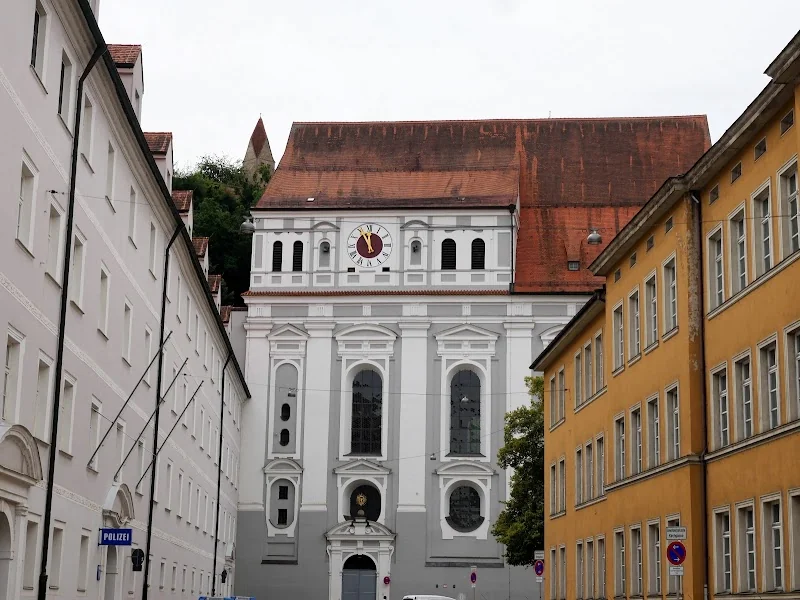
Spiegelgasse 205-480, Landshut
Spiegelgasse 205-480, 84028 Landshut, Germany
Jesuit Church St. Ignatius Landshut | Photos & Reviews
The Jesuit Church St. Ignatius in Landshut is one of those churches that often appears in search queries with very different intentions: some seek photos, others reviews, and still others the correct classification between Landshut, St. Ignatius, and the Jesuit order. Factually correct is: the church is located in the Neustadt of Landshut and is one of the most important testimonies of the Baroque sacral architecture of the city. According to official Landshut sources, it was built in close connection with the Jesuit educational and monastic history of the 17th century; construction began in 1631 and was completed in 1641, with the design explicitly reminiscent of the Munich Jesuit Church St. Michael. Those who discover the church digitally today usually first land on the official project page, which presents history, interior, and construction development with images, interactive elements, and a virtual floor plan. This very mix of history, architecture, and recognizability makes St. Ignatius a place that remains exciting for both culture enthusiasts and photo seekers as well as people with regional interests. ([stadtkirche-landshut.de](https://www.stadtkirche-landshut.de/kirchen/))
Photos, Impressions, and Reviews of the Jesuit Church St. Ignatius
Those searching for photos of the Jesuit Church St. Ignatius are often not just looking for an exterior image of the facade, but an impression of the entire spatial feeling: How does the high altar appear? How strong is the Baroque effect in the nave? Which side altars are particularly striking? Here, the official project page provides helpful orientation, as it offers not only a homepage but also the section Explore the Church itself and a separate section with impressions. Individual stations such as the high altar, Marian altar, Sebastian altar, Joseph altar, Xaverius altar, pulpit, organ loft, and the large crucifix are explained in the spatial context. This creates a kind of substitute for a classic photo gallery for seekers, only with more professional background. For people who explicitly type in photos on Google, this is particularly valuable because they not only find images but also understand the significance of the image motifs. Additionally, the existing review data is very small but so far flawless: a 5.0 in a review indicates more of a hidden gem than a crowded hotspot. This fits well with the church itself, which, despite its high art-historical significance, is still more discovered than mass-visited in the digital everyday life of many visitors. ([jesuitenkirche-landshut.de](https://jesuitenkirche-landshut.de/))
The search query for reviews also shows that many users are not only interested in art history but also in practical expectations: Is a short detour worth it? Does the interior appear impressive enough for a stop on a city exploration? The official language of the project page clearly emphasizes history and architecture, not commercial staging. This is where an SEO advantage lies, as the church is discoverable not through event marketing but through substance. Those looking for images primarily find the great Baroque splendor of the altar area, the unusual interplay of light and side chapels, and the strong presence of the oak cross with bronze crucifix. Those searching for reviews currently receive a very brief but very positive picture. Together, both create a search profile that is typical for Landshut: historically valuable, visually strong, digitally not yet overcrowded. ([jesuitenkirche-landshut.de](https://jesuitenkirche-landshut.de/die-kirche-selbst-erforschen/))
The History of the Jesuit Church from 1535 to 1765
The history of the Jesuit Church St. Ignatius does not begin with the first stone but with the Jesuit order itself. The idea of the order is dated to 1535 and the papal recognition to 1540; in Landshut, the work of the Jesuits has been tangible since the late 16th century. Crucial was the endowment of 56,000 guilders by Countess Maria Magdalena von Haunsperg, which made the founding of a Jesuit college possible. After that, the search for a building site, petitions, purchases of townhouses, and the opening of the gymnasium followed, before the planning of the church and college began in 1629/1630 and the foundation stone was laid in 1631. The construction history thus clearly shows that St. Ignatius was intended as an educational and monastic complex, not just as a single church. Particularly interesting is that the official city and church tradition also emphasizes the delay caused by the Swedish invasion. Despite the war impacts, the choir was completed around 1640, the interior furnishings were already crafted in the same phase, and in the 1640s, the first expansion of the side altars was advanced. The complex grew step by step and not in a single construction surge. ([jesuitenkirche-landshut.de](https://jesuitenkirche-landshut.de/zeitstrahl/))
For the overall picture, it is important that the construction and furnishing history continues over several decades. The high altar was created in 1663, the college building was supplemented in the 1660s, and the gymnasium was completed and occupied in 1689. Even later, further furnishing elements were added, such as the new pulpit from 1731 or the series of images under the windows depicting the work of Saint Ignatius. In 1765, the old Magdalene altar was finally transformed into the Xaverius altar. Thus, the originally Jesuit educational architecture becomes a multifaceted monument that carries different epochs within it: early planning under the conditions of the Thirty Years' War, Baroque design in the mid-17th century, and late Baroque additions in the 18th century. This temporal layering makes the church so interesting for visitors today because it cannot be explained at a glance but makes history visible in space. ([jesuitenkirche-landshut.de](https://jesuitenkirche-landshut.de/zeitstrahl/))
Architecture, Orientation, and Proximity to the Munich Jesuit Church
Architecturally, St. Ignatius is one of the most impressive church buildings in Landshut, especially because it visibly represents the transitional period between Renaissance and Early Baroque. The City Church Landshut explicitly describes it as a significant architectural monument of this phase. Particularly remarkable is the unusual orientation: the choir faces west, which is not self-evident for church buildings and, according to sources, likely had urban planning reasons. This peculiarity continues to attract attention today because it makes the building appear differently in the urban space than many other sacral buildings. The official project page also openly states that Johannes Holl was inspired by the Munich Jesuit Church St. Michael. The page invites a comparison of both churches and makes it clear that St. Ignatius should not be viewed in isolation but in the context of southern German Jesuit architecture. For visitors and seekers, this is a helpful key: those who want to understand the Landshut church should read it as a conscious further development of a proven Jesuit model. ([stadtkirche-landshut.de](https://www.stadtkirche-landshut.de/kirchen/))
Also inside, this demand for clarity and effect is evident. The official Explore the Church itself page names the large oak cross with Jesus bronze, which stands at the threshold to the nave and is 8.5 meters high, as a defining element. Such proportions are not only impressive but also structure the space and make the transition from the entrance area to the liturgical core very conscious. Additionally, the organ loft, which received its current form in 1697 and 1698, was constructed with an additional level featuring a wooden vault. The sources also explain that a stone vault was omitted because the existing pillars likely could not bear the load. Such details are highly interesting for architecture seekers because they show how closely design and statics were connected. Overall, it becomes clear that the Jesuit Church is not an arbitrarily decorated Baroque piece but a clearly composed, functionally thought-out, and historically highly charged church space. ([jesuitenkirche-landshut.de](https://jesuitenkirche-landshut.de/die-kirche-selbst-erforschen/))
High Altar, Side Altars, and the Jesuit Saints Francis Xavier and Ignatius
The heart of the Jesuit Church is the high altar from 1663, whose altar painting is by Johann Christoph Storer. The official description emphasizes the depiction of Saint Ignatius of Loyola, to whom Christ appears with the cross on the way to Rome. This is theologically and iconographically very typical for a Jesuit church: Ignatius does not simply stand as the founder of the order in the space but as a spiritual figure with vision. Surrounding this high altar are the side altars, which together shape the inner dramaturgy of the church space. The Marian altar shows the Assumption of Mary; the cross altar is dedicated to the crucifixion of Christ; the Sebastian altar depicts Saint Sebastian, cared for by Irene; and the Joseph altar represents the Holy Family with angels. Particularly important for many search queries is the Xaverius altar, which emerged in 1765 from the earlier Magdalene altar, thus bringing the Jesuit saint Francis Xavier visibly to the center. This explains why many users come across this church with the search term Francis Xavier. The Apostle altar complements this picture, as figures of Saint Francis Xavier and Saint Francis of Borgia flank the altar painting there. ([jesuitenkirche-landshut.de](https://jesuitenkirche-landshut.de/die-kirche-selbst-erforschen/))
The furnishings also tell a whole landscape of saints and foundations. The Aloysius altar has an altar painting that was originally brought from Rome; the figure of Nepomuk was erected in life size in 1731; the pulpit received its current early Rococo form with a sound cover and angels in 1731. The chronological sequence makes it visible how the space developed not only in Baroque style but over generations. The Jesuit saints Ignatius, Francis Xavier, and Aloysius stand side by side not by chance but form the spiritual narrative of the house. The choir stalls, the oval saint images on the pillars, and the series of images under the windows also belong in this context. For visitors, this is particularly attractive because one can experience the church not only as a building but as a narrative space. Those looking for altars, figures, and artworks find in St. Ignatius not a single highlight but a whole series of liturgical and artistic focal points that vividly illustrate the Jesuit style. ([jesuitenkirche-landshut.de](https://jesuitenkirche-landshut.de/die-kirche-selbst-erforschen/))
Location in the Neustadt, Address, and Orientation in Landshut
The Jesuit Church St. Ignatius is located in the midst of the historic urban structure of Landshut, more precisely in the area of the Neustadt. The tourism site names the address Neustadt 479, 84028 Landshut, and the city describes the church as one of the monuments in the city center area. This is important for practical orientation because many visitors, when searching for Landshut and the Jesuit Church, initially think of larger known churches that actually have different functions or locations. St. Ignatius, on the other hand, is clearly located in the Landshut Neustadt, in that part of the old town that is particularly densely built as a historic street space. This location not only makes the church architecturally interesting but also urbanly significant: it forms a striking conclusion and focal point in the street scene. This explains why it repeatedly appears on city tours, monument days, and cultural-historical walks. ([ostbayern-tourismus.de](https://www.ostbayern-tourismus.de/attraktionen/jesuitenkirche-cead85d963?utm_source=openai))
For classification, it is also helpful that the Jesuit Church is understood by the city and the city church as part of a larger Landshut church and monument landscape. In the context of monument days, it is explicitly mentioned as a city center monument, and the city points out that many of these buildings are only accessible in certain formats. The Jesuit Church is therefore not an isolated excursion destination outside the city but an urban-embedded cultural site that can be well combined with other historical destinations. Those planning a photo stop benefit from the fact that the church is located in a narrow, characterful street space; those interested in history find the connection to monastic, school, and city history in the immediate vicinity. Even if the sources do not provide a separate detail page for parking, the location itself is clear: Neustadt, city center area, historical axis. For seekers, this clarity is valuable because it immediately sorts the frequent name variants correctly. ([landshut.de](https://landshut.de/news/kultur/sonntag-ist-denkmaltag?utm_source=openai))
Reopening 2026, Services, and the Role in Today's Landshut
The recent history of the Jesuit Church is closely linked to renovation and reopening. The Archdiocese of Munich and Freising reported in 2022 that the former Jesuit Church St. Ignatius, closed since August 2007, has received a timeline for reopening after static renovation. The goal was to celebrate services again starting in 2025 and also to return the unique Holy Grave to its place. The City Church Landshut also lists a date for reopening on its current service page: service with Cardinal Marx on June 16. A current regional report from spring 2026 even speaks of the end of a church construction record and the reopening in June 2026. Thus, it is clear: the church is currently in a phase of transition from a renovation object back to a liturgical and public place. ([erzbistum-muenchen.de](https://www.erzbistum-muenchen.de/news/bistum/Jesuitenkirche-in-Landshut-soll-2025-wiedereroeffnet-werden-43146.news))
For the present, this is important because it also changes the use of the church. The City Church emphasizes that the renovation of the interior was still ongoing and therefore no services were held for the time being; at the same time, the reopening is now concretely announced. For Landshut, this means more than just the return of a sacred building. It is the return of a place that has been connected for centuries with Jesuit education, Baroque art, and city identity. Precisely for this reason, St. Ignatius is described in current sources not only as a monument but as the central church of the Marian Men's Congregation and as an important space for liturgy and remembrance. Those looking for current information should therefore pay particular attention to the official announcements from the City Church, as there are bundled service dates and reopening announcements. For visitors who think about photos, history, and current usability together, St. Ignatius is thus a particularly exciting place: historically high-quality, long closed, but now on the way back into public perception. ([stadtkirche-landshut.de](https://www.stadtkirche-landshut.de/kirchen/))
Sources:
- Jesuit Church Landshut - Official Project Page
- Jesuit Church Landshut - Timeline of Construction History
- Jesuit Church Landshut - Explore the Church Itself
- City Church Landshut - Churches
- City Church Landshut - Services
- Archdiocese of Munich and Freising - Jesuit Church in Landshut to be Reopened in 2025
- Tourism Association East Bavaria - Jesuit Church
- City of Landshut - Sunday is Monument Day
Mehr anzeigenWeniger anzeigen
Jesuit Church St. Ignatius Landshut | Photos & Reviews
The Jesuit Church St. Ignatius in Landshut is one of those churches that often appears in search queries with very different intentions: some seek photos, others reviews, and still others the correct classification between Landshut, St. Ignatius, and the Jesuit order. Factually correct is: the church is located in the Neustadt of Landshut and is one of the most important testimonies of the Baroque sacral architecture of the city. According to official Landshut sources, it was built in close connection with the Jesuit educational and monastic history of the 17th century; construction began in 1631 and was completed in 1641, with the design explicitly reminiscent of the Munich Jesuit Church St. Michael. Those who discover the church digitally today usually first land on the official project page, which presents history, interior, and construction development with images, interactive elements, and a virtual floor plan. This very mix of history, architecture, and recognizability makes St. Ignatius a place that remains exciting for both culture enthusiasts and photo seekers as well as people with regional interests. ([stadtkirche-landshut.de](https://www.stadtkirche-landshut.de/kirchen/))
Photos, Impressions, and Reviews of the Jesuit Church St. Ignatius
Those searching for photos of the Jesuit Church St. Ignatius are often not just looking for an exterior image of the facade, but an impression of the entire spatial feeling: How does the high altar appear? How strong is the Baroque effect in the nave? Which side altars are particularly striking? Here, the official project page provides helpful orientation, as it offers not only a homepage but also the section Explore the Church itself and a separate section with impressions. Individual stations such as the high altar, Marian altar, Sebastian altar, Joseph altar, Xaverius altar, pulpit, organ loft, and the large crucifix are explained in the spatial context. This creates a kind of substitute for a classic photo gallery for seekers, only with more professional background. For people who explicitly type in photos on Google, this is particularly valuable because they not only find images but also understand the significance of the image motifs. Additionally, the existing review data is very small but so far flawless: a 5.0 in a review indicates more of a hidden gem than a crowded hotspot. This fits well with the church itself, which, despite its high art-historical significance, is still more discovered than mass-visited in the digital everyday life of many visitors. ([jesuitenkirche-landshut.de](https://jesuitenkirche-landshut.de/))
The search query for reviews also shows that many users are not only interested in art history but also in practical expectations: Is a short detour worth it? Does the interior appear impressive enough for a stop on a city exploration? The official language of the project page clearly emphasizes history and architecture, not commercial staging. This is where an SEO advantage lies, as the church is discoverable not through event marketing but through substance. Those looking for images primarily find the great Baroque splendor of the altar area, the unusual interplay of light and side chapels, and the strong presence of the oak cross with bronze crucifix. Those searching for reviews currently receive a very brief but very positive picture. Together, both create a search profile that is typical for Landshut: historically valuable, visually strong, digitally not yet overcrowded. ([jesuitenkirche-landshut.de](https://jesuitenkirche-landshut.de/die-kirche-selbst-erforschen/))
The History of the Jesuit Church from 1535 to 1765
The history of the Jesuit Church St. Ignatius does not begin with the first stone but with the Jesuit order itself. The idea of the order is dated to 1535 and the papal recognition to 1540; in Landshut, the work of the Jesuits has been tangible since the late 16th century. Crucial was the endowment of 56,000 guilders by Countess Maria Magdalena von Haunsperg, which made the founding of a Jesuit college possible. After that, the search for a building site, petitions, purchases of townhouses, and the opening of the gymnasium followed, before the planning of the church and college began in 1629/1630 and the foundation stone was laid in 1631. The construction history thus clearly shows that St. Ignatius was intended as an educational and monastic complex, not just as a single church. Particularly interesting is that the official city and church tradition also emphasizes the delay caused by the Swedish invasion. Despite the war impacts, the choir was completed around 1640, the interior furnishings were already crafted in the same phase, and in the 1640s, the first expansion of the side altars was advanced. The complex grew step by step and not in a single construction surge. ([jesuitenkirche-landshut.de](https://jesuitenkirche-landshut.de/zeitstrahl/))
For the overall picture, it is important that the construction and furnishing history continues over several decades. The high altar was created in 1663, the college building was supplemented in the 1660s, and the gymnasium was completed and occupied in 1689. Even later, further furnishing elements were added, such as the new pulpit from 1731 or the series of images under the windows depicting the work of Saint Ignatius. In 1765, the old Magdalene altar was finally transformed into the Xaverius altar. Thus, the originally Jesuit educational architecture becomes a multifaceted monument that carries different epochs within it: early planning under the conditions of the Thirty Years' War, Baroque design in the mid-17th century, and late Baroque additions in the 18th century. This temporal layering makes the church so interesting for visitors today because it cannot be explained at a glance but makes history visible in space. ([jesuitenkirche-landshut.de](https://jesuitenkirche-landshut.de/zeitstrahl/))
Architecture, Orientation, and Proximity to the Munich Jesuit Church
Architecturally, St. Ignatius is one of the most impressive church buildings in Landshut, especially because it visibly represents the transitional period between Renaissance and Early Baroque. The City Church Landshut explicitly describes it as a significant architectural monument of this phase. Particularly remarkable is the unusual orientation: the choir faces west, which is not self-evident for church buildings and, according to sources, likely had urban planning reasons. This peculiarity continues to attract attention today because it makes the building appear differently in the urban space than many other sacral buildings. The official project page also openly states that Johannes Holl was inspired by the Munich Jesuit Church St. Michael. The page invites a comparison of both churches and makes it clear that St. Ignatius should not be viewed in isolation but in the context of southern German Jesuit architecture. For visitors and seekers, this is a helpful key: those who want to understand the Landshut church should read it as a conscious further development of a proven Jesuit model. ([stadtkirche-landshut.de](https://www.stadtkirche-landshut.de/kirchen/))
Also inside, this demand for clarity and effect is evident. The official Explore the Church itself page names the large oak cross with Jesus bronze, which stands at the threshold to the nave and is 8.5 meters high, as a defining element. Such proportions are not only impressive but also structure the space and make the transition from the entrance area to the liturgical core very conscious. Additionally, the organ loft, which received its current form in 1697 and 1698, was constructed with an additional level featuring a wooden vault. The sources also explain that a stone vault was omitted because the existing pillars likely could not bear the load. Such details are highly interesting for architecture seekers because they show how closely design and statics were connected. Overall, it becomes clear that the Jesuit Church is not an arbitrarily decorated Baroque piece but a clearly composed, functionally thought-out, and historically highly charged church space. ([jesuitenkirche-landshut.de](https://jesuitenkirche-landshut.de/die-kirche-selbst-erforschen/))
High Altar, Side Altars, and the Jesuit Saints Francis Xavier and Ignatius
The heart of the Jesuit Church is the high altar from 1663, whose altar painting is by Johann Christoph Storer. The official description emphasizes the depiction of Saint Ignatius of Loyola, to whom Christ appears with the cross on the way to Rome. This is theologically and iconographically very typical for a Jesuit church: Ignatius does not simply stand as the founder of the order in the space but as a spiritual figure with vision. Surrounding this high altar are the side altars, which together shape the inner dramaturgy of the church space. The Marian altar shows the Assumption of Mary; the cross altar is dedicated to the crucifixion of Christ; the Sebastian altar depicts Saint Sebastian, cared for by Irene; and the Joseph altar represents the Holy Family with angels. Particularly important for many search queries is the Xaverius altar, which emerged in 1765 from the earlier Magdalene altar, thus bringing the Jesuit saint Francis Xavier visibly to the center. This explains why many users come across this church with the search term Francis Xavier. The Apostle altar complements this picture, as figures of Saint Francis Xavier and Saint Francis of Borgia flank the altar painting there. ([jesuitenkirche-landshut.de](https://jesuitenkirche-landshut.de/die-kirche-selbst-erforschen/))
The furnishings also tell a whole landscape of saints and foundations. The Aloysius altar has an altar painting that was originally brought from Rome; the figure of Nepomuk was erected in life size in 1731; the pulpit received its current early Rococo form with a sound cover and angels in 1731. The chronological sequence makes it visible how the space developed not only in Baroque style but over generations. The Jesuit saints Ignatius, Francis Xavier, and Aloysius stand side by side not by chance but form the spiritual narrative of the house. The choir stalls, the oval saint images on the pillars, and the series of images under the windows also belong in this context. For visitors, this is particularly attractive because one can experience the church not only as a building but as a narrative space. Those looking for altars, figures, and artworks find in St. Ignatius not a single highlight but a whole series of liturgical and artistic focal points that vividly illustrate the Jesuit style. ([jesuitenkirche-landshut.de](https://jesuitenkirche-landshut.de/die-kirche-selbst-erforschen/))
Location in the Neustadt, Address, and Orientation in Landshut
The Jesuit Church St. Ignatius is located in the midst of the historic urban structure of Landshut, more precisely in the area of the Neustadt. The tourism site names the address Neustadt 479, 84028 Landshut, and the city describes the church as one of the monuments in the city center area. This is important for practical orientation because many visitors, when searching for Landshut and the Jesuit Church, initially think of larger known churches that actually have different functions or locations. St. Ignatius, on the other hand, is clearly located in the Landshut Neustadt, in that part of the old town that is particularly densely built as a historic street space. This location not only makes the church architecturally interesting but also urbanly significant: it forms a striking conclusion and focal point in the street scene. This explains why it repeatedly appears on city tours, monument days, and cultural-historical walks. ([ostbayern-tourismus.de](https://www.ostbayern-tourismus.de/attraktionen/jesuitenkirche-cead85d963?utm_source=openai))
For classification, it is also helpful that the Jesuit Church is understood by the city and the city church as part of a larger Landshut church and monument landscape. In the context of monument days, it is explicitly mentioned as a city center monument, and the city points out that many of these buildings are only accessible in certain formats. The Jesuit Church is therefore not an isolated excursion destination outside the city but an urban-embedded cultural site that can be well combined with other historical destinations. Those planning a photo stop benefit from the fact that the church is located in a narrow, characterful street space; those interested in history find the connection to monastic, school, and city history in the immediate vicinity. Even if the sources do not provide a separate detail page for parking, the location itself is clear: Neustadt, city center area, historical axis. For seekers, this clarity is valuable because it immediately sorts the frequent name variants correctly. ([landshut.de](https://landshut.de/news/kultur/sonntag-ist-denkmaltag?utm_source=openai))
Reopening 2026, Services, and the Role in Today's Landshut
The recent history of the Jesuit Church is closely linked to renovation and reopening. The Archdiocese of Munich and Freising reported in 2022 that the former Jesuit Church St. Ignatius, closed since August 2007, has received a timeline for reopening after static renovation. The goal was to celebrate services again starting in 2025 and also to return the unique Holy Grave to its place. The City Church Landshut also lists a date for reopening on its current service page: service with Cardinal Marx on June 16. A current regional report from spring 2026 even speaks of the end of a church construction record and the reopening in June 2026. Thus, it is clear: the church is currently in a phase of transition from a renovation object back to a liturgical and public place. ([erzbistum-muenchen.de](https://www.erzbistum-muenchen.de/news/bistum/Jesuitenkirche-in-Landshut-soll-2025-wiedereroeffnet-werden-43146.news))
For the present, this is important because it also changes the use of the church. The City Church emphasizes that the renovation of the interior was still ongoing and therefore no services were held for the time being; at the same time, the reopening is now concretely announced. For Landshut, this means more than just the return of a sacred building. It is the return of a place that has been connected for centuries with Jesuit education, Baroque art, and city identity. Precisely for this reason, St. Ignatius is described in current sources not only as a monument but as the central church of the Marian Men's Congregation and as an important space for liturgy and remembrance. Those looking for current information should therefore pay particular attention to the official announcements from the City Church, as there are bundled service dates and reopening announcements. For visitors who think about photos, history, and current usability together, St. Ignatius is thus a particularly exciting place: historically high-quality, long closed, but now on the way back into public perception. ([stadtkirche-landshut.de](https://www.stadtkirche-landshut.de/kirchen/))
Sources:
- Jesuit Church Landshut - Official Project Page
- Jesuit Church Landshut - Timeline of Construction History
- Jesuit Church Landshut - Explore the Church Itself
- City Church Landshut - Churches
- City Church Landshut - Services
- Archdiocese of Munich and Freising - Jesuit Church in Landshut to be Reopened in 2025
- Tourism Association East Bavaria - Jesuit Church
- City of Landshut - Sunday is Monument Day
Jesuit Church St. Ignatius Landshut | Photos & Reviews
The Jesuit Church St. Ignatius in Landshut is one of those churches that often appears in search queries with very different intentions: some seek photos, others reviews, and still others the correct classification between Landshut, St. Ignatius, and the Jesuit order. Factually correct is: the church is located in the Neustadt of Landshut and is one of the most important testimonies of the Baroque sacral architecture of the city. According to official Landshut sources, it was built in close connection with the Jesuit educational and monastic history of the 17th century; construction began in 1631 and was completed in 1641, with the design explicitly reminiscent of the Munich Jesuit Church St. Michael. Those who discover the church digitally today usually first land on the official project page, which presents history, interior, and construction development with images, interactive elements, and a virtual floor plan. This very mix of history, architecture, and recognizability makes St. Ignatius a place that remains exciting for both culture enthusiasts and photo seekers as well as people with regional interests. ([stadtkirche-landshut.de](https://www.stadtkirche-landshut.de/kirchen/))
Photos, Impressions, and Reviews of the Jesuit Church St. Ignatius
Those searching for photos of the Jesuit Church St. Ignatius are often not just looking for an exterior image of the facade, but an impression of the entire spatial feeling: How does the high altar appear? How strong is the Baroque effect in the nave? Which side altars are particularly striking? Here, the official project page provides helpful orientation, as it offers not only a homepage but also the section Explore the Church itself and a separate section with impressions. Individual stations such as the high altar, Marian altar, Sebastian altar, Joseph altar, Xaverius altar, pulpit, organ loft, and the large crucifix are explained in the spatial context. This creates a kind of substitute for a classic photo gallery for seekers, only with more professional background. For people who explicitly type in photos on Google, this is particularly valuable because they not only find images but also understand the significance of the image motifs. Additionally, the existing review data is very small but so far flawless: a 5.0 in a review indicates more of a hidden gem than a crowded hotspot. This fits well with the church itself, which, despite its high art-historical significance, is still more discovered than mass-visited in the digital everyday life of many visitors. ([jesuitenkirche-landshut.de](https://jesuitenkirche-landshut.de/))
The search query for reviews also shows that many users are not only interested in art history but also in practical expectations: Is a short detour worth it? Does the interior appear impressive enough for a stop on a city exploration? The official language of the project page clearly emphasizes history and architecture, not commercial staging. This is where an SEO advantage lies, as the church is discoverable not through event marketing but through substance. Those looking for images primarily find the great Baroque splendor of the altar area, the unusual interplay of light and side chapels, and the strong presence of the oak cross with bronze crucifix. Those searching for reviews currently receive a very brief but very positive picture. Together, both create a search profile that is typical for Landshut: historically valuable, visually strong, digitally not yet overcrowded. ([jesuitenkirche-landshut.de](https://jesuitenkirche-landshut.de/die-kirche-selbst-erforschen/))
The History of the Jesuit Church from 1535 to 1765
The history of the Jesuit Church St. Ignatius does not begin with the first stone but with the Jesuit order itself. The idea of the order is dated to 1535 and the papal recognition to 1540; in Landshut, the work of the Jesuits has been tangible since the late 16th century. Crucial was the endowment of 56,000 guilders by Countess Maria Magdalena von Haunsperg, which made the founding of a Jesuit college possible. After that, the search for a building site, petitions, purchases of townhouses, and the opening of the gymnasium followed, before the planning of the church and college began in 1629/1630 and the foundation stone was laid in 1631. The construction history thus clearly shows that St. Ignatius was intended as an educational and monastic complex, not just as a single church. Particularly interesting is that the official city and church tradition also emphasizes the delay caused by the Swedish invasion. Despite the war impacts, the choir was completed around 1640, the interior furnishings were already crafted in the same phase, and in the 1640s, the first expansion of the side altars was advanced. The complex grew step by step and not in a single construction surge. ([jesuitenkirche-landshut.de](https://jesuitenkirche-landshut.de/zeitstrahl/))
For the overall picture, it is important that the construction and furnishing history continues over several decades. The high altar was created in 1663, the college building was supplemented in the 1660s, and the gymnasium was completed and occupied in 1689. Even later, further furnishing elements were added, such as the new pulpit from 1731 or the series of images under the windows depicting the work of Saint Ignatius. In 1765, the old Magdalene altar was finally transformed into the Xaverius altar. Thus, the originally Jesuit educational architecture becomes a multifaceted monument that carries different epochs within it: early planning under the conditions of the Thirty Years' War, Baroque design in the mid-17th century, and late Baroque additions in the 18th century. This temporal layering makes the church so interesting for visitors today because it cannot be explained at a glance but makes history visible in space. ([jesuitenkirche-landshut.de](https://jesuitenkirche-landshut.de/zeitstrahl/))
Architecture, Orientation, and Proximity to the Munich Jesuit Church
Architecturally, St. Ignatius is one of the most impressive church buildings in Landshut, especially because it visibly represents the transitional period between Renaissance and Early Baroque. The City Church Landshut explicitly describes it as a significant architectural monument of this phase. Particularly remarkable is the unusual orientation: the choir faces west, which is not self-evident for church buildings and, according to sources, likely had urban planning reasons. This peculiarity continues to attract attention today because it makes the building appear differently in the urban space than many other sacral buildings. The official project page also openly states that Johannes Holl was inspired by the Munich Jesuit Church St. Michael. The page invites a comparison of both churches and makes it clear that St. Ignatius should not be viewed in isolation but in the context of southern German Jesuit architecture. For visitors and seekers, this is a helpful key: those who want to understand the Landshut church should read it as a conscious further development of a proven Jesuit model. ([stadtkirche-landshut.de](https://www.stadtkirche-landshut.de/kirchen/))
Also inside, this demand for clarity and effect is evident. The official Explore the Church itself page names the large oak cross with Jesus bronze, which stands at the threshold to the nave and is 8.5 meters high, as a defining element. Such proportions are not only impressive but also structure the space and make the transition from the entrance area to the liturgical core very conscious. Additionally, the organ loft, which received its current form in 1697 and 1698, was constructed with an additional level featuring a wooden vault. The sources also explain that a stone vault was omitted because the existing pillars likely could not bear the load. Such details are highly interesting for architecture seekers because they show how closely design and statics were connected. Overall, it becomes clear that the Jesuit Church is not an arbitrarily decorated Baroque piece but a clearly composed, functionally thought-out, and historically highly charged church space. ([jesuitenkirche-landshut.de](https://jesuitenkirche-landshut.de/die-kirche-selbst-erforschen/))
High Altar, Side Altars, and the Jesuit Saints Francis Xavier and Ignatius
The heart of the Jesuit Church is the high altar from 1663, whose altar painting is by Johann Christoph Storer. The official description emphasizes the depiction of Saint Ignatius of Loyola, to whom Christ appears with the cross on the way to Rome. This is theologically and iconographically very typical for a Jesuit church: Ignatius does not simply stand as the founder of the order in the space but as a spiritual figure with vision. Surrounding this high altar are the side altars, which together shape the inner dramaturgy of the church space. The Marian altar shows the Assumption of Mary; the cross altar is dedicated to the crucifixion of Christ; the Sebastian altar depicts Saint Sebastian, cared for by Irene; and the Joseph altar represents the Holy Family with angels. Particularly important for many search queries is the Xaverius altar, which emerged in 1765 from the earlier Magdalene altar, thus bringing the Jesuit saint Francis Xavier visibly to the center. This explains why many users come across this church with the search term Francis Xavier. The Apostle altar complements this picture, as figures of Saint Francis Xavier and Saint Francis of Borgia flank the altar painting there. ([jesuitenkirche-landshut.de](https://jesuitenkirche-landshut.de/die-kirche-selbst-erforschen/))
The furnishings also tell a whole landscape of saints and foundations. The Aloysius altar has an altar painting that was originally brought from Rome; the figure of Nepomuk was erected in life size in 1731; the pulpit received its current early Rococo form with a sound cover and angels in 1731. The chronological sequence makes it visible how the space developed not only in Baroque style but over generations. The Jesuit saints Ignatius, Francis Xavier, and Aloysius stand side by side not by chance but form the spiritual narrative of the house. The choir stalls, the oval saint images on the pillars, and the series of images under the windows also belong in this context. For visitors, this is particularly attractive because one can experience the church not only as a building but as a narrative space. Those looking for altars, figures, and artworks find in St. Ignatius not a single highlight but a whole series of liturgical and artistic focal points that vividly illustrate the Jesuit style. ([jesuitenkirche-landshut.de](https://jesuitenkirche-landshut.de/die-kirche-selbst-erforschen/))
Location in the Neustadt, Address, and Orientation in Landshut
The Jesuit Church St. Ignatius is located in the midst of the historic urban structure of Landshut, more precisely in the area of the Neustadt. The tourism site names the address Neustadt 479, 84028 Landshut, and the city describes the church as one of the monuments in the city center area. This is important for practical orientation because many visitors, when searching for Landshut and the Jesuit Church, initially think of larger known churches that actually have different functions or locations. St. Ignatius, on the other hand, is clearly located in the Landshut Neustadt, in that part of the old town that is particularly densely built as a historic street space. This location not only makes the church architecturally interesting but also urbanly significant: it forms a striking conclusion and focal point in the street scene. This explains why it repeatedly appears on city tours, monument days, and cultural-historical walks. ([ostbayern-tourismus.de](https://www.ostbayern-tourismus.de/attraktionen/jesuitenkirche-cead85d963?utm_source=openai))
For classification, it is also helpful that the Jesuit Church is understood by the city and the city church as part of a larger Landshut church and monument landscape. In the context of monument days, it is explicitly mentioned as a city center monument, and the city points out that many of these buildings are only accessible in certain formats. The Jesuit Church is therefore not an isolated excursion destination outside the city but an urban-embedded cultural site that can be well combined with other historical destinations. Those planning a photo stop benefit from the fact that the church is located in a narrow, characterful street space; those interested in history find the connection to monastic, school, and city history in the immediate vicinity. Even if the sources do not provide a separate detail page for parking, the location itself is clear: Neustadt, city center area, historical axis. For seekers, this clarity is valuable because it immediately sorts the frequent name variants correctly. ([landshut.de](https://landshut.de/news/kultur/sonntag-ist-denkmaltag?utm_source=openai))
Reopening 2026, Services, and the Role in Today's Landshut
The recent history of the Jesuit Church is closely linked to renovation and reopening. The Archdiocese of Munich and Freising reported in 2022 that the former Jesuit Church St. Ignatius, closed since August 2007, has received a timeline for reopening after static renovation. The goal was to celebrate services again starting in 2025 and also to return the unique Holy Grave to its place. The City Church Landshut also lists a date for reopening on its current service page: service with Cardinal Marx on June 16. A current regional report from spring 2026 even speaks of the end of a church construction record and the reopening in June 2026. Thus, it is clear: the church is currently in a phase of transition from a renovation object back to a liturgical and public place. ([erzbistum-muenchen.de](https://www.erzbistum-muenchen.de/news/bistum/Jesuitenkirche-in-Landshut-soll-2025-wiedereroeffnet-werden-43146.news))
For the present, this is important because it also changes the use of the church. The City Church emphasizes that the renovation of the interior was still ongoing and therefore no services were held for the time being; at the same time, the reopening is now concretely announced. For Landshut, this means more than just the return of a sacred building. It is the return of a place that has been connected for centuries with Jesuit education, Baroque art, and city identity. Precisely for this reason, St. Ignatius is described in current sources not only as a monument but as the central church of the Marian Men's Congregation and as an important space for liturgy and remembrance. Those looking for current information should therefore pay particular attention to the official announcements from the City Church, as there are bundled service dates and reopening announcements. For visitors who think about photos, history, and current usability together, St. Ignatius is thus a particularly exciting place: historically high-quality, long closed, but now on the way back into public perception. ([stadtkirche-landshut.de](https://www.stadtkirche-landshut.de/kirchen/))
Sources:
- Jesuit Church Landshut - Official Project Page
- Jesuit Church Landshut - Timeline of Construction History
- Jesuit Church Landshut - Explore the Church Itself
- City Church Landshut - Churches
- City Church Landshut - Services
- Archdiocese of Munich and Freising - Jesuit Church in Landshut to be Reopened in 2025
- Tourism Association East Bavaria - Jesuit Church
- City of Landshut - Sunday is Monument Day
Upcoming Events
No events found
Frequently Asked Questions
Reviews
Wolf Ese
9. December 2024