
München
Isarstrand, 81667 München, Deutschland
Isarstrand | Swimming & Barbecuing in Munich
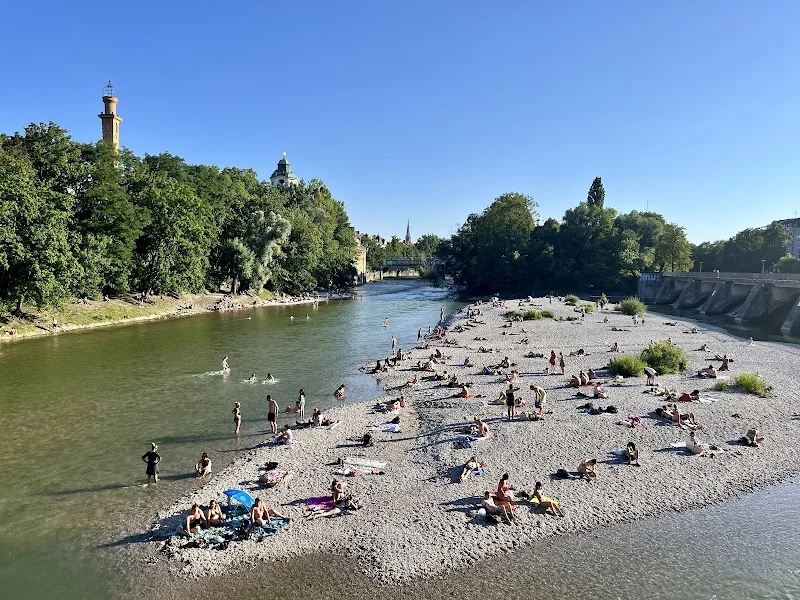
The Isarstrand in Munich is not a classic swimming area with an entrance fee, but the name for the popular riverbank and gravel bank areas along the Isar, where locals and visitors spend their time in the summer. The state capital describes the Isar as a river section about 14 kilometers long through the city, with shallow banks, gravel banks, and floodplains that serve as natural and recreational spaces. This mix of city, water, and landscape creates a unique character: you can quickly reach the bank, sit on gravel or grass, look at the river, and at the same time have a view of the skyline, bridges, and neighborhoods of the city center. The Isar is therefore more of a recreational landscape than an event hall, which is why there is no fixed capacity like at a venue; the use is public, open, and heavily dependent on the weather, water level, and local considerations. Anyone visiting the Isarstrand for the first time quickly realizes why the area is so often sought after: it’s about swimming, walking, cycling, barbecuing in permitted zones, and experiencing a very immediate, typically Munich summer moment. ([stadt.muenchen.de](https://stadt.muenchen.de/infos/isar.html))
Where is the Isarstrand in Munich and what does the place feel like?
Those looking for the Isarstrand usually mean the city-close riverbank areas along the Isar, which stretch from southern Munich to the city center and are particularly accessible there. For orientation, muenchen.de names the Reichenbach Bridge as a central point of contact, while the city lists various swimming sections and recreational spots along the river. Some particularly well-known points include Flaucher, Reichenbach Bridge, Wittelsbacher Bridge, Museum Island, Prater Island, and the area towards Oberföhring. This mix of southern natural sections and urban riverbank spots shapes the character of the Isarstrand: down by the river, it quickly becomes quieter, while up on the bridges and streets, the city continues with full energy. The Isarstrand is therefore not a closed place with entry control, but an open city feeling that feels very different depending on the section. Sometimes the surroundings are spacious and nature-focused, sometimes short, lively, and urban, sometimes perfect for a break after a city stroll. ([muenchen.de](https://www.muenchen.de/freizeit/diverse-orte/isar?utm_source=openai))
Especially in the areas around Reichenbach Bridge and Wittelsbacher Bridge, the Isarstrand is often described as a meeting point. According to muenchen.de, the Reichenbach Bridge is a popular meeting place for locals who want to take a lunch break together or have a drink after work because of its location and the connection between Glockenbachviertel and Au. The bridge is also popular with pedestrians, joggers, and cyclists, and from above, there is a view of the surroundings that particularly showcases the urban character of the river. This is important for the SEO logic behind the keyword Isarstrand Munich: many are not only looking for a swimming spot but for a place where the city suddenly becomes softer. This slight shift between metropolis and relaxation is what makes it appealing. For visitors, this means: if you expect an organized amusement park, you are mistaken. However, if you are looking for an open, spontaneous, and very beautiful urban space, the Isarstrand is just the right place. ([muenchen.de](https://www.muenchen.de/en/sights/reichenbachbrucke?utm_source=openai))
Swimming in the Isar: permitted sections, safety, and water quality
A central interest in the Isarstrand is swimming. According to the state capital Munich, swimming in the Isar within the city limits is allowed at several clearly defined spots. These include sections from the city limits to just before the Marienklausen Bridge, from shortly after the Marienklausen Bridge to shortly after the Thalkirchner Bridge, in the Isar Canal between Marienklause and Thalkirchner Bridge, as well as in the urban area from shortly after the weir at Flaucher Bridge to the Braunauer Railway Bridge. Particularly relevant for many visitors is also the section on the eastern riverbank from the Braunauer Railway Bridge to just before the Wittelsbacher Bridge, as well as from about the middle between Wittelsbacher Bridge and Reichenbach Bridge to the Reichenbach Bridge. The official information shows that swimming is possible, but not everywhere and not without limits. That’s why it makes sense to check the permitted areas before visiting and to take the signage on site seriously. ([stadt.muenchen.de](https://stadt.muenchen.de/infos/isar.html))
Another important aspect is safety. The city emphasizes that swimming and boating in the Isar always occur at your own risk and should not be done during high water due to strong currents and possible debris. Munich also points out that despite the renaturation, the Isar remains a wild river, and therefore, especially after heavy rainfall, consistent swimming water quality cannot be guaranteed. This is exactly where it shows why the Isarstrand is more of a natural than a comfort place: it thrives on immediate proximity to the water, but also on respect for the river. For planning, this means that the Isar app and the official notices on site are useful because they display the current swimming and warning areas. Anyone wanting to relax at the Isarstrand should therefore not only think about towels and sunscreen but also about the conditions of the river. This combination of freedom and attentiveness is essential to the experience. ([stadt.muenchen.de](https://stadt.muenchen.de/infos/isar.html))
Barbecue zones, picnicking, and rules at the riverbank
When it comes to the keyword Isarstrand Bar or Isarstrand Barbecuing, it often revolves around the same desire: a relaxed summer spot by the water where you can sit, eat, and extend the evening. The official regulations of the city are clear. Barbecuing is only allowed at the Isar in designated areas, and according to the state capital Munich, only charcoal or gas on commercially available grilling devices may be used there. Ground fires are prohibited, and commercially available devices with short or no leg length may only be operated in the grilling zones on vegetation-free areas such as gravel banks. The city also asks to take your trash back, avoid glass, reduce noise, and not to damage the natural space. This sounds strict, but it is logical: the Isar floodplains are to be preserved as a landscape and recreational area, not as an improvised party space. Therefore, anyone picnicking at the Isarstrand should think more about a blanket, reusable dishes, and a small bag for waste than about classic campfire romance. ([stadt.muenchen.de](https://stadt.muenchen.de/infos/grillen-stadt.html))
Especially important for visitors with grilling plans is the inner city boundary. Munich explicitly states that grilling is not allowed in the entire inner-city area from the Brudermühl Bridge to the Oberföhring Weir. This prohibition also includes the areas around Braunauer Railway Bridge, Wittelsbacher Bridge, Reichenbach Bridge, Museum Island, and Prater Island. Therefore, anyone visiting the Isarstrand around the city center should not take grilling for granted. For a real grilling experience, the southern area at Flaucher or another officially designated grilling zone is more suitable, while the inner-city banks are more for swimming, walking, sunbathing, and a short stop by the water. This distinction also helps with SEO: the search term grilling is often combined with Isarstrand Munich, but it is important that the permitted and prohibited sections are clearly separated. This makes the place attractive in the long term because it should not be completely overloaded despite high usage. ([stadt.muenchen.de](https://stadt.muenchen.de/infos/grillen-stadt.html))
Reichenbach Bridge, Wittelsbacher Bridge, and Cornelius Bridge as access points
For many visitors, the Isarstrand begins at a bridge. Especially the Reichenbach Bridge is a classic entry point, as it is a popular meeting place directly at the Isar according to muenchen.de. The bridge connects Glockenbachviertel with Au, is often used by pedestrians, joggers, and cyclists, and is located at a section where you can quickly switch from urban life to the river. On the western side, there is the Reichenbach Kiosk, which according to muenchen.de offers cold drinks and snacks. So, if you are looking for the Isarstrand as a spontaneous after-work spot, you get exactly the right mix of local supply and proximity to the river here. The city’s official orientation also refers to this area, as well as the good accessibility with U1 and U2 via Fraunhoferstraße. Thus, the Reichenbach Bridge is not only a geographical point but a real key to understanding the Isarstrand in Munich. ([muenchen.de](https://www.muenchen.de/en/sights/reichenbachbrucke?utm_source=openai))
Equally important are the Wittelsbacher Bridge and the Cornelius Bridge. The city names the Wittelsbacher Bridge as one of the well-known places for recreation at the Isar, and certain sections east of the bridge are explicitly approved for swimming. The Cornelius Bridge, in turn, is known for its Isar balcony, where events such as the Culture Beach take place. It connects Isarvorstadt and Au and symbolizes the urban, almost stage-like character of the inner-city Isar. So, if you are searching for Isarstrand Cornelius Bridge, you are often looking for this mix of water, city, and temporary summer atmosphere. In practice, this means: the bridges are not just mere traffic structures but shape the use of the riverbank. They help with orientation, provide meeting points, create sightlines, and make visible how closely Munich and the Isar are connected. That’s why these bridges appear so frequently in autocomplete keywords and should not be missing in the SEO description. ([muenchen.de](https://www.muenchen.de/freizeit/diverse-orte/isar?utm_source=openai))
Maps, Directions, and Parking at the Isarstrand
Anyone wanting to find the Isarstrand conveniently should not improvise but use the official maps and notices. The city and muenchen.de refer to the Isar app or the Isar map, which displays swimming zones, grilling zones, and current notices. This is particularly helpful because the use of the river can change depending on water level, season, and signage. For getting there, public transport and bicycles are usually the best choice. Munich points out that parking spaces at recreational areas quickly become full, and parking outside designated areas in green spaces is not allowed. This is practically relevant, especially in the popular sections around Reichenbach Bridge, Cornelius Bridge, and Wittelsbacher Bridge, as the urban space is densely built and there is little room for spontaneously parking cars. So, if you are searching for Isarstrand Maps or Isarstrand Parking, you are essentially looking for a stress-free, local visit planning. That’s exactly what the official maps and public transport notices are for. ([stadt.muenchen.de](https://stadt.muenchen.de/infos/grillen-stadt.html))
For the first visit, a simple plan is recommended: get off at a well-connected spot, walk to the river, check the permitted areas, and then decide spontaneously whether to swim, walk, or just sit. As starting points, muenchen.de mentions among others the Reichenbach Bridge, Flaucher, and Thalkirchen, with the Reichenbach Bridge being particularly useful for the urban Isarstrand. If you prefer it quieter, you should head further south or, depending on your destination, to less frequented areas. If you are looking for a short break after work, stay closer to the city center. It is also important to bring water, sun protection, possibly a blanket, and a bag for your own trash. This way, the visit remains relaxed and considerate. The goal at the Isarstrand is not to consume as much infrastructure as possible, but to experience a beautiful and genuine summer moment with little effort. This is exactly where the strength of this place lies: it is uncomplicated, open, and very direct. ([muenchen.de](https://www.muenchen.de/fr/node/5648?utm_source=openai))
Kiosk, Bar, or Beer Garden: What Visitors Really Expect at the Isarstrand
The keyword Isarstrand Bar shows that many visitors at the river expect not only water and gravel but also a little break with drinks or snacks. Here, the reality at the Isarstrand is more down-to-earth than staged. There is no fixed beach bar like at a resort, but mainly kiosks, drinking spots, and in the surrounding area also beer gardens and dining options. The Reichenbach Kiosk is particularly well-known, which muenchen.de describes as a place with cold drinks and snacks. This fits very well with the character of the Isarstrand: you buy something, sit by the water, and stay as long as the weather and mood allow. The city also mentions kiosks and beer gardens along the banks as supply points. If you are looking for a real bar in the classic sense, you will find it more in Glockenbachviertel, at Gärtnerplatz, or in the surrounding neighborhoods; however, if you are looking for a spontaneous drink by the river, the Isarstrand is very well suited. ([muenchen.de](https://www.muenchen.de/en/sights/reichenbachbrucke?utm_source=openai))
This proximity of water and city is particularly attractive because it connects different uses. At the Isarstrand, people meet for swimming, reading, talking, cycling, sunbathing, and a short after-work break. The city explicitly describes these places as spaces for walks, nature observation, and relaxed hours for families by the water. At the same time, the popularity of Reichenbach Bridge, Cornelius Bridge, and the surrounding sections shows that the Isarstrand is also a social meeting point. For some, it is a quiet break, for others, a lively summer place with a lot of movement. Both are correct. And that’s what makes the location strong in SEO: it is not a rigid event venue, but a very flexibly usable urban space with high recognition value. Those searching for Isarstrand Munich Maps, reviews, or Bar actually want to know if the trip is worth it. The answer is: yes, if you are looking for an open, unobstructed, and authentic place by the water. No, if you expect a fixed, planable event location with service and clear seating. This clarity makes the description credible and useful. ([muenchen.de](https://www.muenchen.de/freizeit/diverse-orte/isar?utm_source=openai))
Sources:
- State Capital Munich - Experience the Isar: River in the City
- State Capital Munich - Barbecuing in the City
- muenchen.de - The Isar in Munich: Swimming, Barbecuing, and Relaxing
- muenchen.de - Reichenbach Bridge: Meeting Point at the Isar
- muenchen.de - Cornelius Bridge: Information about the Famous Bridge in Munich
- muenchen.de - Reichenbach Bridge: Popular meeting place at the Isar river
Show moreShow less
Isarstrand | Swimming & Barbecuing in Munich
The Isarstrand in Munich is not a classic swimming area with an entrance fee, but the name for the popular riverbank and gravel bank areas along the Isar, where locals and visitors spend their time in the summer. The state capital describes the Isar as a river section about 14 kilometers long through the city, with shallow banks, gravel banks, and floodplains that serve as natural and recreational spaces. This mix of city, water, and landscape creates a unique character: you can quickly reach the bank, sit on gravel or grass, look at the river, and at the same time have a view of the skyline, bridges, and neighborhoods of the city center. The Isar is therefore more of a recreational landscape than an event hall, which is why there is no fixed capacity like at a venue; the use is public, open, and heavily dependent on the weather, water level, and local considerations. Anyone visiting the Isarstrand for the first time quickly realizes why the area is so often sought after: it’s about swimming, walking, cycling, barbecuing in permitted zones, and experiencing a very immediate, typically Munich summer moment. ([stadt.muenchen.de](https://stadt.muenchen.de/infos/isar.html))
Where is the Isarstrand in Munich and what does the place feel like?
Those looking for the Isarstrand usually mean the city-close riverbank areas along the Isar, which stretch from southern Munich to the city center and are particularly accessible there. For orientation, muenchen.de names the Reichenbach Bridge as a central point of contact, while the city lists various swimming sections and recreational spots along the river. Some particularly well-known points include Flaucher, Reichenbach Bridge, Wittelsbacher Bridge, Museum Island, Prater Island, and the area towards Oberföhring. This mix of southern natural sections and urban riverbank spots shapes the character of the Isarstrand: down by the river, it quickly becomes quieter, while up on the bridges and streets, the city continues with full energy. The Isarstrand is therefore not a closed place with entry control, but an open city feeling that feels very different depending on the section. Sometimes the surroundings are spacious and nature-focused, sometimes short, lively, and urban, sometimes perfect for a break after a city stroll. ([muenchen.de](https://www.muenchen.de/freizeit/diverse-orte/isar?utm_source=openai))
Especially in the areas around Reichenbach Bridge and Wittelsbacher Bridge, the Isarstrand is often described as a meeting point. According to muenchen.de, the Reichenbach Bridge is a popular meeting place for locals who want to take a lunch break together or have a drink after work because of its location and the connection between Glockenbachviertel and Au. The bridge is also popular with pedestrians, joggers, and cyclists, and from above, there is a view of the surroundings that particularly showcases the urban character of the river. This is important for the SEO logic behind the keyword Isarstrand Munich: many are not only looking for a swimming spot but for a place where the city suddenly becomes softer. This slight shift between metropolis and relaxation is what makes it appealing. For visitors, this means: if you expect an organized amusement park, you are mistaken. However, if you are looking for an open, spontaneous, and very beautiful urban space, the Isarstrand is just the right place. ([muenchen.de](https://www.muenchen.de/en/sights/reichenbachbrucke?utm_source=openai))
Swimming in the Isar: permitted sections, safety, and water quality
A central interest in the Isarstrand is swimming. According to the state capital Munich, swimming in the Isar within the city limits is allowed at several clearly defined spots. These include sections from the city limits to just before the Marienklausen Bridge, from shortly after the Marienklausen Bridge to shortly after the Thalkirchner Bridge, in the Isar Canal between Marienklause and Thalkirchner Bridge, as well as in the urban area from shortly after the weir at Flaucher Bridge to the Braunauer Railway Bridge. Particularly relevant for many visitors is also the section on the eastern riverbank from the Braunauer Railway Bridge to just before the Wittelsbacher Bridge, as well as from about the middle between Wittelsbacher Bridge and Reichenbach Bridge to the Reichenbach Bridge. The official information shows that swimming is possible, but not everywhere and not without limits. That’s why it makes sense to check the permitted areas before visiting and to take the signage on site seriously. ([stadt.muenchen.de](https://stadt.muenchen.de/infos/isar.html))
Another important aspect is safety. The city emphasizes that swimming and boating in the Isar always occur at your own risk and should not be done during high water due to strong currents and possible debris. Munich also points out that despite the renaturation, the Isar remains a wild river, and therefore, especially after heavy rainfall, consistent swimming water quality cannot be guaranteed. This is exactly where it shows why the Isarstrand is more of a natural than a comfort place: it thrives on immediate proximity to the water, but also on respect for the river. For planning, this means that the Isar app and the official notices on site are useful because they display the current swimming and warning areas. Anyone wanting to relax at the Isarstrand should therefore not only think about towels and sunscreen but also about the conditions of the river. This combination of freedom and attentiveness is essential to the experience. ([stadt.muenchen.de](https://stadt.muenchen.de/infos/isar.html))
Barbecue zones, picnicking, and rules at the riverbank
When it comes to the keyword Isarstrand Bar or Isarstrand Barbecuing, it often revolves around the same desire: a relaxed summer spot by the water where you can sit, eat, and extend the evening. The official regulations of the city are clear. Barbecuing is only allowed at the Isar in designated areas, and according to the state capital Munich, only charcoal or gas on commercially available grilling devices may be used there. Ground fires are prohibited, and commercially available devices with short or no leg length may only be operated in the grilling zones on vegetation-free areas such as gravel banks. The city also asks to take your trash back, avoid glass, reduce noise, and not to damage the natural space. This sounds strict, but it is logical: the Isar floodplains are to be preserved as a landscape and recreational area, not as an improvised party space. Therefore, anyone picnicking at the Isarstrand should think more about a blanket, reusable dishes, and a small bag for waste than about classic campfire romance. ([stadt.muenchen.de](https://stadt.muenchen.de/infos/grillen-stadt.html))
Especially important for visitors with grilling plans is the inner city boundary. Munich explicitly states that grilling is not allowed in the entire inner-city area from the Brudermühl Bridge to the Oberföhring Weir. This prohibition also includes the areas around Braunauer Railway Bridge, Wittelsbacher Bridge, Reichenbach Bridge, Museum Island, and Prater Island. Therefore, anyone visiting the Isarstrand around the city center should not take grilling for granted. For a real grilling experience, the southern area at Flaucher or another officially designated grilling zone is more suitable, while the inner-city banks are more for swimming, walking, sunbathing, and a short stop by the water. This distinction also helps with SEO: the search term grilling is often combined with Isarstrand Munich, but it is important that the permitted and prohibited sections are clearly separated. This makes the place attractive in the long term because it should not be completely overloaded despite high usage. ([stadt.muenchen.de](https://stadt.muenchen.de/infos/grillen-stadt.html))
Reichenbach Bridge, Wittelsbacher Bridge, and Cornelius Bridge as access points
For many visitors, the Isarstrand begins at a bridge. Especially the Reichenbach Bridge is a classic entry point, as it is a popular meeting place directly at the Isar according to muenchen.de. The bridge connects Glockenbachviertel with Au, is often used by pedestrians, joggers, and cyclists, and is located at a section where you can quickly switch from urban life to the river. On the western side, there is the Reichenbach Kiosk, which according to muenchen.de offers cold drinks and snacks. So, if you are looking for the Isarstrand as a spontaneous after-work spot, you get exactly the right mix of local supply and proximity to the river here. The city’s official orientation also refers to this area, as well as the good accessibility with U1 and U2 via Fraunhoferstraße. Thus, the Reichenbach Bridge is not only a geographical point but a real key to understanding the Isarstrand in Munich. ([muenchen.de](https://www.muenchen.de/en/sights/reichenbachbrucke?utm_source=openai))
Equally important are the Wittelsbacher Bridge and the Cornelius Bridge. The city names the Wittelsbacher Bridge as one of the well-known places for recreation at the Isar, and certain sections east of the bridge are explicitly approved for swimming. The Cornelius Bridge, in turn, is known for its Isar balcony, where events such as the Culture Beach take place. It connects Isarvorstadt and Au and symbolizes the urban, almost stage-like character of the inner-city Isar. So, if you are searching for Isarstrand Cornelius Bridge, you are often looking for this mix of water, city, and temporary summer atmosphere. In practice, this means: the bridges are not just mere traffic structures but shape the use of the riverbank. They help with orientation, provide meeting points, create sightlines, and make visible how closely Munich and the Isar are connected. That’s why these bridges appear so frequently in autocomplete keywords and should not be missing in the SEO description. ([muenchen.de](https://www.muenchen.de/freizeit/diverse-orte/isar?utm_source=openai))
Maps, Directions, and Parking at the Isarstrand
Anyone wanting to find the Isarstrand conveniently should not improvise but use the official maps and notices. The city and muenchen.de refer to the Isar app or the Isar map, which displays swimming zones, grilling zones, and current notices. This is particularly helpful because the use of the river can change depending on water level, season, and signage. For getting there, public transport and bicycles are usually the best choice. Munich points out that parking spaces at recreational areas quickly become full, and parking outside designated areas in green spaces is not allowed. This is practically relevant, especially in the popular sections around Reichenbach Bridge, Cornelius Bridge, and Wittelsbacher Bridge, as the urban space is densely built and there is little room for spontaneously parking cars. So, if you are searching for Isarstrand Maps or Isarstrand Parking, you are essentially looking for a stress-free, local visit planning. That’s exactly what the official maps and public transport notices are for. ([stadt.muenchen.de](https://stadt.muenchen.de/infos/grillen-stadt.html))
For the first visit, a simple plan is recommended: get off at a well-connected spot, walk to the river, check the permitted areas, and then decide spontaneously whether to swim, walk, or just sit. As starting points, muenchen.de mentions among others the Reichenbach Bridge, Flaucher, and Thalkirchen, with the Reichenbach Bridge being particularly useful for the urban Isarstrand. If you prefer it quieter, you should head further south or, depending on your destination, to less frequented areas. If you are looking for a short break after work, stay closer to the city center. It is also important to bring water, sun protection, possibly a blanket, and a bag for your own trash. This way, the visit remains relaxed and considerate. The goal at the Isarstrand is not to consume as much infrastructure as possible, but to experience a beautiful and genuine summer moment with little effort. This is exactly where the strength of this place lies: it is uncomplicated, open, and very direct. ([muenchen.de](https://www.muenchen.de/fr/node/5648?utm_source=openai))
Kiosk, Bar, or Beer Garden: What Visitors Really Expect at the Isarstrand
The keyword Isarstrand Bar shows that many visitors at the river expect not only water and gravel but also a little break with drinks or snacks. Here, the reality at the Isarstrand is more down-to-earth than staged. There is no fixed beach bar like at a resort, but mainly kiosks, drinking spots, and in the surrounding area also beer gardens and dining options. The Reichenbach Kiosk is particularly well-known, which muenchen.de describes as a place with cold drinks and snacks. This fits very well with the character of the Isarstrand: you buy something, sit by the water, and stay as long as the weather and mood allow. The city also mentions kiosks and beer gardens along the banks as supply points. If you are looking for a real bar in the classic sense, you will find it more in Glockenbachviertel, at Gärtnerplatz, or in the surrounding neighborhoods; however, if you are looking for a spontaneous drink by the river, the Isarstrand is very well suited. ([muenchen.de](https://www.muenchen.de/en/sights/reichenbachbrucke?utm_source=openai))
This proximity of water and city is particularly attractive because it connects different uses. At the Isarstrand, people meet for swimming, reading, talking, cycling, sunbathing, and a short after-work break. The city explicitly describes these places as spaces for walks, nature observation, and relaxed hours for families by the water. At the same time, the popularity of Reichenbach Bridge, Cornelius Bridge, and the surrounding sections shows that the Isarstrand is also a social meeting point. For some, it is a quiet break, for others, a lively summer place with a lot of movement. Both are correct. And that’s what makes the location strong in SEO: it is not a rigid event venue, but a very flexibly usable urban space with high recognition value. Those searching for Isarstrand Munich Maps, reviews, or Bar actually want to know if the trip is worth it. The answer is: yes, if you are looking for an open, unobstructed, and authentic place by the water. No, if you expect a fixed, planable event location with service and clear seating. This clarity makes the description credible and useful. ([muenchen.de](https://www.muenchen.de/freizeit/diverse-orte/isar?utm_source=openai))
Sources:
- State Capital Munich - Experience the Isar: River in the City
- State Capital Munich - Barbecuing in the City
- muenchen.de - The Isar in Munich: Swimming, Barbecuing, and Relaxing
- muenchen.de - Reichenbach Bridge: Meeting Point at the Isar
- muenchen.de - Cornelius Bridge: Information about the Famous Bridge in Munich
- muenchen.de - Reichenbach Bridge: Popular meeting place at the Isar river
Isarstrand | Swimming & Barbecuing in Munich
The Isarstrand in Munich is not a classic swimming area with an entrance fee, but the name for the popular riverbank and gravel bank areas along the Isar, where locals and visitors spend their time in the summer. The state capital describes the Isar as a river section about 14 kilometers long through the city, with shallow banks, gravel banks, and floodplains that serve as natural and recreational spaces. This mix of city, water, and landscape creates a unique character: you can quickly reach the bank, sit on gravel or grass, look at the river, and at the same time have a view of the skyline, bridges, and neighborhoods of the city center. The Isar is therefore more of a recreational landscape than an event hall, which is why there is no fixed capacity like at a venue; the use is public, open, and heavily dependent on the weather, water level, and local considerations. Anyone visiting the Isarstrand for the first time quickly realizes why the area is so often sought after: it’s about swimming, walking, cycling, barbecuing in permitted zones, and experiencing a very immediate, typically Munich summer moment. ([stadt.muenchen.de](https://stadt.muenchen.de/infos/isar.html))
Where is the Isarstrand in Munich and what does the place feel like?
Those looking for the Isarstrand usually mean the city-close riverbank areas along the Isar, which stretch from southern Munich to the city center and are particularly accessible there. For orientation, muenchen.de names the Reichenbach Bridge as a central point of contact, while the city lists various swimming sections and recreational spots along the river. Some particularly well-known points include Flaucher, Reichenbach Bridge, Wittelsbacher Bridge, Museum Island, Prater Island, and the area towards Oberföhring. This mix of southern natural sections and urban riverbank spots shapes the character of the Isarstrand: down by the river, it quickly becomes quieter, while up on the bridges and streets, the city continues with full energy. The Isarstrand is therefore not a closed place with entry control, but an open city feeling that feels very different depending on the section. Sometimes the surroundings are spacious and nature-focused, sometimes short, lively, and urban, sometimes perfect for a break after a city stroll. ([muenchen.de](https://www.muenchen.de/freizeit/diverse-orte/isar?utm_source=openai))
Especially in the areas around Reichenbach Bridge and Wittelsbacher Bridge, the Isarstrand is often described as a meeting point. According to muenchen.de, the Reichenbach Bridge is a popular meeting place for locals who want to take a lunch break together or have a drink after work because of its location and the connection between Glockenbachviertel and Au. The bridge is also popular with pedestrians, joggers, and cyclists, and from above, there is a view of the surroundings that particularly showcases the urban character of the river. This is important for the SEO logic behind the keyword Isarstrand Munich: many are not only looking for a swimming spot but for a place where the city suddenly becomes softer. This slight shift between metropolis and relaxation is what makes it appealing. For visitors, this means: if you expect an organized amusement park, you are mistaken. However, if you are looking for an open, spontaneous, and very beautiful urban space, the Isarstrand is just the right place. ([muenchen.de](https://www.muenchen.de/en/sights/reichenbachbrucke?utm_source=openai))
Swimming in the Isar: permitted sections, safety, and water quality
A central interest in the Isarstrand is swimming. According to the state capital Munich, swimming in the Isar within the city limits is allowed at several clearly defined spots. These include sections from the city limits to just before the Marienklausen Bridge, from shortly after the Marienklausen Bridge to shortly after the Thalkirchner Bridge, in the Isar Canal between Marienklause and Thalkirchner Bridge, as well as in the urban area from shortly after the weir at Flaucher Bridge to the Braunauer Railway Bridge. Particularly relevant for many visitors is also the section on the eastern riverbank from the Braunauer Railway Bridge to just before the Wittelsbacher Bridge, as well as from about the middle between Wittelsbacher Bridge and Reichenbach Bridge to the Reichenbach Bridge. The official information shows that swimming is possible, but not everywhere and not without limits. That’s why it makes sense to check the permitted areas before visiting and to take the signage on site seriously. ([stadt.muenchen.de](https://stadt.muenchen.de/infos/isar.html))
Another important aspect is safety. The city emphasizes that swimming and boating in the Isar always occur at your own risk and should not be done during high water due to strong currents and possible debris. Munich also points out that despite the renaturation, the Isar remains a wild river, and therefore, especially after heavy rainfall, consistent swimming water quality cannot be guaranteed. This is exactly where it shows why the Isarstrand is more of a natural than a comfort place: it thrives on immediate proximity to the water, but also on respect for the river. For planning, this means that the Isar app and the official notices on site are useful because they display the current swimming and warning areas. Anyone wanting to relax at the Isarstrand should therefore not only think about towels and sunscreen but also about the conditions of the river. This combination of freedom and attentiveness is essential to the experience. ([stadt.muenchen.de](https://stadt.muenchen.de/infos/isar.html))
Barbecue zones, picnicking, and rules at the riverbank
When it comes to the keyword Isarstrand Bar or Isarstrand Barbecuing, it often revolves around the same desire: a relaxed summer spot by the water where you can sit, eat, and extend the evening. The official regulations of the city are clear. Barbecuing is only allowed at the Isar in designated areas, and according to the state capital Munich, only charcoal or gas on commercially available grilling devices may be used there. Ground fires are prohibited, and commercially available devices with short or no leg length may only be operated in the grilling zones on vegetation-free areas such as gravel banks. The city also asks to take your trash back, avoid glass, reduce noise, and not to damage the natural space. This sounds strict, but it is logical: the Isar floodplains are to be preserved as a landscape and recreational area, not as an improvised party space. Therefore, anyone picnicking at the Isarstrand should think more about a blanket, reusable dishes, and a small bag for waste than about classic campfire romance. ([stadt.muenchen.de](https://stadt.muenchen.de/infos/grillen-stadt.html))
Especially important for visitors with grilling plans is the inner city boundary. Munich explicitly states that grilling is not allowed in the entire inner-city area from the Brudermühl Bridge to the Oberföhring Weir. This prohibition also includes the areas around Braunauer Railway Bridge, Wittelsbacher Bridge, Reichenbach Bridge, Museum Island, and Prater Island. Therefore, anyone visiting the Isarstrand around the city center should not take grilling for granted. For a real grilling experience, the southern area at Flaucher or another officially designated grilling zone is more suitable, while the inner-city banks are more for swimming, walking, sunbathing, and a short stop by the water. This distinction also helps with SEO: the search term grilling is often combined with Isarstrand Munich, but it is important that the permitted and prohibited sections are clearly separated. This makes the place attractive in the long term because it should not be completely overloaded despite high usage. ([stadt.muenchen.de](https://stadt.muenchen.de/infos/grillen-stadt.html))
Reichenbach Bridge, Wittelsbacher Bridge, and Cornelius Bridge as access points
For many visitors, the Isarstrand begins at a bridge. Especially the Reichenbach Bridge is a classic entry point, as it is a popular meeting place directly at the Isar according to muenchen.de. The bridge connects Glockenbachviertel with Au, is often used by pedestrians, joggers, and cyclists, and is located at a section where you can quickly switch from urban life to the river. On the western side, there is the Reichenbach Kiosk, which according to muenchen.de offers cold drinks and snacks. So, if you are looking for the Isarstrand as a spontaneous after-work spot, you get exactly the right mix of local supply and proximity to the river here. The city’s official orientation also refers to this area, as well as the good accessibility with U1 and U2 via Fraunhoferstraße. Thus, the Reichenbach Bridge is not only a geographical point but a real key to understanding the Isarstrand in Munich. ([muenchen.de](https://www.muenchen.de/en/sights/reichenbachbrucke?utm_source=openai))
Equally important are the Wittelsbacher Bridge and the Cornelius Bridge. The city names the Wittelsbacher Bridge as one of the well-known places for recreation at the Isar, and certain sections east of the bridge are explicitly approved for swimming. The Cornelius Bridge, in turn, is known for its Isar balcony, where events such as the Culture Beach take place. It connects Isarvorstadt and Au and symbolizes the urban, almost stage-like character of the inner-city Isar. So, if you are searching for Isarstrand Cornelius Bridge, you are often looking for this mix of water, city, and temporary summer atmosphere. In practice, this means: the bridges are not just mere traffic structures but shape the use of the riverbank. They help with orientation, provide meeting points, create sightlines, and make visible how closely Munich and the Isar are connected. That’s why these bridges appear so frequently in autocomplete keywords and should not be missing in the SEO description. ([muenchen.de](https://www.muenchen.de/freizeit/diverse-orte/isar?utm_source=openai))
Maps, Directions, and Parking at the Isarstrand
Anyone wanting to find the Isarstrand conveniently should not improvise but use the official maps and notices. The city and muenchen.de refer to the Isar app or the Isar map, which displays swimming zones, grilling zones, and current notices. This is particularly helpful because the use of the river can change depending on water level, season, and signage. For getting there, public transport and bicycles are usually the best choice. Munich points out that parking spaces at recreational areas quickly become full, and parking outside designated areas in green spaces is not allowed. This is practically relevant, especially in the popular sections around Reichenbach Bridge, Cornelius Bridge, and Wittelsbacher Bridge, as the urban space is densely built and there is little room for spontaneously parking cars. So, if you are searching for Isarstrand Maps or Isarstrand Parking, you are essentially looking for a stress-free, local visit planning. That’s exactly what the official maps and public transport notices are for. ([stadt.muenchen.de](https://stadt.muenchen.de/infos/grillen-stadt.html))
For the first visit, a simple plan is recommended: get off at a well-connected spot, walk to the river, check the permitted areas, and then decide spontaneously whether to swim, walk, or just sit. As starting points, muenchen.de mentions among others the Reichenbach Bridge, Flaucher, and Thalkirchen, with the Reichenbach Bridge being particularly useful for the urban Isarstrand. If you prefer it quieter, you should head further south or, depending on your destination, to less frequented areas. If you are looking for a short break after work, stay closer to the city center. It is also important to bring water, sun protection, possibly a blanket, and a bag for your own trash. This way, the visit remains relaxed and considerate. The goal at the Isarstrand is not to consume as much infrastructure as possible, but to experience a beautiful and genuine summer moment with little effort. This is exactly where the strength of this place lies: it is uncomplicated, open, and very direct. ([muenchen.de](https://www.muenchen.de/fr/node/5648?utm_source=openai))
Kiosk, Bar, or Beer Garden: What Visitors Really Expect at the Isarstrand
The keyword Isarstrand Bar shows that many visitors at the river expect not only water and gravel but also a little break with drinks or snacks. Here, the reality at the Isarstrand is more down-to-earth than staged. There is no fixed beach bar like at a resort, but mainly kiosks, drinking spots, and in the surrounding area also beer gardens and dining options. The Reichenbach Kiosk is particularly well-known, which muenchen.de describes as a place with cold drinks and snacks. This fits very well with the character of the Isarstrand: you buy something, sit by the water, and stay as long as the weather and mood allow. The city also mentions kiosks and beer gardens along the banks as supply points. If you are looking for a real bar in the classic sense, you will find it more in Glockenbachviertel, at Gärtnerplatz, or in the surrounding neighborhoods; however, if you are looking for a spontaneous drink by the river, the Isarstrand is very well suited. ([muenchen.de](https://www.muenchen.de/en/sights/reichenbachbrucke?utm_source=openai))
This proximity of water and city is particularly attractive because it connects different uses. At the Isarstrand, people meet for swimming, reading, talking, cycling, sunbathing, and a short after-work break. The city explicitly describes these places as spaces for walks, nature observation, and relaxed hours for families by the water. At the same time, the popularity of Reichenbach Bridge, Cornelius Bridge, and the surrounding sections shows that the Isarstrand is also a social meeting point. For some, it is a quiet break, for others, a lively summer place with a lot of movement. Both are correct. And that’s what makes the location strong in SEO: it is not a rigid event venue, but a very flexibly usable urban space with high recognition value. Those searching for Isarstrand Munich Maps, reviews, or Bar actually want to know if the trip is worth it. The answer is: yes, if you are looking for an open, unobstructed, and authentic place by the water. No, if you expect a fixed, planable event location with service and clear seating. This clarity makes the description credible and useful. ([muenchen.de](https://www.muenchen.de/freizeit/diverse-orte/isar?utm_source=openai))
Sources:
- State Capital Munich - Experience the Isar: River in the City
- State Capital Munich - Barbecuing in the City
- muenchen.de - The Isar in Munich: Swimming, Barbecuing, and Relaxing
- muenchen.de - Reichenbach Bridge: Meeting Point at the Isar
- muenchen.de - Cornelius Bridge: Information about the Famous Bridge in Munich
- muenchen.de - Reichenbach Bridge: Popular meeting place at the Isar river
Upcoming Events
No events found
Frequently Asked Questions
Reviews
Noah T
19. September 2024
The beach was gone. Sadly due to the heavy rainfall this month the water was very high and the beach was completely below water. We didn't get to enjoy the beach on our visit to Munich but the current was also a spectacle to behold.
Bine Bajt
24. June 2025
Good refreshment in the city centre. Clean and cold water :)
AL
27. August 2023
One of the best spots in the city if you want to chill on a sunny day. You have to wear shoes tho because of the stones.
Ludovica
17. October 2025
My fav place in Munich.
Balázs Tiszai
11. September 2024
Not so great as other spots along the river, but still nice.