
Regierungspl. 567, Landshut
Regierungspl. 567, 84028 Landshut, Germany
Dominican Church Landshut | History & Tours
The Dominican Church of St. Blasius is one of the most distinctive historical sites in Landshut and is also a building with a clear identity: early Gothic origins, Baroque redesign, ecclesiastical use, and cultural openness. Those who visit the church at the Government Square encounter not just a monument, but a space where city history, order history, and art history overlap closely. The city of Landshut refers to the construction year of 1271 and the Rococo interior design by Johann Baptist Zimmermann, while the city church today describes the church as a place for services, concerts, and tours. This mixture makes the Dominican Church particularly interesting for visitors who are looking for a church, a monument, and a special cultural site in Landshut at the same time. Due to its location in the old town, the visit can be easily combined with a walk through the historic center. ([landshut.de](https://landshut.de/node/546))
History of the Dominican Church St. Blasius in Landshut
The history of the Dominican Church begins in the 13th century. The city of Landshut states that the year of construction is 1271 and classifies the church as an early Gothic church building. Thus, the church belongs to that layer of Landshut's city history where the religious and urban development of the residence and trading city were closely intertwined. The name St. Blasius refers to the patronage, while the location at Government Square anchors the site within the structure of the city center. Therefore, those standing in front of the church today see not just a single building, but a historically grown building block of the Landshut center, which has remained visible for centuries and shapes the character of the old town. ([landshut.de](https://landshut.de/node/546))
The later history is also important for understanding the Dominican Church. The city church of Landshut explains that the time of the Dominicans ended with the secularization in 1802. The former monastery then initially served as the seat of the Bavarian State University; today it houses the government of Lower Bavaria, which also manages the church as property. This development shows how strongly the use of a historical site can change over the centuries without losing its monument value. In the case of the Dominican Church, this transformation is particularly exciting because the building remains ecclesiastically and culturally present, even though the original religious community no longer lives on site. Thus, the church exemplifies Landshut's ability to transfer historical substance into the present. ([stadtkirche-landshut.de](https://www.stadtkirche-landshut.de/kirchen/))
For visitors, this historical depth is immediately palpable. The Dominican Church is not located off the beaten path, but right in the urban memory of the city. This is remarkable for a building from the 13th century, as it has not become a mere museum backdrop but remains integrated into vibrant use to this day. This circumstance also explains why the church repeatedly appears in city tours, monument programs, and ecclesiastical offerings. Those who want to understand Landshut will find at the Dominican Church a place where the Middle Ages, secularization, and today's urban society converge in a single address. The historical significance arises here not only from the age of the building but from its uninterrupted presence in the public space. ([landshut.de](https://landshut.de/node/546))
The Rococo Interior by Johann Baptist Zimmermann
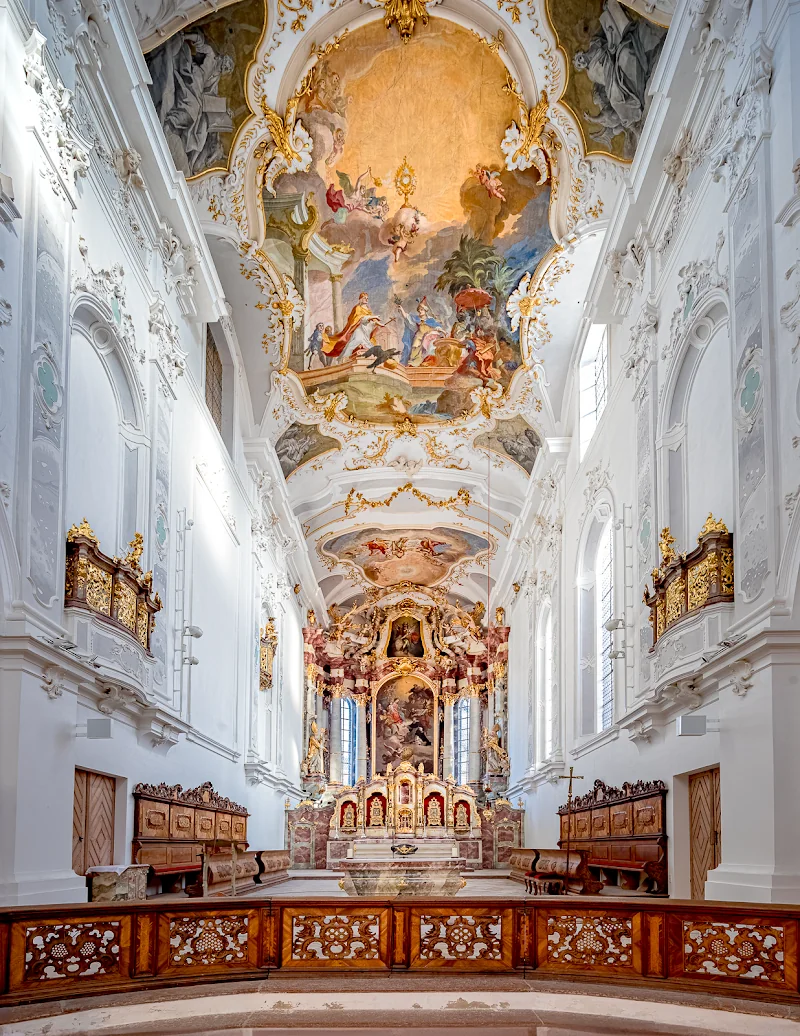
The true fame of the Dominican Church begins for many inside. The city of Landshut explicitly states that Johann Baptist Zimmermann created an interior design of inimitable elegance between 1747 and 1749. He not only designed decorative elements but also executed the entire spatial planning himself. This fact makes the church art historically valuable: it is not only beautifully designed but conceived as a total space. The effect arises from the interplay of architecture, ornament, light, and sightlines. When a church is not only adorned but rethought in its spatial concept, an experience emerges that goes beyond mere decoration. Therefore, the Dominican Church is officially considered one of the most outstanding creations of Bavarian Rococo. ([landshut.de](https://landshut.de/node/546))
For the visitor, this means a significant shift between external impression and internal spatial feeling. The building dates back to the 13th century, but the view inside opens up to another era: the 18th century, to the brilliant Rococo world of Zimmermann. This contrast is precisely what makes the charm of the house. The medieval origin is preserved, but the spatial effect is shaped and refined by the later design. Therefore, entering the church does not present a simple chronology of architectural styles but a consciously composed transition between epochs. This is a fundamental reason why the Dominican Church in Landshut is perceived not only as a parish or order church but also as an important art monument. It combines the severity of early Gothic origins with the lightness and elegance for which Bavarian Rococo is appreciated today. ([landshut.de](https://landshut.de/node/546))
Additionally, there is the special cultural role that the building continues to fulfill today. The city church of Landshut calls the Dominican Church a place that is open for services, concerts, and tours. Thus, the Rococo space is not merely an object of observation but is actively used. Such use is important for historical church spaces because it preserves their atmosphere while simultaneously opening up new access points. Those who experience the Dominican Church during a tour or as part of a concert perceive the architecture not only visually but also acoustically and spatially. This is precisely the strength of this place: it is historically significant but not closed off. Zimmermann's spatial concept continues to resonate today because it is preserved in a vibrant context. This connection of monument preservation, liturgy, and culture makes the Dominican Church one of the most impressive places in Landshut. ([stadtkirche-landshut.de](https://www.stadtkirche-landshut.de/kirchen/))
Services, Concerts, and Tours at the Dominican Church
The Dominican Church is not only a building for viewing but also a place of spiritual use. On the service page of the city church of Landshut, a Sunday service at 11:30 AM is mentioned for the Dominican Church St. Blasius, but only sporadically in summer. At the same time, the page points out that the times for special occasions may change and that current information should be checked on the parishes' homepages. For visitors, this means: the church is not a place with daily standard opening hours like a museum, but a space that is primarily accessible in connection with the liturgical calendar and special events. Therefore, those who want to experience a service in this building should specifically check the current information. ([stadtkirche-landshut.de](https://www.stadtkirche-landshut.de/gottesdienste/))
The city church also clearly states that the Dominican Church is open for services, concerts, and tours. This is an important note for all those who want to visit the church out of cultural interest. Unlike purely tourist attractions, the religious function remains present here, while the space is also open for musical and educational formats. This multipurpose use contributes to the Dominican Church remaining in the public consciousness. Therefore, those visiting Landshut can experience the place in various ways depending on their interests: as a quiet church space, as a concert venue, or as a stop on a thematic tour. This also makes it interesting for inquiries about services, tours, and visits, as the types of use are closely related to the historical character of the building. ([stadtkirche-landshut.de](https://www.stadtkirche-landshut.de/kirchen/))
Particularly attractive are the offerings around the Day of Open Monuments. The city of Landshut lists the Dominican Church as part of the city monument program; various tours are regularly offered on this day, including to the late Gothic high altar, in the lower church, and in the nave. This shows that the church is not only open on such days but is also explored in content. Therefore, those searching for Dominican Church Landshut Monument Day will find a very concrete access point here: it is not just about free entry but about a structured mediation of building and art history. For visitors, this is particularly valuable because they receive targeted explanations of the different layers of the place and can better contextualize the significance of the house. ([landshut.de](https://landshut.de/news/kultur/sonntag-ist-denkmaltag?utm_source=openai))
Parking and Access at Government Square
For practical planning, the location of the Dominican Church is a clear advantage. The city of Landshut names Government Square as the site, and on the city's parking overview, Government Square itself appears as a short-term parking zone. There, a rate of 1.50 euros per hour applies from Monday to Saturday from 9:00 AM to 7:00 PM, charged in short time units. This is very helpful for a short church visit or a specific appointment, as one can park directly near the building. Those who use the Dominican Church as a stop in a tour of the old town benefit from a directly regulated urban parking option in the immediate vicinity of the monument. ([erleben.landshut.de](https://erleben.landshut.de/parkmoeglichkeiten/))
In addition, the city points to several larger parking options in the old town. Particularly important are the parking garage Old Town/Centre on the Mühleninsel, the large parking lot Grieserwiese, and the parking garage at Wittstraße. According to the city of Landshut, while the historic city center is easily accessible, parking options are limited; therefore, Grieserwiese is recommended as a large parking lot, from which it is about a five-minute walk to the old town. The parking garage at Wittstraße is even closer, with about a two-minute walk to the old town. For visiting the Dominican Church, this means practically: those who want to spend more time in Landshut's center can conveniently switch to one of the larger parking solutions and use the walk to the church as part of an old town tour. ([erleben.landshut.de](https://erleben.landshut.de/parkmoeglichkeiten/))
The location at Government Square makes the Dominican Church particularly uncomplicated for visitors moving in the city center. The combination of short-term parking directly at the site and larger parking garages in the vicinity is a significant advantage, especially if one wants to connect the church with other stops in the old town. For orientation, it is also important that the city of Landshut clearly locates the site in the historic center. Therefore, those searching for parking at Dominican Church Landshut or access to Dominican Church Landshut will receive a relatively simple solution: either directly in the area of Government Square or via the nearby central parking facilities. This practical accessibility is a not to be underestimated part of the visitor experience, as it allows access to the monument space without lengthy preparation. ([erleben.landshut.de](https://erleben.landshut.de/parkmoeglichkeiten/))
Plan Your Visit: Monument Day, Church Tour, and Opening Hours
Those who want to experience the Dominican Church purposefully should adapt their visit to the respective usage profile of the building. The city church of Landshut makes it clear that the church is not continuously operated as a daily open viewing site but is accessible for services, concerts, and tours. This is precisely why it is particularly worthwhile to look at current information. The combination of liturgical dates and cultural openings is typical for historical church spaces, but in the case of the Dominican Church, it is particularly well-documented. Therefore, dates that are explicitly mentioned in service or tour programs are suitable for a quiet visit. This is also the most reliable strategy for those seeking a specific opening time. ([stadtkirche-landshut.de](https://www.stadtkirche-landshut.de/kirchen/))
Particularly interesting are the church tours offered by the tourist information in Landshut. The Dominican Church St. Blasius is mentioned as a meeting point; additionally, there is a special tour that includes a 30-minute visit to the Dominican Church. Furthermore, the city of Landshut mentions a church tour that can be booked year-round, starting at the Dominican Church and addressing the theme of Landshut's churches and chapels over time. Therefore, those who want to not only stop by briefly but understand the place with professional guidance have a very concrete and official point of contact. This is particularly attractive for groups, culture-interested guests, or visitors focused on architecture, as the tour systematically reveals the historical and art historical dimensions of the place. ([timm4.landshut.de](https://timm4.landshut.de/veranstaltungen/kirchenfuehrung_in_landshut-452707-12351029/?utm_source=openai))
The Day of Open Monuments is also a sensible time for a visit. The city of Landshut explicitly lists the Dominican Church among the downtown buildings to be visited in this context. This shows that the church is regularly integrated into city cultural programs and is not viewed in isolation. For visitors, this is a good opportunity to experience the place together with other historical buildings in the city and gain insights into the lower church, nave, and high altar. In connection with the regular summer Sunday service, the tours, and the parking options at Government Square, a very clear visit plan emerges: easily accessible, historically significant, and easily accessible in the right format. Those who want to experience the Dominican Church Landshut not by chance but consciously will find several official ways to do so. ([landshut.de](https://landshut.de/news/kultur/sonntag-ist-denkmaltag?utm_source=openai))
Sources:
- City of Landshut - Dominican Church St. Blasius ([landshut.de](https://landshut.de/node/546))
- City Church Landshut - Church Overview ([stadtkirche-landshut.de](https://www.stadtkirche-landshut.de/kirchen/))
- City Church Landshut - Services ([stadtkirche-landshut.de](https://www.stadtkirche-landshut.de/gottesdienste/))
- Experience Landshut - Parking Options ([erleben.landshut.de](https://erleben.landshut.de/parkmoeglichkeiten/))
- City of Landshut - Sunday is Monument Day ([landshut.de](https://landshut.de/news/kultur/sonntag-ist-denkmaltag?utm_source=openai))
- Landshut Tourism - Church Tour in Landshut ([timm4.landshut.de](https://timm4.landshut.de/veranstaltungen/kirchenfuehrung_in_landshut-452707-12351029/?utm_source=openai))
Mehr anzeigenWeniger anzeigen
Dominican Church Landshut | History & Tours
The Dominican Church of St. Blasius is one of the most distinctive historical sites in Landshut and is also a building with a clear identity: early Gothic origins, Baroque redesign, ecclesiastical use, and cultural openness. Those who visit the church at the Government Square encounter not just a monument, but a space where city history, order history, and art history overlap closely. The city of Landshut refers to the construction year of 1271 and the Rococo interior design by Johann Baptist Zimmermann, while the city church today describes the church as a place for services, concerts, and tours. This mixture makes the Dominican Church particularly interesting for visitors who are looking for a church, a monument, and a special cultural site in Landshut at the same time. Due to its location in the old town, the visit can be easily combined with a walk through the historic center. ([landshut.de](https://landshut.de/node/546))
History of the Dominican Church St. Blasius in Landshut
The history of the Dominican Church begins in the 13th century. The city of Landshut states that the year of construction is 1271 and classifies the church as an early Gothic church building. Thus, the church belongs to that layer of Landshut's city history where the religious and urban development of the residence and trading city were closely intertwined. The name St. Blasius refers to the patronage, while the location at Government Square anchors the site within the structure of the city center. Therefore, those standing in front of the church today see not just a single building, but a historically grown building block of the Landshut center, which has remained visible for centuries and shapes the character of the old town. ([landshut.de](https://landshut.de/node/546))
The later history is also important for understanding the Dominican Church. The city church of Landshut explains that the time of the Dominicans ended with the secularization in 1802. The former monastery then initially served as the seat of the Bavarian State University; today it houses the government of Lower Bavaria, which also manages the church as property. This development shows how strongly the use of a historical site can change over the centuries without losing its monument value. In the case of the Dominican Church, this transformation is particularly exciting because the building remains ecclesiastically and culturally present, even though the original religious community no longer lives on site. Thus, the church exemplifies Landshut's ability to transfer historical substance into the present. ([stadtkirche-landshut.de](https://www.stadtkirche-landshut.de/kirchen/))
For visitors, this historical depth is immediately palpable. The Dominican Church is not located off the beaten path, but right in the urban memory of the city. This is remarkable for a building from the 13th century, as it has not become a mere museum backdrop but remains integrated into vibrant use to this day. This circumstance also explains why the church repeatedly appears in city tours, monument programs, and ecclesiastical offerings. Those who want to understand Landshut will find at the Dominican Church a place where the Middle Ages, secularization, and today's urban society converge in a single address. The historical significance arises here not only from the age of the building but from its uninterrupted presence in the public space. ([landshut.de](https://landshut.de/node/546))
The Rococo Interior by Johann Baptist Zimmermann
The true fame of the Dominican Church begins for many inside. The city of Landshut explicitly states that Johann Baptist Zimmermann created an interior design of inimitable elegance between 1747 and 1749. He not only designed decorative elements but also executed the entire spatial planning himself. This fact makes the church art historically valuable: it is not only beautifully designed but conceived as a total space. The effect arises from the interplay of architecture, ornament, light, and sightlines. When a church is not only adorned but rethought in its spatial concept, an experience emerges that goes beyond mere decoration. Therefore, the Dominican Church is officially considered one of the most outstanding creations of Bavarian Rococo. ([landshut.de](https://landshut.de/node/546))
For the visitor, this means a significant shift between external impression and internal spatial feeling. The building dates back to the 13th century, but the view inside opens up to another era: the 18th century, to the brilliant Rococo world of Zimmermann. This contrast is precisely what makes the charm of the house. The medieval origin is preserved, but the spatial effect is shaped and refined by the later design. Therefore, entering the church does not present a simple chronology of architectural styles but a consciously composed transition between epochs. This is a fundamental reason why the Dominican Church in Landshut is perceived not only as a parish or order church but also as an important art monument. It combines the severity of early Gothic origins with the lightness and elegance for which Bavarian Rococo is appreciated today. ([landshut.de](https://landshut.de/node/546))
Additionally, there is the special cultural role that the building continues to fulfill today. The city church of Landshut calls the Dominican Church a place that is open for services, concerts, and tours. Thus, the Rococo space is not merely an object of observation but is actively used. Such use is important for historical church spaces because it preserves their atmosphere while simultaneously opening up new access points. Those who experience the Dominican Church during a tour or as part of a concert perceive the architecture not only visually but also acoustically and spatially. This is precisely the strength of this place: it is historically significant but not closed off. Zimmermann's spatial concept continues to resonate today because it is preserved in a vibrant context. This connection of monument preservation, liturgy, and culture makes the Dominican Church one of the most impressive places in Landshut. ([stadtkirche-landshut.de](https://www.stadtkirche-landshut.de/kirchen/))
Services, Concerts, and Tours at the Dominican Church
The Dominican Church is not only a building for viewing but also a place of spiritual use. On the service page of the city church of Landshut, a Sunday service at 11:30 AM is mentioned for the Dominican Church St. Blasius, but only sporadically in summer. At the same time, the page points out that the times for special occasions may change and that current information should be checked on the parishes' homepages. For visitors, this means: the church is not a place with daily standard opening hours like a museum, but a space that is primarily accessible in connection with the liturgical calendar and special events. Therefore, those who want to experience a service in this building should specifically check the current information. ([stadtkirche-landshut.de](https://www.stadtkirche-landshut.de/gottesdienste/))
The city church also clearly states that the Dominican Church is open for services, concerts, and tours. This is an important note for all those who want to visit the church out of cultural interest. Unlike purely tourist attractions, the religious function remains present here, while the space is also open for musical and educational formats. This multipurpose use contributes to the Dominican Church remaining in the public consciousness. Therefore, those visiting Landshut can experience the place in various ways depending on their interests: as a quiet church space, as a concert venue, or as a stop on a thematic tour. This also makes it interesting for inquiries about services, tours, and visits, as the types of use are closely related to the historical character of the building. ([stadtkirche-landshut.de](https://www.stadtkirche-landshut.de/kirchen/))
Particularly attractive are the offerings around the Day of Open Monuments. The city of Landshut lists the Dominican Church as part of the city monument program; various tours are regularly offered on this day, including to the late Gothic high altar, in the lower church, and in the nave. This shows that the church is not only open on such days but is also explored in content. Therefore, those searching for Dominican Church Landshut Monument Day will find a very concrete access point here: it is not just about free entry but about a structured mediation of building and art history. For visitors, this is particularly valuable because they receive targeted explanations of the different layers of the place and can better contextualize the significance of the house. ([landshut.de](https://landshut.de/news/kultur/sonntag-ist-denkmaltag?utm_source=openai))
Parking and Access at Government Square
For practical planning, the location of the Dominican Church is a clear advantage. The city of Landshut names Government Square as the site, and on the city's parking overview, Government Square itself appears as a short-term parking zone. There, a rate of 1.50 euros per hour applies from Monday to Saturday from 9:00 AM to 7:00 PM, charged in short time units. This is very helpful for a short church visit or a specific appointment, as one can park directly near the building. Those who use the Dominican Church as a stop in a tour of the old town benefit from a directly regulated urban parking option in the immediate vicinity of the monument. ([erleben.landshut.de](https://erleben.landshut.de/parkmoeglichkeiten/))
In addition, the city points to several larger parking options in the old town. Particularly important are the parking garage Old Town/Centre on the Mühleninsel, the large parking lot Grieserwiese, and the parking garage at Wittstraße. According to the city of Landshut, while the historic city center is easily accessible, parking options are limited; therefore, Grieserwiese is recommended as a large parking lot, from which it is about a five-minute walk to the old town. The parking garage at Wittstraße is even closer, with about a two-minute walk to the old town. For visiting the Dominican Church, this means practically: those who want to spend more time in Landshut's center can conveniently switch to one of the larger parking solutions and use the walk to the church as part of an old town tour. ([erleben.landshut.de](https://erleben.landshut.de/parkmoeglichkeiten/))
The location at Government Square makes the Dominican Church particularly uncomplicated for visitors moving in the city center. The combination of short-term parking directly at the site and larger parking garages in the vicinity is a significant advantage, especially if one wants to connect the church with other stops in the old town. For orientation, it is also important that the city of Landshut clearly locates the site in the historic center. Therefore, those searching for parking at Dominican Church Landshut or access to Dominican Church Landshut will receive a relatively simple solution: either directly in the area of Government Square or via the nearby central parking facilities. This practical accessibility is a not to be underestimated part of the visitor experience, as it allows access to the monument space without lengthy preparation. ([erleben.landshut.de](https://erleben.landshut.de/parkmoeglichkeiten/))
Plan Your Visit: Monument Day, Church Tour, and Opening Hours
Those who want to experience the Dominican Church purposefully should adapt their visit to the respective usage profile of the building. The city church of Landshut makes it clear that the church is not continuously operated as a daily open viewing site but is accessible for services, concerts, and tours. This is precisely why it is particularly worthwhile to look at current information. The combination of liturgical dates and cultural openings is typical for historical church spaces, but in the case of the Dominican Church, it is particularly well-documented. Therefore, dates that are explicitly mentioned in service or tour programs are suitable for a quiet visit. This is also the most reliable strategy for those seeking a specific opening time. ([stadtkirche-landshut.de](https://www.stadtkirche-landshut.de/kirchen/))
Particularly interesting are the church tours offered by the tourist information in Landshut. The Dominican Church St. Blasius is mentioned as a meeting point; additionally, there is a special tour that includes a 30-minute visit to the Dominican Church. Furthermore, the city of Landshut mentions a church tour that can be booked year-round, starting at the Dominican Church and addressing the theme of Landshut's churches and chapels over time. Therefore, those who want to not only stop by briefly but understand the place with professional guidance have a very concrete and official point of contact. This is particularly attractive for groups, culture-interested guests, or visitors focused on architecture, as the tour systematically reveals the historical and art historical dimensions of the place. ([timm4.landshut.de](https://timm4.landshut.de/veranstaltungen/kirchenfuehrung_in_landshut-452707-12351029/?utm_source=openai))
The Day of Open Monuments is also a sensible time for a visit. The city of Landshut explicitly lists the Dominican Church among the downtown buildings to be visited in this context. This shows that the church is regularly integrated into city cultural programs and is not viewed in isolation. For visitors, this is a good opportunity to experience the place together with other historical buildings in the city and gain insights into the lower church, nave, and high altar. In connection with the regular summer Sunday service, the tours, and the parking options at Government Square, a very clear visit plan emerges: easily accessible, historically significant, and easily accessible in the right format. Those who want to experience the Dominican Church Landshut not by chance but consciously will find several official ways to do so. ([landshut.de](https://landshut.de/news/kultur/sonntag-ist-denkmaltag?utm_source=openai))
Sources:
- City of Landshut - Dominican Church St. Blasius ([landshut.de](https://landshut.de/node/546))
- City Church Landshut - Church Overview ([stadtkirche-landshut.de](https://www.stadtkirche-landshut.de/kirchen/))
- City Church Landshut - Services ([stadtkirche-landshut.de](https://www.stadtkirche-landshut.de/gottesdienste/))
- Experience Landshut - Parking Options ([erleben.landshut.de](https://erleben.landshut.de/parkmoeglichkeiten/))
- City of Landshut - Sunday is Monument Day ([landshut.de](https://landshut.de/news/kultur/sonntag-ist-denkmaltag?utm_source=openai))
- Landshut Tourism - Church Tour in Landshut ([timm4.landshut.de](https://timm4.landshut.de/veranstaltungen/kirchenfuehrung_in_landshut-452707-12351029/?utm_source=openai))
Dominican Church Landshut | History & Tours
The Dominican Church of St. Blasius is one of the most distinctive historical sites in Landshut and is also a building with a clear identity: early Gothic origins, Baroque redesign, ecclesiastical use, and cultural openness. Those who visit the church at the Government Square encounter not just a monument, but a space where city history, order history, and art history overlap closely. The city of Landshut refers to the construction year of 1271 and the Rococo interior design by Johann Baptist Zimmermann, while the city church today describes the church as a place for services, concerts, and tours. This mixture makes the Dominican Church particularly interesting for visitors who are looking for a church, a monument, and a special cultural site in Landshut at the same time. Due to its location in the old town, the visit can be easily combined with a walk through the historic center. ([landshut.de](https://landshut.de/node/546))
History of the Dominican Church St. Blasius in Landshut
The history of the Dominican Church begins in the 13th century. The city of Landshut states that the year of construction is 1271 and classifies the church as an early Gothic church building. Thus, the church belongs to that layer of Landshut's city history where the religious and urban development of the residence and trading city were closely intertwined. The name St. Blasius refers to the patronage, while the location at Government Square anchors the site within the structure of the city center. Therefore, those standing in front of the church today see not just a single building, but a historically grown building block of the Landshut center, which has remained visible for centuries and shapes the character of the old town. ([landshut.de](https://landshut.de/node/546))
The later history is also important for understanding the Dominican Church. The city church of Landshut explains that the time of the Dominicans ended with the secularization in 1802. The former monastery then initially served as the seat of the Bavarian State University; today it houses the government of Lower Bavaria, which also manages the church as property. This development shows how strongly the use of a historical site can change over the centuries without losing its monument value. In the case of the Dominican Church, this transformation is particularly exciting because the building remains ecclesiastically and culturally present, even though the original religious community no longer lives on site. Thus, the church exemplifies Landshut's ability to transfer historical substance into the present. ([stadtkirche-landshut.de](https://www.stadtkirche-landshut.de/kirchen/))
For visitors, this historical depth is immediately palpable. The Dominican Church is not located off the beaten path, but right in the urban memory of the city. This is remarkable for a building from the 13th century, as it has not become a mere museum backdrop but remains integrated into vibrant use to this day. This circumstance also explains why the church repeatedly appears in city tours, monument programs, and ecclesiastical offerings. Those who want to understand Landshut will find at the Dominican Church a place where the Middle Ages, secularization, and today's urban society converge in a single address. The historical significance arises here not only from the age of the building but from its uninterrupted presence in the public space. ([landshut.de](https://landshut.de/node/546))
The Rococo Interior by Johann Baptist Zimmermann
The true fame of the Dominican Church begins for many inside. The city of Landshut explicitly states that Johann Baptist Zimmermann created an interior design of inimitable elegance between 1747 and 1749. He not only designed decorative elements but also executed the entire spatial planning himself. This fact makes the church art historically valuable: it is not only beautifully designed but conceived as a total space. The effect arises from the interplay of architecture, ornament, light, and sightlines. When a church is not only adorned but rethought in its spatial concept, an experience emerges that goes beyond mere decoration. Therefore, the Dominican Church is officially considered one of the most outstanding creations of Bavarian Rococo. ([landshut.de](https://landshut.de/node/546))
For the visitor, this means a significant shift between external impression and internal spatial feeling. The building dates back to the 13th century, but the view inside opens up to another era: the 18th century, to the brilliant Rococo world of Zimmermann. This contrast is precisely what makes the charm of the house. The medieval origin is preserved, but the spatial effect is shaped and refined by the later design. Therefore, entering the church does not present a simple chronology of architectural styles but a consciously composed transition between epochs. This is a fundamental reason why the Dominican Church in Landshut is perceived not only as a parish or order church but also as an important art monument. It combines the severity of early Gothic origins with the lightness and elegance for which Bavarian Rococo is appreciated today. ([landshut.de](https://landshut.de/node/546))
Additionally, there is the special cultural role that the building continues to fulfill today. The city church of Landshut calls the Dominican Church a place that is open for services, concerts, and tours. Thus, the Rococo space is not merely an object of observation but is actively used. Such use is important for historical church spaces because it preserves their atmosphere while simultaneously opening up new access points. Those who experience the Dominican Church during a tour or as part of a concert perceive the architecture not only visually but also acoustically and spatially. This is precisely the strength of this place: it is historically significant but not closed off. Zimmermann's spatial concept continues to resonate today because it is preserved in a vibrant context. This connection of monument preservation, liturgy, and culture makes the Dominican Church one of the most impressive places in Landshut. ([stadtkirche-landshut.de](https://www.stadtkirche-landshut.de/kirchen/))
Services, Concerts, and Tours at the Dominican Church
The Dominican Church is not only a building for viewing but also a place of spiritual use. On the service page of the city church of Landshut, a Sunday service at 11:30 AM is mentioned for the Dominican Church St. Blasius, but only sporadically in summer. At the same time, the page points out that the times for special occasions may change and that current information should be checked on the parishes' homepages. For visitors, this means: the church is not a place with daily standard opening hours like a museum, but a space that is primarily accessible in connection with the liturgical calendar and special events. Therefore, those who want to experience a service in this building should specifically check the current information. ([stadtkirche-landshut.de](https://www.stadtkirche-landshut.de/gottesdienste/))
The city church also clearly states that the Dominican Church is open for services, concerts, and tours. This is an important note for all those who want to visit the church out of cultural interest. Unlike purely tourist attractions, the religious function remains present here, while the space is also open for musical and educational formats. This multipurpose use contributes to the Dominican Church remaining in the public consciousness. Therefore, those visiting Landshut can experience the place in various ways depending on their interests: as a quiet church space, as a concert venue, or as a stop on a thematic tour. This also makes it interesting for inquiries about services, tours, and visits, as the types of use are closely related to the historical character of the building. ([stadtkirche-landshut.de](https://www.stadtkirche-landshut.de/kirchen/))
Particularly attractive are the offerings around the Day of Open Monuments. The city of Landshut lists the Dominican Church as part of the city monument program; various tours are regularly offered on this day, including to the late Gothic high altar, in the lower church, and in the nave. This shows that the church is not only open on such days but is also explored in content. Therefore, those searching for Dominican Church Landshut Monument Day will find a very concrete access point here: it is not just about free entry but about a structured mediation of building and art history. For visitors, this is particularly valuable because they receive targeted explanations of the different layers of the place and can better contextualize the significance of the house. ([landshut.de](https://landshut.de/news/kultur/sonntag-ist-denkmaltag?utm_source=openai))
Parking and Access at Government Square
For practical planning, the location of the Dominican Church is a clear advantage. The city of Landshut names Government Square as the site, and on the city's parking overview, Government Square itself appears as a short-term parking zone. There, a rate of 1.50 euros per hour applies from Monday to Saturday from 9:00 AM to 7:00 PM, charged in short time units. This is very helpful for a short church visit or a specific appointment, as one can park directly near the building. Those who use the Dominican Church as a stop in a tour of the old town benefit from a directly regulated urban parking option in the immediate vicinity of the monument. ([erleben.landshut.de](https://erleben.landshut.de/parkmoeglichkeiten/))
In addition, the city points to several larger parking options in the old town. Particularly important are the parking garage Old Town/Centre on the Mühleninsel, the large parking lot Grieserwiese, and the parking garage at Wittstraße. According to the city of Landshut, while the historic city center is easily accessible, parking options are limited; therefore, Grieserwiese is recommended as a large parking lot, from which it is about a five-minute walk to the old town. The parking garage at Wittstraße is even closer, with about a two-minute walk to the old town. For visiting the Dominican Church, this means practically: those who want to spend more time in Landshut's center can conveniently switch to one of the larger parking solutions and use the walk to the church as part of an old town tour. ([erleben.landshut.de](https://erleben.landshut.de/parkmoeglichkeiten/))
The location at Government Square makes the Dominican Church particularly uncomplicated for visitors moving in the city center. The combination of short-term parking directly at the site and larger parking garages in the vicinity is a significant advantage, especially if one wants to connect the church with other stops in the old town. For orientation, it is also important that the city of Landshut clearly locates the site in the historic center. Therefore, those searching for parking at Dominican Church Landshut or access to Dominican Church Landshut will receive a relatively simple solution: either directly in the area of Government Square or via the nearby central parking facilities. This practical accessibility is a not to be underestimated part of the visitor experience, as it allows access to the monument space without lengthy preparation. ([erleben.landshut.de](https://erleben.landshut.de/parkmoeglichkeiten/))
Plan Your Visit: Monument Day, Church Tour, and Opening Hours
Those who want to experience the Dominican Church purposefully should adapt their visit to the respective usage profile of the building. The city church of Landshut makes it clear that the church is not continuously operated as a daily open viewing site but is accessible for services, concerts, and tours. This is precisely why it is particularly worthwhile to look at current information. The combination of liturgical dates and cultural openings is typical for historical church spaces, but in the case of the Dominican Church, it is particularly well-documented. Therefore, dates that are explicitly mentioned in service or tour programs are suitable for a quiet visit. This is also the most reliable strategy for those seeking a specific opening time. ([stadtkirche-landshut.de](https://www.stadtkirche-landshut.de/kirchen/))
Particularly interesting are the church tours offered by the tourist information in Landshut. The Dominican Church St. Blasius is mentioned as a meeting point; additionally, there is a special tour that includes a 30-minute visit to the Dominican Church. Furthermore, the city of Landshut mentions a church tour that can be booked year-round, starting at the Dominican Church and addressing the theme of Landshut's churches and chapels over time. Therefore, those who want to not only stop by briefly but understand the place with professional guidance have a very concrete and official point of contact. This is particularly attractive for groups, culture-interested guests, or visitors focused on architecture, as the tour systematically reveals the historical and art historical dimensions of the place. ([timm4.landshut.de](https://timm4.landshut.de/veranstaltungen/kirchenfuehrung_in_landshut-452707-12351029/?utm_source=openai))
The Day of Open Monuments is also a sensible time for a visit. The city of Landshut explicitly lists the Dominican Church among the downtown buildings to be visited in this context. This shows that the church is regularly integrated into city cultural programs and is not viewed in isolation. For visitors, this is a good opportunity to experience the place together with other historical buildings in the city and gain insights into the lower church, nave, and high altar. In connection with the regular summer Sunday service, the tours, and the parking options at Government Square, a very clear visit plan emerges: easily accessible, historically significant, and easily accessible in the right format. Those who want to experience the Dominican Church Landshut not by chance but consciously will find several official ways to do so. ([landshut.de](https://landshut.de/news/kultur/sonntag-ist-denkmaltag?utm_source=openai))
Sources:
- City of Landshut - Dominican Church St. Blasius ([landshut.de](https://landshut.de/node/546))
- City Church Landshut - Church Overview ([stadtkirche-landshut.de](https://www.stadtkirche-landshut.de/kirchen/))
- City Church Landshut - Services ([stadtkirche-landshut.de](https://www.stadtkirche-landshut.de/gottesdienste/))
- Experience Landshut - Parking Options ([erleben.landshut.de](https://erleben.landshut.de/parkmoeglichkeiten/))
- City of Landshut - Sunday is Monument Day ([landshut.de](https://landshut.de/news/kultur/sonntag-ist-denkmaltag?utm_source=openai))
- Landshut Tourism - Church Tour in Landshut ([timm4.landshut.de](https://timm4.landshut.de/veranstaltungen/kirchenfuehrung_in_landshut-452707-12351029/?utm_source=openai))
Upcoming Events
No events found
Frequently Asked Questions
Reviews
Mariela H.
16. December 2019
The Dominican Church in Landshut was built in 1271 in the early Gothic style. Between 1747 and 1749, the Munich court artist Johann Baptist Zimmermann created an interior of unparalleled elegance, making the Dominican Church one of the finest examples of Bavarian Rococo. A visit is highly recommended, especially during the Advent season when a nativity scene exhibition is always on display.
Jutta Berninger
6. January 2019
A beautiful church with a nativity scene. Ideal for the pre-Christmas season and for contemplation.
Niklas Fischer
8. August 2017
A very beautiful, ornate and valuable church of the former Dominican abbey.
Wolfgang Golsch (Singu)
16. May 2019
A beautiful church if you are interested in such buildings.
Babette Badura
24. May 2019
Unfortunately no contact person found this morning.