
Trilok Gurtu
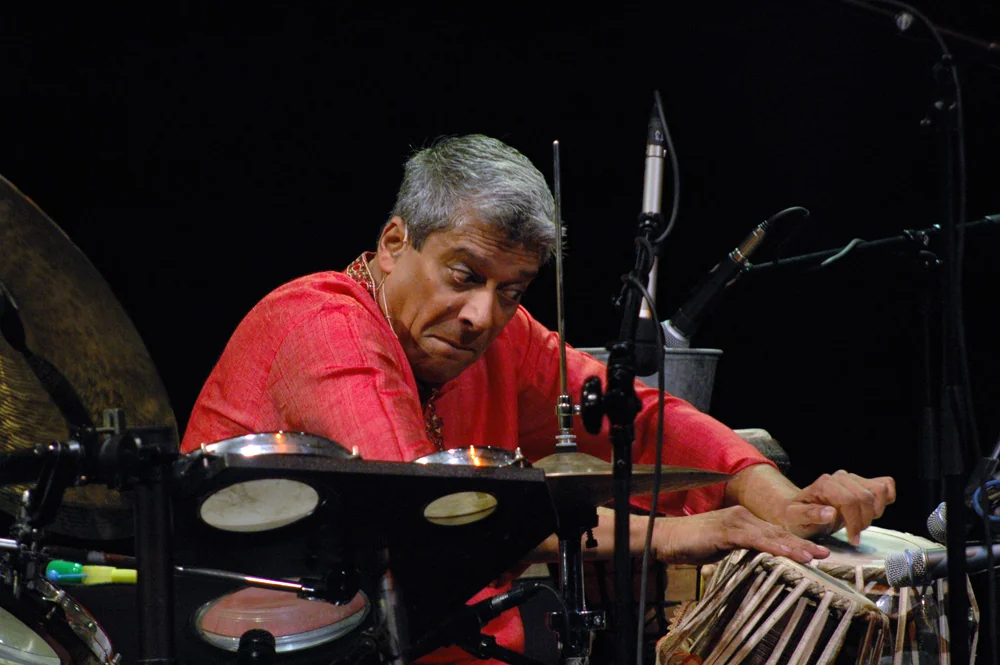
Image from Wikipedia
Image from Wikipedia
Trilok Gurtu – Rhythm Pioneer Between Mumbai, Hamburg, and the World
An Artist Who Breaks Boundaries: A Lifelong Search for Sound, Groove, and Expression
Trilok Gurtu, born on October 30, 1951, in Bombay (now Mumbai), is among the most influential percussionists and composers of our time. His music career merges the precision of Indian rhythmic traditions with the openness of jazz and world music. As the son of the legendary classical singer Shobha Gurtu and the grandson of a sitar artist, he grew up in a highly musical family that shaped his artistic development from an early age. Since the 1970s, he has captivated audiences with his distinctive stage presence, unconventional sound colors, and a discography that expands the landscape of improvised music.
Gurtu became internationally known as a virtuosic mediator between cultures: his music integrates tabla, drums, konnakol, and hybrid instruments into contemporary compositions and improvisational dialogues. Collaborations with icons like John McLaughlin, Jan Garbarek, Joe Zawinul, Bill Laswell, and Robert Miles have shaped an artistic language that resonates equally in jazz clubs, concert halls, and festivals. In Hamburg, the cosmopolitan found a second home—without ever losing the creative exchange with the Indian scene.
Early Years: Tradition as a Springboard
Gurtu's first formative experiences came as a child at the tabla. Daily immersion in taal cycles, the vocalization of complex rhythms through konnakol, and listening to classical vocal styles laid the foundation for his later sonic language. At a young age, he worked with popular ensembles and toured in India and Europe. The interplay of raga logic, percussive architecture, and improvisational freedom became his trademark—a foundation upon which he later forged connections between jazz fusion, world music, and orchestral colors. This technical sovereignty enabled him to translate traditional patterns into irregular meters, polyrhythmic layers, and modern production aesthetics.
Europe, Jazz, and the Step onto the Big Stage
In Europe, key doors opened for Gurtu: engagements with adventurous bands, jazz projects, and crossover formations quickly made him a sought-after partner. His artistic development was propelled by his work in John McLaughlin's trio, where he stood out for four years as a featured soloist with unprecedented sound imagination. Collaborations with Jan Garbarek and Joe Zawinul deepened his role as a sound architect between melodic clarity, harmonic expansiveness, and highly complex rhythmics. Gurtu's presence on international festival stages—from the Montreux cosmos to renowned European tours—cemented his reputation as an innovator.
Breakthrough as a Solo Artist and Band Leader
With the solo debut Usfret (1988), Gurtu firmly established himself as a composer and producer. In the following years, he formed flexibly cast ensembles, where tabla, drum set, electronic sound processes, and voices merged into organic narratives. His discography from the 1990s and early 2000s—including albums like Crazy Saints and the internationally acclaimed crossover projects—repeatedly reflected his ability to translate Indian phrasing into jazz harmonies and European chamber music textures. As a band leader, he cultivated an aesthetic where composition and improvisation coexist equally: themes and ostinati provide direction while micro-timings, ghost notes, and dynamic arcs steer the dramatic breath.
Between Electronics, Chamber Music, and Club Culture
Gurtu's curiosity led to surprising alliances: with the 2004 project Miles_Gurtu alongside Robert Miles, he fused organic percussion, electronic sound design, and ambient-like textures into a vivid, club-friendly sound. His work with the Arkè String Quartet opened the space for chamber music without smoothing the percussive energy: string voices met tapping tabla figures, syncopated patterns, and angular accents. During this phase, it became clear how much Gurtu treats composition as a plastic form—he models sound spaces, shifts balances, allows silence and attack to wrestle with each other, and thereby achieves a dramaturgy that extends far beyond virtuosic-percussive spectacle.
Awards, Recognition, and Cultural Influence
The music press has acknowledged Gurtu's influence with numerous awards and polls. Repeated accolades in the DownBeat Critics Poll as the best percussionist affirm his international authority in the jazz and world music discourse. At the same time, he has shaped generations of musicians who have forged new bridges between South Asian tradition, drum'n'bass, electronica, and improvised music in London, Hamburg, and Mumbai. In the European scene, he is regarded as a catalyst who thinks about world music beyond folkloristic surfaces: as a compositional, rhythmic, and sonic avant-garde that pushes the concert format forward.
Discography Overview: Milestones and Soundscapes
Gurtu's discography can be read as a journey through sound topographies. After Usfret (1988), albums followed that explored new aesthetic fields: the condensed fusion sketches of the early 1990s, chamber-music-influenced productions around the turn of the millennium, and electronic dialogues stemming from Miles_Gurtu (2004). In 2020, God Is A Drummer was released—a showcase of his percussive handwriting, where compositional arcs and sound design intertwine closely. In 2022/2023, with One Thought Away, he developed a solo-centered studio concept where he layered instruments and unfolded an intimate, almost contemplative sonic language.
A focus of the recent years has been the collaboration with the Arkè String Quartet. The album Mirror, released in 2025, bundles finely balanced arrangements, sensitive micro-dynamics, and a tonally rich production. Critical reactions emphasize the maturity of the sound, the clarity of the textures, and the masterful handling of rhythmic overlays. Furthermore, Mirror has been noted in specialized lists and longlists, underscoring the cultural relevance of the project. The discography thus documents a continuous exploration: from powerful groove to quiet, choral planes.
Live Culture: The Stage as a Laboratory
On stage, Gurtu's artistic development is especially palpable. His stage presence is fueled by precision, communication, and dramatic tension. Collaborating with the Jan Garbarek Group places these qualities in a poetic context: Nordic tone, melodic reduction, wide spaces—and underneath, the vital pulse fields of his percussion. Recent concert announcements for the 2025/26 season confirm his unbroken relevance: Gurtu remains a magnet for festivals seeking curated dialogues between jazz, world music, and chamber aesthetics.
In live performances, Gurtu often works with loop architectures, call-and-response figures, and percussive "scene changes." Sound play on cymbals, dampening on the drum, singing short phrases, or blowing on surfaces extends the palette. Technically, the coordination of both hands on tabla and drum set simultaneously impresses—choreographed interweaving that oscillates between powerful backbeats, tanpura-leaning drone planes, and delicate tihais.
Style, Technique, and Production: A Style Analysis
From a professional perspective, Gurtu connects three levels: first, the rhythmic grammar of the Hindustani tradition (Teentaal, Jhaptal, Rupak with konnakol syllabics), second, the orchestral mindset of modern jazz drummers (voice leading, voicings between snare, tom, and cymbal arcs), and third, a production aesthetic that utilizes space, reverb, and overtone contours as compositional parameters. His arrangements often base themselves on cyclical patterns that are modulated through subdivision shifts. Micro-tempo variations—imperceptible pushes—generate tension without jeopardizing the overall flow. The result: music that grooves physically while stimulating the intellect.
In production, Gurtu pays attention to the plasticity and presence of transients. The resolution between acoustic and electronic sources remains deliberately permeable: percussion and string quartet can celebrate in the same sonic space when EQ and reverb sorting arrange the formants. In projects like One Thought Away, the artist also serves as a multi-instrumentalist—bass, keyboards, percussion—enhancing the authorship of the sound sculpture.
Cultural Significance and Reception
Gurtu represents a world music that thinks interculturally in a structural rather than decorative way. In London, his work influenced the "Asian Underground" movement; in continental Europe, it inspired jazz and contemporary chamber music; in India, it strengthened the self-awareness of a new generation that views tradition as a laboratory. Critics praise him as a musician who doesn't blur genre boundaries but renegotiates them—in the details of arrangements, in the architecture of groove modules, and in the attitude of understanding music as an open system. Numerous awards and his ongoing presence in the concert programs of major venues underline this authority.
Current Projects 2024–2026
With Mirror (2025) featuring the Arkè String Quartet, Gurtu continues his chamber music line; the album has been included in professional longlists and reviewed by music press platforms. At the same time, collaboration with the Jan Garbarek Group remains a central live pillar—extending into the festival season of 2026. Additionally, his official website references One Thought Away as the latest studio revelation of his solo working method since 2022, which continues to live on as a sound diary in the studio. Between Hamburg, European tour stops, and Indian collaborations, a vibrant network is emerging, continuously exploring new artistic terrain.
Conclusion: Why Trilok Gurtu is More Important Today than Ever
Trilok Gurtu creates music that touches, moves, and educates. He thinks of rhythm as language, as dramaturgy, and as a bridge between continents. His discography documents courage, his stage presence conveys confidence, and his artistic development shows: world music is not a style mixture but a way of thinking in connections. Those who wish to experience music as living research should hear Gurtu live—where sound, body, and space converge into a single, great groove.
Official Channels of Trilok Gurtu:
- Instagram: No official profile found
- Facebook: No official profile found
- YouTube: No official profile found
- Spotify: No official profile found
- TikTok: No official profile found
Sources:
- Trilok Gurtu – Official Website
- MIG Music – Artist Profile Trilok Gurtu
- Betreutes Proggen – Review: Trilok Gurtu – Mirror (April 2025)
- German Record Critics' Award – Longlist 3/2025
- Jazzreportagen – Jan Garbarek Group feat. Trilok Gurtu (April 2025)
- Rausgegangen – Jazzfest Bonn 2026: Jan Garbarek Group feat. Trilok Gurtu
- Wikipedia (EN) – Trilok Gurtu
- Wikipedia (DE) – Trilok Gurtu
- Wikipedia – Miles_Gurtu (Robert Miles & Trilok Gurtu)
Upcoming Events
Jan Garbarek Group feat. Trilok Gurtu
Opening concert of Jazzfest Bonn 2026: Jan Garbarek Group feat. Trilok Gurtu in the Beethovenhalle.
Jan Garbarek Group feat. Trilok Gurtu
Sound poetry and groove in the Beethoven Hall Bonn: Jan Garbarek Group feat. Trilok Gurtu. Friday, 17.04.2026, from 30 €. Intense concert experience – secure tickets now! #JazzfestBonn