
Gustav Klimt
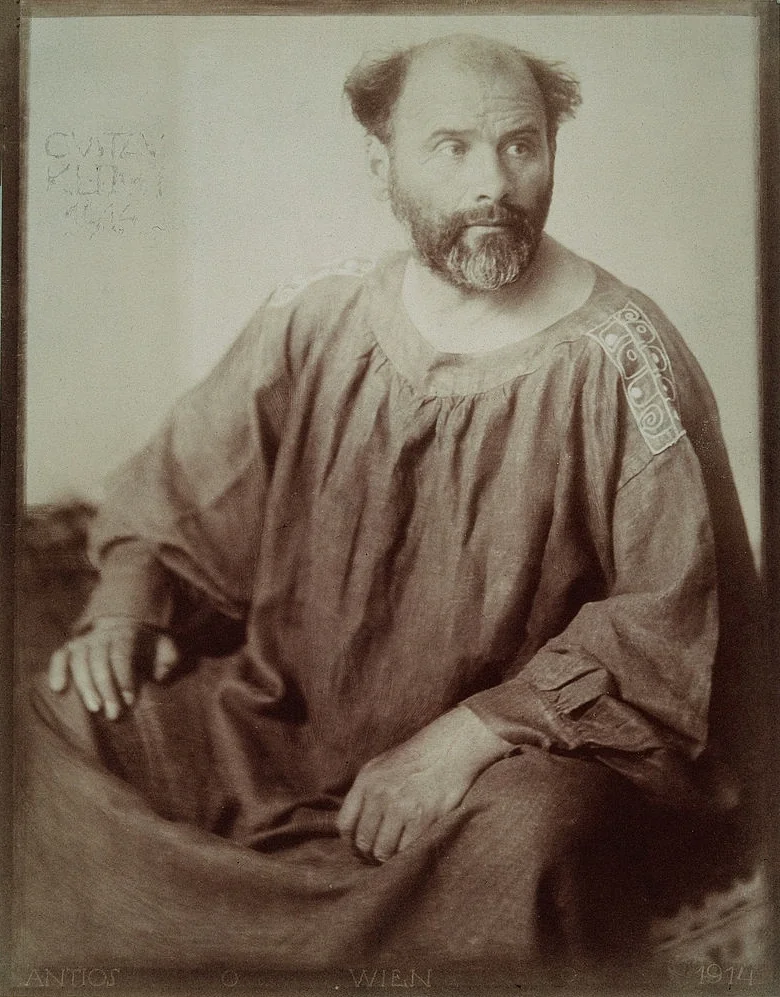
Image from Wikipedia
Image from Wikipedia
Gustav Klimt – Icon of the Vienna Secession and Master of the Golden Modern
The Artist Who Gold-Plated Vienna: Why Gustav Klimt Continues to Fascinate Today
Gustav Klimt (born July 14, 1862, in Baumgarten near Vienna; died February 6, 1918, in Vienna) is regarded as the most influential artistic personality of the Vienna Modern and the most famous representative of the Vienna Secession. His "musical career" in a metaphorical sense – understood as an artistic path on the great "stage" of the art metropolis Vienna – led him from decorative painter to avant-gardist, from a controversial provocateur to a myth of modernity. Works like "The Kiss," "Adele Bloch-Bauer I," and the monumental Stoclet Frieze mark milestones in his artistic development, characterized by distinctive composition, lavish ornamentation, and refined materiality with gold and silver overlays. Klimt's presence in art history remains unbroken – in museums, exhibitions, and on the international art market.
Early Years and Education: Craftsmanship, Precision, and the Path to a Unique Language
Growing up as the son of an engraver, Klimt developed a sense for material, surface, and decorative design early on. A scholarship took him to the Vienna School of Arts and Crafts, where he received an excellent technical education alongside his brother Ernst. During this phase, monumental and decorative painting still dominated: interiors, theaters, and public buildings provided the first major stages for his aesthetic arrangements. These years shaped his understanding of composition and arrangement, which later infused his paintings with a particular tension between figure, space, and ornament. His artistic evolution moved from an academic historicism toward a new, independent visual language that co-founded the Vienna Modern.
The Vienna Secession: Declaration of Independence and Artistic Breakthrough
In 1897, Klimt became the founding president of the Vienna Secession – the most important platform of the Austrian avant-garde around 1900. The Secession organized exhibitions, opened Vienna to international influences, and understood art as a holistic experience. Klimt's curatorial handwriting and authority shaped the early years of the Secession; his goal was to free art from academic constraints and experiment with new forms, genres, and modes of production. The much-discussed faculty paintings for the University of Vienna – "Philosophy," "Medicine," and "Jurisprudence" – were publicly scandalized but marked a radical redefinition of motifs, symbolism, and the representation of human experience. These debates fueled Klimt's artistic independence and sharpened his profile as a leading voice of modernity.
The Breakthrough: Golden Phase, "The Kiss," and the Birth of a Trademark
Between 1903 and 1912, Klimt reached his "golden phase," during which gold leaf, precious materials, and ornamental patterns became his signature. The iconic painting "The Kiss" (1908/09) embodies this synthesis of symbolic imagery, decorative rhythm, and exquisite surface – a work that is among the most valuable and well-known images in Europe and is regarded as the pinnacle of the collection at the Belvedere. The portraits, especially "Adele Bloch-Bauer I," combine psychological precision with luxurious material poetry. These works became the epitome of a progressive Jugendstil that brought art, design, and everyday life together and continues to shape visual culture to this day.
Networks of Modernity: Architecture, Design, and Total Artwork
Klimt's work emerged within a vital network of architects, artisans, and designers. His collaboration with protagonists like Josef Hoffmann and Koloman Moser, evident, for instance, at the 1908 "Kunstschau" or in the Stoclet Palace in Brussels, reflects a thinking in spaces, surfaces, and atmospheres. The Stoclet Frieze unfolds as a mosaic band, an orchestral composition of line, ornament, and metallic sheen – a prime example of the secessionist total artwork. The dialogue between painting, applied art, and architecture was not ancillary for Klimt but a central component of his artistic practice and production.
Emilie Flöge, Portrait Art, and the Intimacy of the Gaze
As muse, friend, and fashion entrepreneur, Emilie Flöge shaped the world around Klimt just as much as numerous portrait models from the bourgeois Viennese society. Klimt's portraits blend typification and individual psychology, fashion and corporeality, light and materiality. In the composition, there is a stretch between concentrated physiognomy and a vibrating field of ornament – a stylistic arrangement that places subject and environment into a dynamic relationship. This finely balanced relationship between closeness and distance explains why Klimt's portraits are still regarded today as artistic statements about personality, society, and representation.
Landscapes and Late Work: Attersee, Surface Sound, and Color Order
Less spectacular than his golden portraits, but artistically groundbreaking, are Klimt's landscapes, many of which were created at Attersee. Square formats, dense pointillism, structured color application, and the reduction of spatial depth create a quiet, meditative tension. These nature images develop a different kind of stage presence: not figurative and representative, but flat, sonorous, and painterly. In these compositions, often characterized as "color weavings," lies the key to Klimt's painterly virtuosity – and to a modernity that liberated painting from storytelling and celebrated pure visual impact.
Reception, Restitution, and Records: Klimt in the 20th and 21st Century
The story of Klimt's works after 1918 is also a story of loss, dispossession, and restitution. The case of "Adele Bloch-Bauer I" – analyzed in literature and film – brought the issue of Nazi looted art into the global spotlight and permanently shaped the public perception of Klimt's oeuvre. Meanwhile, art criticism has increasingly solidified Klimt's status as a key figure in symbolism and the Vienna Secession. His cultural influence is evident not only in museums but also in design, fashion, and pop culture, where ornamentation, gold gleam, and decorative abstraction are constantly re-quoted and adapted.
The international art market underscores this authority impressively: In 2023, "Dame mit Fächer," Klimt's last completed portrait, achieved the highest auction price for a work of art in Europe to date at Sotheby’s in London. In 2024/2025, the newly rediscovered "Bildnis Fräulein Lieser" was also the focus; the auction in Vienna was widely discussed. In November 2025, a pivotal moment occurred: "Portrait of Elisabeth Lederer" set a new record for a modern artwork with $236.4 million and marked the highest price ever achieved for Klimt. These superlatives reflect how strongly Klimt's artistic achievement is intertwined with cultural capital, provenance research, and the global collector market.
Exhibitions, Research, and Technical Analysis: Klimt in the Lab of the Present
Institutions like the Belvedere in Vienna continuously dedicate special exhibitions to Klimt, curating his production in new contexts and deepening scholarly research. Projects like "Klimt versus Klimt" and the recent exhibition "Gustav Klimt – Pigment & Pixel" (February 20 to September 7, 2025) offer insights into material analyses, layer structures, overpainting, and work processes. The combination of restoration, imaging technology, and digital mediation strengthens trust in source material, expands expertise regarding painting techniques, and documents Klimt's compositional thinking through sketches, studies, and variations. Meanwhile, TV formats and documentaries reach new audiences and highlight the ongoing popularity of the artist.
Style, Technique, and Composition: How Klimt Translated Sound into Color
Klimt's work can be read as a "visual score" of the Vienna Modern. His compositions balance figure and ornament, surface and depth, line and color; the production integrates gold leaf, silver, and occasionally platinum into a painterly style that is substantial, glittering, yet never arbitrary. In the visual dramaturgy, ornament often takes on the role of a sound carpet, generating rhythm and tension. The symbolic content – Eros, death, departure, decadence – is conveyed not didactically but through formal means. This stylistic mixture makes Klimt a link between late symbolism, Art Nouveau, and a modernity that was to open new spaces through abstraction.
Catalog of Works in Focus: Major Works and Motif Constants
Klimt's discography in the sense of his oeuvre includes portraits, allegories, landscapes, and monumental ensembles. Major works include "The Kiss," "Adele Bloch-Bauer I" and "II," "The Three Ages of Woman," and the Stoclet Frieze. Recurring motifs – the idealized female figure, ornamentally charged nature, symbolic attributes – are varied in their own color order and finely nuanced line work. The picture surfaces are meticulously arranged, often held in static frontal positions, and rhythmically structured. This creates a picture architecture in which gaze direction and ornament particles are finely calibrated and guide the eyes of viewers along choreographed paths.
Cultural Influence and the Present: From the Belvedere to the World
No other Austrian artist embodies the identity of Vienna around 1900 as strongly as Gustav Klimt does today. The Belvedere positions "The Kiss" as the centerpiece of its collection and as a symbol of national art history. Museums worldwide – from the Leopold Collection to international institutions – anchor Klimt as a reference for questions of modernity, gender, corporeality, and decorative abstraction. In fashion, design, and media culture, Klimt's ornamentation continues as a "speaking surface." Recent record prices and large exhibitions confirm the enduring relevance of his oeuvre – aesthetically, historically, and economically.
Conclusion: Why Gustav Klimt Feels More Urgent Today Than Ever
Klimt's art demonstrates how sensuality, intellect, and craftsmanship converge into a unique language of forms. His artistic evolution – from strictly composed decorative painting to a golden symbolic language – makes him a key figure of modernity. For music lovers, Klimt offers a surprising resonant space: His compositions function like orchestrated sound surfaces, his ornaments pulse in rhythm, and his portraits breathe in the finest rhythms. Those who experience Klimt today – in museums, through forensic studio insights from research, or in light of the cultural-historical depths of his themes – understand why these images never fall silent. Appeal: Experience Klimt live – "The Kiss" at the Belvedere, new exhibitions, and the ongoing research let his art resound anew each time.
Official Channels of Gustav Klimt:
- Instagram: No official profile found
- Facebook: No official profile found
- YouTube: No official profile found
- Spotify: No official profile found
- TikTok: No official profile found
Sources:
- Encyclopaedia Britannica – Gustav Klimt: Biography, The Kiss
- Belvedere Museum Vienna – Collection featuring Klimt's "The Kiss"
- Belvedere – Exhibition "Gustav Klimt – Pigment & Pixel" (February 20 – September 7, 2025)
- Belvedere – Action "Come for a Kiss" in front of Klimt's "The Kiss" (February 2026)
- Leopold Museum – Work and Collection Information on Gustav Klimt
- The Art Newspaper – Klimt "Dame mit Fächer": European Auction Record (June 27, 2023)
- Axios – "Portrait of Elisabeth Lederer": Record Sale of Modern Art (November 2025)
- Wallpaper – Klimt Record Sale "Portrait of Elisabeth Lederer" (November 2025)
- AP News – "Portrait of Fräulein Lieser": Auction in Vienna (April 2024)
- The Art Newspaper – "Portrait of Fräulein Lieser": Sale and Context (April 2024)
- Wikipedia – Gustav Klimt: Biography, Works, and Reception
- Wikipedia – "The Kiss (Klimt)": Creation, Exhibition 1908