
Bram Stoker
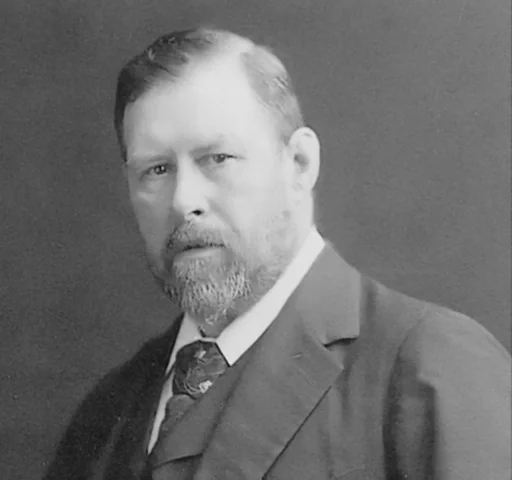
Image from Wikipedia
Image from Wikipedia
Bram Stoker – The Architect of Modern Horror and a Man of the Theater
How an Irish Theater Man Shaped the Sound World of Horror with "Dracula"
Abraham "Bram" Stoker, born on November 8, 1847, in the Dublin suburb of Clontarf and died on April 20, 1912, in London, is regarded as the creator of the probably most influential vampire in cultural history: Count Dracula. Before his name became inextricably linked with Gothic Fiction, Stoker had a multifaceted career in music in the metaphorical sense of the stage: as an organizer, dramaturg, and business manager of the Lyceum Theatre, he shaped performance practices, the composition of theatrical evenings, timing, and the "stage presence" of Sir Henry Irving and his ensemble – a school that rhythmically punctuated and scenically charged his storytelling. His novel "Dracula," published in 1897, transformed literary suspense into a cultural icon that is still audible and visible today. (britannica.com)
Stoker overcame a severe childhood illness, studied mathematics at Trinity College Dublin from 1864, excelled as an athlete, and, alongside his public service, early on gravitated towards journalism as a theater critic. This "artistic development" between administration, critique, and stage sharpened his sensibility for composition, arrangement, and the dramaturgical impact of scenes – a core aspect of his literary style. His first book was notably a manual for administration (1879), followed by his first novel, "The Snake’s Pass," in 1890. (britannica.com)
Early Years and Formative Influences
As the third of seven children, Stoker grew up in a Protestant-dominated environment; bedridden for a long time, he developed an imaginative power early on that would later pervade his prose. At Trinity College, he became prominent both athletically and intellectually – serving as auditor of the College Historical Society and president of the University Philosophical Society, a rare dual role that bolstered his self-conception as a culture-shaping organizer. During this time, he began his engagement with sensational literature, folk beliefs, and the interplay of myth and modernity. (en.wikipedia.org)
Alongside his public service at Dublin Castle, Stoker wrote for the Dublin Evening Mail and met Sir Henry Irving in 1876. This encounter marked a turning point: the critic became a man of practice, the observer a co-creator behind the scenes – a musicality of theater that made rhythms, pauses, and crescendos of tension not only audible but narratable. In 1878, Stoker married Florence Balcombe; shortly thereafter, the couple moved to London. (en.wikipedia.org)
From Dublin Critic to London Theater Maker
From 1878 to 1898, Stoker worked as acting and later business manager at the Lyceum Theatre, the home of Henry Irving. He organized tours, refined play schedules, coordinated personnel, and acted as a bridge between artistic production and the public – a sort of producer avant la lettre. This everyday practice gave him a precise sense of scene changes, lighting, stage music, and the economy of effect, which later formally and atmospherically shaped "Dracula." At the same time, Irving's social circles opened doors for Stoker to London high society. (en.wikipedia.org)
The connection to Irving remained not only biographically central; in 1906, Stoker published the two-volume study "Personal Reminiscences of Henry Irving," which offers intimate insights into theater work, production aesthetics, and artistic cooperation of the era – a primary source for Stoker's "experience" in the cultural and performance industry. Thus, his years in theater laid the foundation for prose that is composed like a stage plan: choral, scenic, and rhythmically structured. (en.wikipedia.org)
"Dracula" (1897): Composing a Modern Myth Soundtrack
"Dracula" was published in 1897 – organized in letter form, diaries, telegrams, and newspaper articles. This epistolary structure functions like a polyphonic arrangement: voices overlap, perspectives modulate tonal coloring, and the narrative pace follows a dramaturgical cadence. The content sees the Transylvanian vampire traveling to England, meeting bourgeois resistance led by Van Helsing, Mina, and Jonathan Harker. The result is not just a novel but a kind of "score" for narrative tension management, continuously interpreted by film, theater, and music ever since. (britannica.com)
The cultural-historical impact is immense: From "Nosferatu" (1922) to countless stage adaptations and recent film interpretations, "Dracula" has shaped the image of the vampire in Western pop culture. Stoker's precision in visual motifs (blood, mirrors, threshold), his sense of recurring leitmotifs, and the rhythmic staging of revelations make the book a reference work of horror – aesthetically as formatively impactful as a classical leitmotif in program music. (britannica.com)
Bibliography, Expanded Discography, and Critical Reception
In addition to "Dracula," Stoker published novels such as "The Mystery of the Sea" (1902), "The Jewel of Seven Stars" (1903), "The Lady of the Shroud" (1909), and "The Lair of the White Worm" (1911). Posthumously, "Dracula’s Guest and Other Weird Stories" appeared in 1914 – a volume edited by his widow Florence. While no other title reached the popularity of "Dracula," these works create a coherent oeuvre straddling occultism, fear of technology, archaeological fascination, and colonial anxiety – thematic fields that literary criticism still discusses today. (britannica.com)
Stoker does not have a "discography" in the narrower sense – yet his prose generated one of the most fruitful sound traditions ever: from Wojciech Kilar's sinister score to Francis Ford Coppola's "Bram Stoker’s Dracula" (1992) to recent re-releases. The soundtrack charted in the UK and was re-released in 2024 – evidence of how strongly music creators utilize Stoker's visual and tonal structures. The musical has also adapted "Dracula" numerous times, including Frank Wildhorn's version, which combines the motif of dramatic arias, duets, and choral scenes with Stoker's theme of romantic obsession. (officialcharts.com)
Style, Genre, and Compositional Techniques
Stoker's "composition" is based on montage, polyphony, and precise escalation. The epistolary form functions like a multi-track cut: each voice carries a motif – rationality, superstition, love, science – whose counterpoint eventually culminates in a collective action. His "production" heavily relies on scenic markers (location changes, time pressure) that emotionally engage readers, much like a change of scenery dictates the pace of a performance. These techniques are set in the context of the Gothic novel of the late 19th century, which translates media upheavals and urban fears into symbolic spaces. (britannica.com)
An expert in theater, Stoker had a keen sense of the "stage presence" of characters. Dracula rarely stays long in the spotlight but remains acoustically and atmospherically present – a dramaturgical trick that already functioned in Irving's stage effects. The novel oscillates between intimacy (diary) and spectacle (chase scenes), between liturgical language (host, ban rituals) and modern technology (phonograph, telegraph). These tension fields continue to nourish musical readings from chorales to industrial. (britannica.com)
Cultural Influence, Adaptations, and Soundscapes
"Dracula" has generated a worldwide adaptation culture: film classics, TV series, audio dramas, games – and repeatedly music, from symphonic adaptations to dark-electronic atmospheres. That even festivals celebrate Stoker's legacy is evidenced by the annual Bram Stoker Festival in Dublin, which makes the hybrid nature of the work between literature, theater, and sound tangible through parades, concerts, screenings, and immersive formats. In 2025, the festival also presented a program for the Expo in Osaka – a current testament to Stoker's international radiance. (dublincity.ie)
Stoker's universe remains relevant today through new interpretations: In 2025, Luc Besson's English-language film "Dracula: A Love Tale" was released, while re-releases of classic soundtracks and new stagings continuously refresh the "sound" of the Stoker universe. The history of reception resembles an ongoing remix culture where leitmotifs, harmonies, and tempos are continually rearranged. (en.wikipedia.org)
Research, Archive Discoveries, and Editorial Dynamics
Beyond popular culture, archives provide scholarly impulses. In 2024, the long-overlooked Stoker story "Gibbet Hill" was identified in the collections of the National Library of Ireland and published in book form for the first time – including a preface by the author Roddy Doyle. Such discoveries enrich Stoker's "discography" in a metaphorical sense with new "tracks" from his imaginative world and provide criticism with fresh material for the poetics of horror. (britannica.com)
The Stoker family also actively curates the legacy: The official Bram Stoker Estate provides biographies, overviews of works, bibliographies, and materials – a central resource for research and fans that brings together primary and secondary texts and sharpens the focus on Stoker's theater work. This institutional care supports the reliability of the available knowledge and solidifies Stoker's authority as a key figure in Gothic literature. (bramstokerestate.com)
Conclusion: Why Bram Stoker Sounds More Relevant Than Ever Today
Stoker's work is a prime example of successful "production" of cultural long-term impact: it is precisely composed, scenically conceived, and open to musical and theatrical transformation. His "music career" as a theater maker shapes the pulse of his prose; his characters are crafted to resonate equally on stages, screens, and in scores. Reading or listening to Dracula offers an education in timing, tone colors, and dramaturgical economy.
Stoker remains fascinating because his themes reflect our present: technological enthusiasm alongside magical thinking, body politics alongside sexual morality, globality alongside homeland myths. His novel is not a museum exhibit but a living resonance body. Appeal: Experience Stoker’s world live – in theaters, concert halls, at festivals – and listen closely to how literature becomes the music of modernity.
Official Channels of Bram Stoker:
- Instagram: No official profile found
- Facebook: No official profile found
- YouTube: No official profile found
- Spotify: No official profile found
- TikTok: No official profile found
Sources:
- Encyclopaedia Britannica – Bram Stoker (updated March 11, 2026)
- Bram Stoker Estate – Official Website of the Family
- National Library of Ireland – Discovery of the story "Gibbet Hill" (2024)
- Wikipedia (en) – Bram Stoker
- Wikipedia (de) – Bram Stoker
- Bram Stoker Festival Dublin – Official Website
- Dublin City Council – Bram Stoker Festival
- Music and Stage – Frank Wildhorn’s "Dracula"
- Official Charts – Bram Stoker’s Dracula (Original Soundtrack)
- Resident Music – Wojciech Kilar: Bram Stoker’s Dracula OST (2024 Reissue)
- Trinity College Dublin – Trinity Writers: Bram Stoker (PDF)
- Wikipedia: Image and text source