
Annemirl Bauer
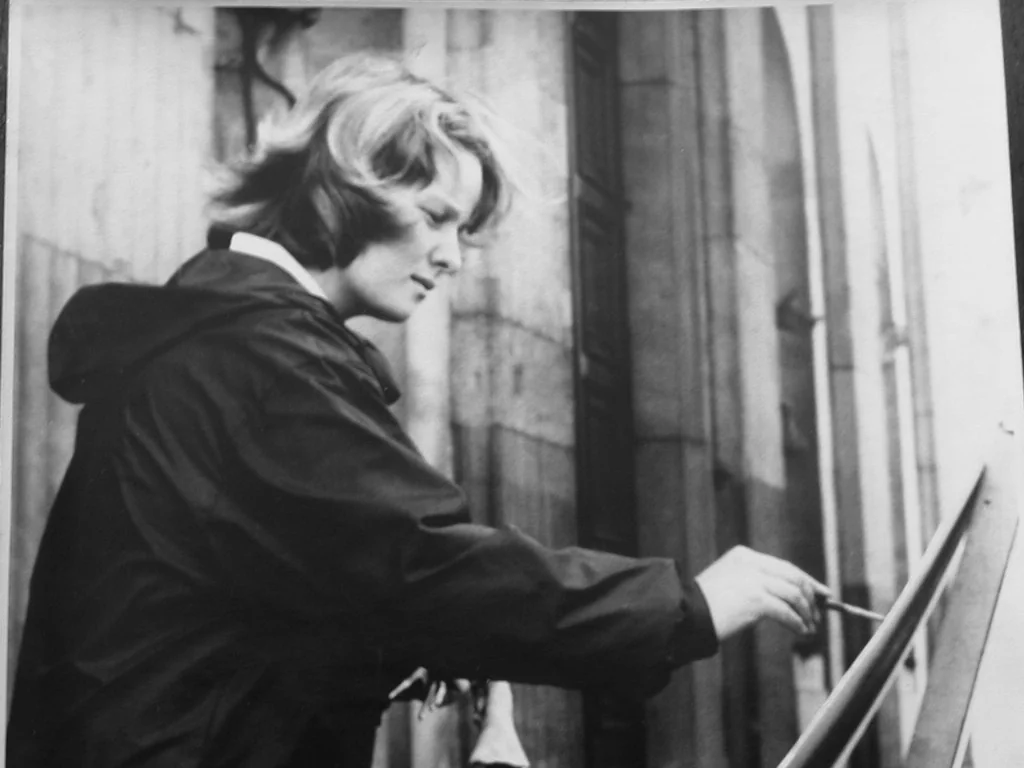
Image from Wikipedia
Image from Wikipedia
Annemirl Bauer – Painter, Graphic Artist, and Uncompromising Voice of East German Art
Between Departure and Resistance: The Powerful Œuvre of an Artist Who Made History with Color and Attitude
Born on April 10, 1939, in Jena and died on August 23, 1989, in Berlin, Annemirl Bauer shaped an independent visual language as a painter and graphic artist, inseparably linking aesthetics and attitude. In East Germany, she emerged early as a critic of the regime and thereby fell into an existential conflict between artistic freedom and political repression. Although she did not have a traditional music career, her stage presence, in the sense of a publicly outspoken artist, and her artistic development follow a dramatic trajectory reminiscent of the intensity of great stages: from her early years of training through radical confession images to later honors and major exhibitions after 1990.
As the daughter of the painter Tina Bauer-Pezellen and the photographer Siegbert Bauer, she grew up in an environment where artistic visibility was taken for granted. At the same time, she learned early on that art always comments on society. This dual focus – formal precision and political-ethical urgency – shapes her entire artistic development. The consistency with which Bauer connected aesthetic means, material experiments, and a clear stance remains relevant to this day.
Biography: Education, Influences, Initial Artistic Steps
Between 1955 and 1958, Annemirl Bauer studied at a vocational school for applied arts in Sonneberg (ceramics and toy design). Following this, she professionalized her profile as a painter and graphic artist; biographical notes also refer to study stays at renowned academies, including Weißensee and Dresden. Her early stylistic development shows a confident line work, clear form decisions, and an expressive color palette – a composition that negotiates content and form on equal footing. Even her early works reveal a keen sensitivity to social tensions, role models, and female experiences.
In 1970s Berlin, Bauer worked as a freelance artist. She oscillated between urban impulses and the rural retreat zone of Niederwerbig in Fläming, where she used an old vicarage as her studio and home from the mid-1970s. This topography – city and countryside, public and intimate – became the resonance space for her visual ideas and her arrangements of color, line, and material.
Stance as a Program: Opposition, Freedom of Travel, and the 1984 Exclusion
In February 1984, Bauer addressed a bold petition to leading cultural officials of East Germany. She demanded freedom of travel for all citizens and criticized the "constraints on an entire people." This placed the primacy of individual freedom over state dogmas. The consequence was harsh: in July 1984, she was expelled from the Association of Visual Artists of East Germany – a step equivalent to a professional ban. In musical terms: the audience was deprived of an outstanding artistic voice, but the artist did not fall silent. She continued to work, documenting resistance and vulnerability, addressing abuses of power, border regimes, and gender roles – and sharpened her stylistic profile.
The exclusion marked a turning point in her artistic career. Harassment, economic hardships, and constant surveillance formed the pressure cooker in which Bauer intensified the language of her images. In 1986, she was able to be readmitted to the association – also through the advocacy of colleagues. Her artistic development during these years remains characterized by uncompromising immediacy: she painted against forgetting, against silencing, and for the visibility of the feminine.
Works, Themes, and Style: Consciousness of Form, Material Courage, Picture-Text Dramaturgies
Bauer's oeuvre encompasses thousands of works: paintings, drawings, collages, objects. Characteristic is a "speaking" arrangement of line, surface, and color. In content, she dissects role stereotypes, depicts single mothers, exposes patriarchal patterns, addresses environmental destruction, and the cost of political borders. The visual worlds open up to commenting text fragments; word plays become formal axes of the picture space. Formally, she combines traditional painting surfaces (paper, canvas) with unconventional supports – doors, carpets, window frames, furniture boards – thus transforming the ordinary into art. Material becomes a bearer of meaning, and composition becomes a counterstatement.
The artistic development shows an increasing density: fast, confident contours, decisive surface placements, pointed color notes. Her works oscillate between apparent cheerfulness and deep existential sharpness. This fluctuation has been described in reception as "opulent and dissident" – a fitting formula for the tension-rich dual movement of aesthetic richness and political questioning.
Exhibitions, Reception, and Collections: From East German Presence to Canonical Visibility
Posthumously, visibility significantly increased. A major recognition took place in the German Bundestag: From March to June 2012, the exhibition "In My Own Country" at the Berlin Wall Memorial of the Marie-Elisabeth-Lüders-Haus showcased her works – accompanied by curatorial contextualization and a supporting program. As early as 2010, Berlin honored her life's work through the naming of Annemirl-Bauer-Platz in Friedrichshain (on September 18, 2010). In 2015, the Diesel Power Plant Cottbus art museum dedicated an extensive retrospective to her, deepening the research on materials, context, and forms with a catalog and art-historical contributions.
Collections underpin the authority of her oeuvre: works are located, among others, in the art collection of the German Bundestag, in the Berlinische Galerie, in the Museum Junge Kunst (now part of the Brandenburg State Museum of Modern Art), in the art collection of Berliner Volksbank, and in the Moritzburg Museum Halle. This presence in significant institutions documents the lasting relevance of Bauer's artistic signature and thematic focus.
Current Projects and Outlook: Retrospective 2026 and Ongoing Contextualization
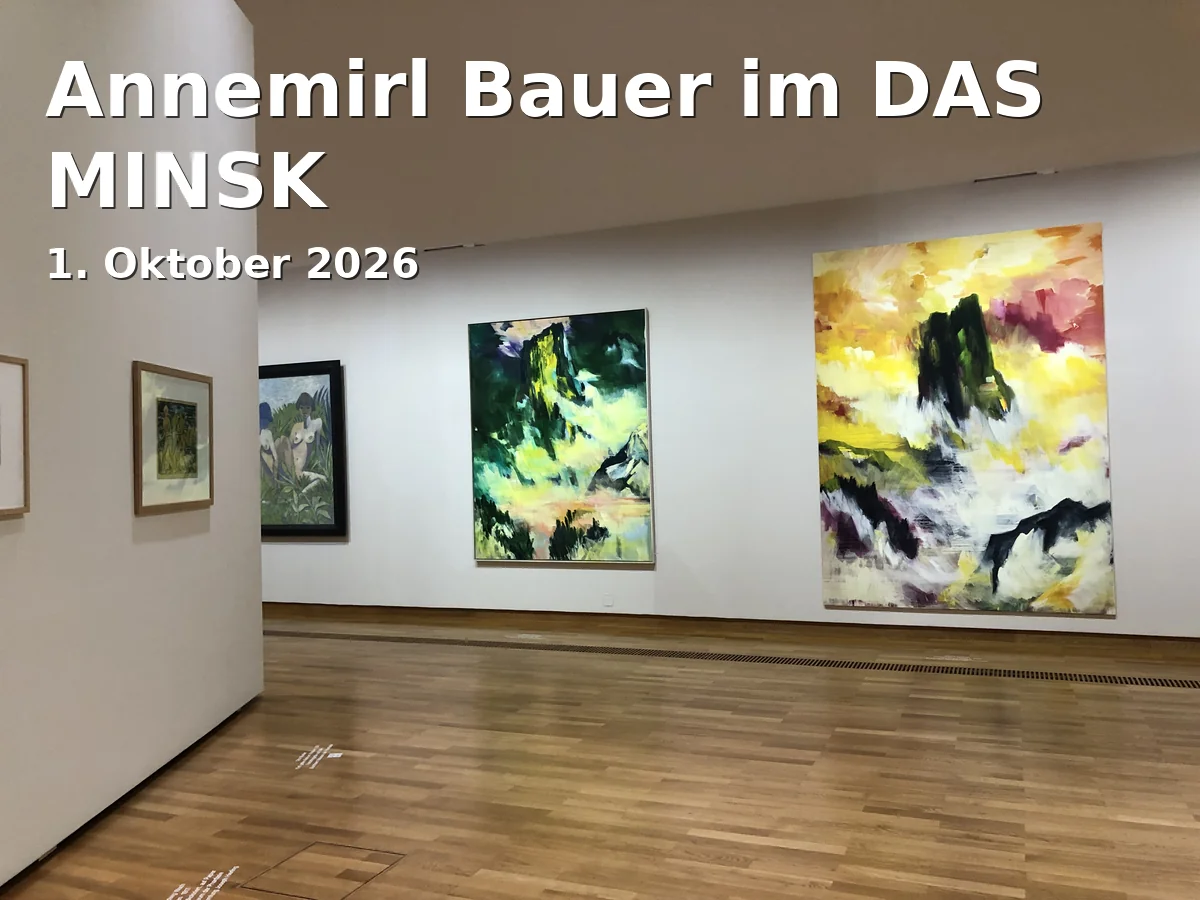
Her impact remains in motion: From September 5, 2026, to February 7, 2027, DAS MINSK Kunsthaus in Potsdam will showcase a major retrospective. Curated by Marie Gerbaulet (Assistant: Luisa Bachmann) and in close collaboration with Amrei Bauer, the estate administrator and director of the Annemirl-Bauer-Haus in Niederwerbig, the exhibition will focus on the diversity of media – painting, works on paper, collages, objects – while positioning Annemirl Bauer as both a locally rooted and regionally significant voice of East German art. Beyond this exhibition, the Annemirl-Bauer-Haus, with its archive, guided tours, and programs, ensures vibrant art education and the preservation of the estate.
International connections add additional accents: Her works were part of the exhibition "The Medea Insurrection" at the Wende Museum in California in 2019 – an example of how the artistic development of East German women artists is incorporated into global narratives of art and dissent. This expands the horizon of reception from a West German culture of remembrance to a transnational art history of the 20th century.
Technique and Visual Language: Composition as Ethics
Bauer's composition is inseparably linked with ethics. The image fields emerge from the interplay of line and surface, color, and word. Her arrangements generate a clear visual direction and widen the iconography to semantic levels. The consciously chosen materials – often drawn from the female-connoted household – function as metaphors for social attributions that the artist dissolves, overwrites, and redefines. Thus, a visual grammar emerges in which the private becomes political and the aesthetic becomes argumentative.
These procedures sharpen a style that simultaneously creates proximity and distance: figures remain typified, faces rarely individualized; gesture replaces portrait. It is a conscious compositional decision that makes the general visible and transfers experiential knowledge into pictorial form. Hence, her art becomes a chronicle of feelings and an analysis of structural power relations.
Cultural Influence: Feminist Perspectives, Culture of Remembrance, Urban Space
As a "fighter and comforter" – as characterized by museums – Bauer condensed individual experience with social diagnosis. Her artistic development is closely linked to feminist debates; she demanded visibility for female life and thought in a "male world." The culture of remembrance is reflected in urban space: Annemirl-Bauer-Platz in Berlin-Friedrichshain bears her name, makes history walkable, and connects art with urban public life. At the same time, projects like "FrauenOrte Brandenburg" mark the historical significance of her life and work location in Niederwerbig and make female biographies in the region visible.
This complexity also shapes the canon: museum collections and exhibitions position Bauer today as a central figure of critical art in East Germany. Her works resonate with contemporary contexts – serving as an impulse for contemporary female artists, as a mirror of our debates about freedom, bodies, care, environment, and state.
Conclusion: Why Annemirl Bauer Resonates Today
Annemirl Bauer uniquely connects artistic excellence, formal innovation, and societal relevance. Her images are more than testimonies of a time: they are compositions with attitude, precisely arranged, sensitively colored, and courageously content-driven. Anyone experiencing her work encounters a voice that comforts and incites, that allows for doubt yet aims for change. For this reason, it is worth rediscovering her works in broader overviews and in the intimate spaces of the Annemirl-Bauer-Haus. Take advantage of future exhibitions such as the retrospective in 2026 in Potsdam – experience this artistic development "live," in the original, where color, material, and scale unfold their full impact.
Official Channels of Annemirl Bauer:
- Instagram: No official profile found
- Facebook: No official profile found
- YouTube: No official profile found
- Spotify: No official profile found
- TikTok: No official profile found
Sources:
- Wikipedia – Annemirl Bauer (German)
- Wikipedia – Annemirl Bauer (English)
- DAS MINSK Kunsthaus Potsdam – Retrospective Annemirl Bauer (September 5, 2026 – February 7, 2027)
- German Bundestag – Exhibition "In My Own Country" (2012)
- FrauenOrte Brandenburg – Commemorative Plaque for Annemirl Bauer (Niederwerbig)
- Lost Women Art – Annemirl Bauer: Painting for Justice
- Art Collection of the German Bundestag – Annemirl Bauer (Collection)
- Open Studios Brandenburg – Annemirl Bauer House (referring to annemirlbauer.de)
- Wikipedia: Image and text source
Upcoming Events
Annemirl Bauer – Retrospective at DAS MINSK
Annemirl Bauer
Annemirl Bauer at DAS MINSK Art House
Annemirl Bauer at DAS MINSK
Annemirl Bauer at DAS MINSK
Annemirl Bauer at DAS MINSK
Annemirl Bauer at DAS MINSK
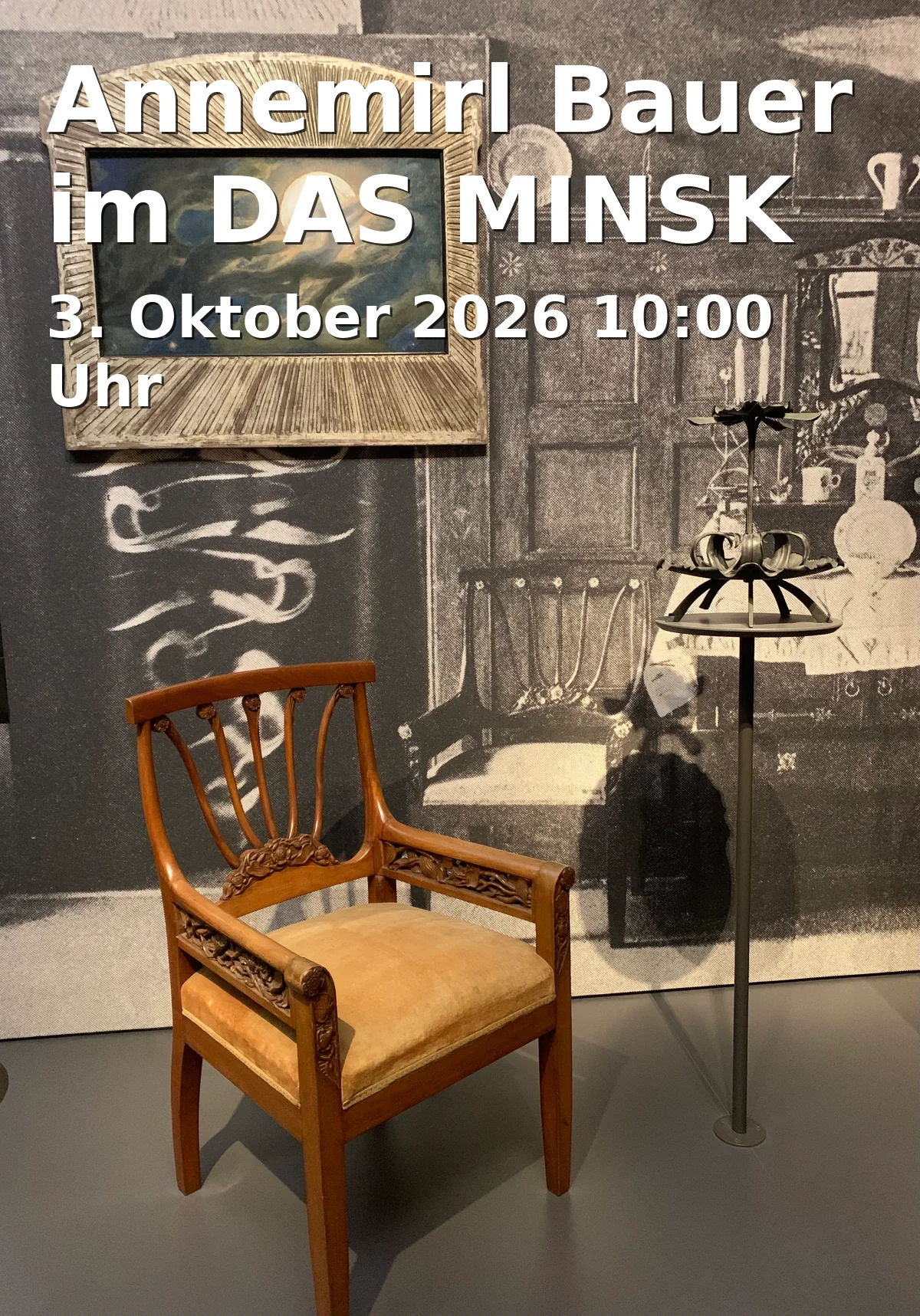
Annemirl Bauer at DAS MINSK
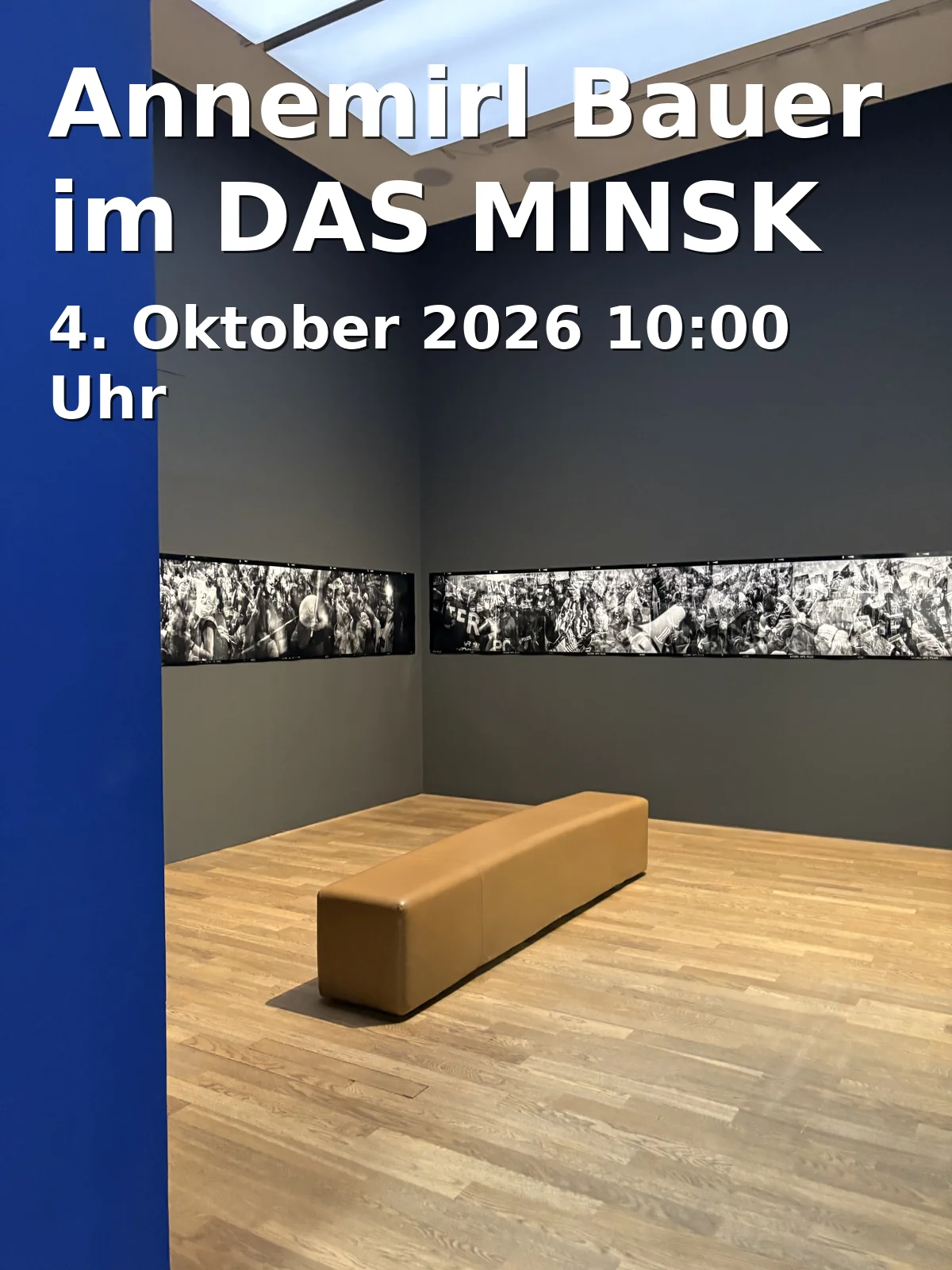
Annemirl Bauer at DAS MINSK