
Aatifi
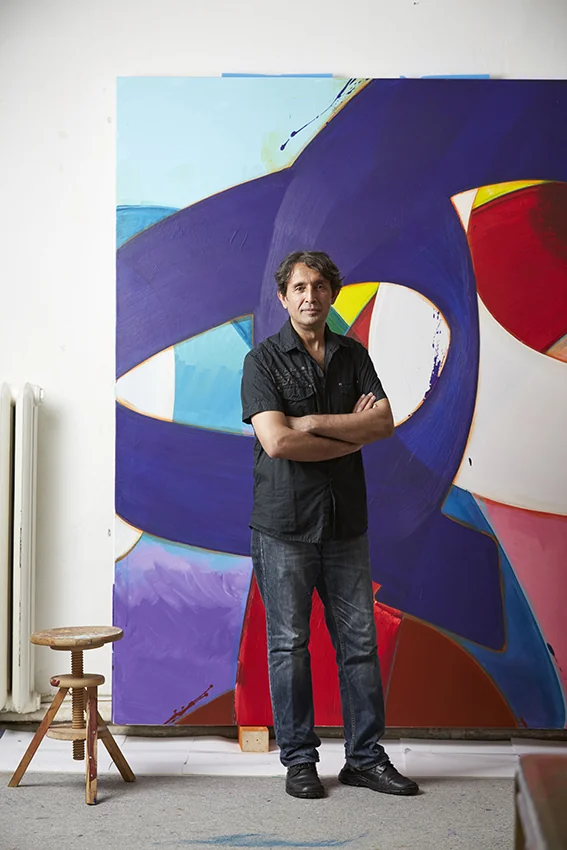
Image from Wikipedia
Image from Wikipedia
Aatifi – Abstract Calligraphy between Kabul and Bielefeld
An artist who transforms script into color and space
Aatifi, born in Kandahar in 1965, is one of the most distinctive voices in contemporary abstract scriptural art, merging classical calligraphy with modern painting. His artistic development spans from early training as a master calligrapher in Afghanistan to studying painting in Kabul and later a guest study at the Academy of Fine Arts in Dresden. Since the mid-1990s, the Afghan-German artist has lived and worked in Bielefeld, where he has honed a characteristic visual language that productively intertwines Eastern and Western influences.
In his paintings, etchings, and ink drawings, Aatifi liberates the calligraphic form from a clear textual reference and transforms it into rhythmic, color-infused compositions. This “abstract neography” breathes the rigor of line, the freedom of gesture, and the dynamics of the painting process. The artist gained international prominence in 2015 with "Aatifi – News from Afghanistan" at the Pergamon Museum in Berlin – a milestone in his visual career, characterized by the stage presence of color, the artistic development of form, and the pull of the format.
Early Years: Master Calligrapher and Painting Student
The artist's biography begins with an exceptionally early and systematic training: As a child, Aatifi was introduced to the great styles of Islamic calligraphy in Kandahar. Mastery of Kufi, Naskh, Thuluth, Nastaliq, and other scripts forms the foundation of his later artistic production. From 1989 to 1992, he studied painting at the University of Kabul, where he began to connect orthodox calligraphy with the means of image composition. This phase marks the transition from pure lettering to free art – a first crucial step in his artistic development.
His early accolades in Afghanistan honor his technical skills and sense of composition. However, more important than the awards was his decision to no longer treat letters as semantic carriers, but as modular, form-creating particles of contemporary painting. This shift in perspective becomes the guiding motif of his oeuvre.
Arrival in Germany: Dresden, Bielefeld, and the Language of Color
In 1995, Aatifi emigrated to Germany. In Dresden, he met painter and HfBK professor Siegfried Klotz, who invited him for a guest study in 1997/98. The Dresden environment—with its tradition of figurative rigor, precise drawing, and solid craftsmanship in painting—broadens his horizons. The experience of German painting after 1945, from expressive gesture to reduced form, has a lasting impact on his compositions.
By the end of the 1990s, Aatifi moved his studio to Bielefeld. Here, he distills the essence of his dual tradition: autonomous pictorial signs arise from calligraphic fragments; a flowing, corporeal line emerges from the teachings of proportions; and a characteristic color dramaturgy results from biographical experiences between Afghanistan and Germany. This leads to the development of a universally readable visual language that strongly defines his work.
Breakthrough in the Museum: “News from Afghanistan” (Pergamon Museum, 2015)
The major institutional breakthrough came in 2015 with a solo exhibition at the Museum of Islamic Art in the Pergamon Museum in Berlin. Approximately three dozen large-format paintings, prints, and ink drawings present a panorama of “abstract scripture.” The project, integrated into the permanent exhibition, signifies that calligraphic tradition is not simply museum-ified but reactivated in the present—as a vivid, independent position in contemporary art. An accompanying catalog and films about the creation of the works deepen this positioning.
The curatorial approach makes visible how Aatifi frees the calligraphic line from the constraints of the readable. The “writing without text” becomes the resonant body of painting—punctuated by crescendos of chromatic reliefs, pauses in monochromatic areas, and contrapuntal placements of ink and acrylic. Critical voices emphasize the balance between awareness of tradition and avant-garde openness: a work that does not simply quote art history but continues it.
Development of Work: Painting, Printmaking, Ink
Aatifi's discography of images—his catalog of works—includes paintings on canvas, paper works, etchings, linocuts, and mixed techniques he calls “Aatigrafie.” His method of production combines precise placements with improvisational freedom. Acrylic surfaces meet calligraphic strokes; soft smudges contrast with clear contours; and depth is created through layering, glazing, and negative forms.
In the painterly composition, Aatifi acts like an arranger: calligraphic motifs are varied, transposed, and rhythmized. Bundles of lines condense into knots from which new form relationships grow. The gaze follows the gesture, jumping between foreground and background, exploring color tones. This act of seeing, this “reading without reading,” becomes the aesthetic core of his stage presence on canvas.
Exhibitions and Resonance: From Düsseldorf to Dachau
Since at least the 2010s, Aatifi has established himself in renowned institutions and formats: Museum Ratingen (“Process III”), DIE GROSSE Kunstausstellung NRW at the Museum Kunstpalast, the program lines “paper positions” in Berlin and Basel, as well as group shows like “Here and Now – Current Art in Westfalen” at the Gustav-Lübcke Museum Hamm or “Written Imagery” at the New Gallery Dachau. Galleries like VON&VON (Nuremberg) and international platforms position his work within a global discourse on script and image, abstraction, and the migration of forms.
Auction and market observations, as well as collection lists, locate works in private collections across Europe, Australia, and the USA. This speaks to the adaptability of his visual language—and for a critical reception that reads cultural hybridity not as a fracture but as a productive tension.
Current Projects 2024–2026: Anniversaries, Retrospectives, New Phases of Work
In 2024/25, the artist celebrates “25 years of Atelier Aatifi in Bielefeld” with a series of curated insights, studio formats, and overview exhibitions. Under the title “25 Years – 25 Works,” several parts will present paintings, ink and charcoal drawings, and prints from different creative periods. The formats emphasize the continuities and breaks in his artistic development—from the calligraphic foundation through Dresden's drawing discipline to the free, large-format color rhetoric of his later years.
A highlight of the recent plans: “Aatifi – Maraka” as a major guest exhibition at the Kunstforum Hermann Stenner (November 22, 2025, to February 22, 2026), bringing together around 100 works from 25 years, including numerous pieces from 2025. The project framework includes educational programs, public studio formats, and discussions that underscore Aatifi's objective: art as a universal, intercultural medium for understanding. These current chapters demonstrate how consistently he continues to develop his position without denying his calligraphic origins.
Style Analysis: From the Economy of Signs to Color Symphony
Formally, Aatifi's art thrives on an economy of means: reduced forms, clear axes, and precisely set contrasts. Yet within this rigor unfolds an astonishing abundance of color and space. The compositions oscillate between flatness and depth illusion, between calm passages and eruptive gestures. One feels the proximity to classical calligraphy—the respect for the line, the breath of white space—while simultaneously experiencing the expressiveness of a modern painting that is physical, sensual, and present.
In the production process, drawing and painting intertwine. Ink defines the syntax, while acrylic orchestrates the sound. The arrangement does not follow any singular readability but invites associative seeing. In this way, an international visual language arises that does not erase cultural markings but translates them into an open vocabulary of form.
Cultural Context: Tradition, Migration, Present
Aatifi's work can be read as a dialogical project in art history: Between Islamic script culture and European painting history, he conveys an aesthetics of in-betweenness. His pictorial signs carry traces of memory—from Ibn Muqla to European post-war painting—and update them in a globalized present. In times of cultural polarization, he sets a counterpoint: the calligraphic line becomes a bridge that does not level differences but makes them productive.
Here lies his cultural influence: Aatifi shows how an independent, transcultural idiom can emerge from the interweaving of origin and exile. This explains why his works are included in museums and collections, and why curatorial programs integrate them into discourses on identity, migration, and heritage.
Reception and Authority: Voices from Museums and the Scene
The institutional anchoring—most notably at the Museum of Islamic Art at the Pergamon Museum—gives the work authority. Scholarly texts, catalogs, and galleries consistently emphasize the high quality and innovative reinterpretation of a long tradition. This recognition is based not on exoticization but on artistic evidence: line, form, color, and space operate with technical precision and artistic necessity.
Additionally, accolades, scholarships, and a dense exhibition schedule underline the reliability of his position. Auction listings and gallery profiles provide market orientation; press voices emphasize the balance between historical depth and contemporary relevance. Thus, a robust EEAT profile emerges: Experience (long-standing musical career in forms), Expertise (composition, arrangement, production in the medium of painting), Authority (institutions, catalogs, galleries), and Trustworthiness (documented biography, recorded exhibitions).
Conclusion: Why See Aatifi Now?
Those who experience Aatifi's art witness the transformation from script to image, from tradition to present, from personal history to universal address. His works prove that cultural roots are not endpoints but a resonance space for new, international visual languages. Aatifi combines disciplined calligraphy with free painting—creating compositions that are simultaneously meditative and energetic, structured and improvised.
Those wishing to feel the pull of this “abstract neography” should not miss the upcoming exhibitions. Live before the images, line, color, and space reveal their full presence—this vibrant now in which art becomes a shared language.
Aatifi's Official Channels:
- Instagram: No official profile found
- Facebook: No official profile found
- YouTube: No official profile found
- Spotify: No official profile found
- TikTok: No official profile found
Sources:
- Aatifi – Official Website: Biography
- Aatifi – Official Website: Current News, Exhibitions 2024–2026
- State Museums of Berlin – Museum of Islamic Art: “Aatifi – News from Afghanistan” (2015)
- SimonBart Gallery – Aatifi: Biography
- MutualArt – Aatifi: Artist Overview
- Wikipedia: Aatifi – Image and Text Source
Upcoming Events
Aatifi – Maraka
Maraka with the Artist
Guided tours on Sundays and public holidays through the exhibition
Guided tours on Sundays and holidays through the exhibition
Twice Creative Workshop Try Something Different
Leading Artist Aatifi in Maraka with 108 Works