Startups & Innovation Events in Landshut
Startups & Innovation Events in Landshut: Where Ideas Become Reality (Outlook)
Landshut is continuing to develop into a place where aspiring founders, startups, universities, and established companies regularly come together. This article compiles the most important formats and shows how you can find suitable events in 2026/2027, prepare yourself, and connect on site.
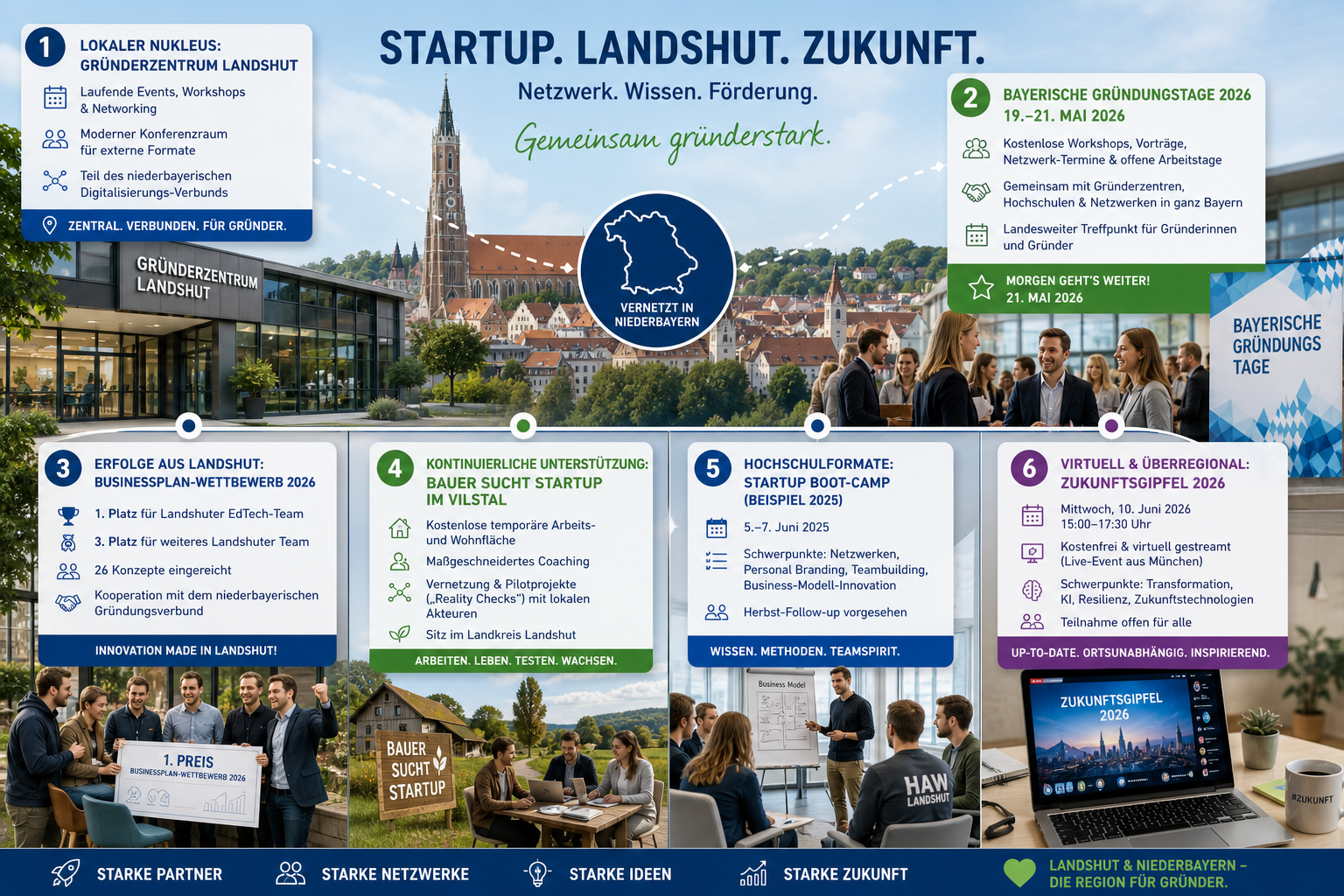
Landshut Startup Center: Hub for Events, Workshops & Contacts
If you are looking for startup events in Landshut, the path often leads through the local startup center. Such centers are typically the first point of contact for:
- Orientation (from idea to validated problem statement)
- Business Model Development Formats (e.g., Business Model Canvas, customer segments, pricing logic)
- Financing & Funding (basics on grants, loans, equity capital)
- Pitch Training and feedback sessions
- Networking with mentors, service providers, investor networks, and regional companies
Practical for the next steps: When choosing an event, pay attention to whether a format prioritizes input (lecture/workshop), output (pitch/working session), or matchmaking (network, 1:1 consultations). Especially efficient are evenings with short impulses plus moderated networking, because you can quickly have several conversations without it just being “business card collecting.”
Bavarian Founders’ Days: Annual Focus in May
A recurring fixture in the Bavarian startup calendar is the Bavarian Founders’ Days, which usually take place annually in May. For aspiring founders in and around Landshut, they are helpful as a “compact week” because you can cover several topics in a short time—without long journeys or high entry barriers.
Typical program focuses that you can expect there in the future as well:
- Idea Check: Problem–solution fit, target group, value proposition
- Law & Legal Form: Basics on choosing the legal form and initial obligations
- Marketing & Sales: Positioning, channels, first customers
- Financing: Funding logic, financial plan, pitch structure
This is how you get the most out of it: Plan 2–3 concrete questions in advance (e.g., “How do I prove willingness to pay in my target group?”) and take 15 minutes after each appointment to transfer insights directly into a document. The transfer into your daily work is the biggest lever.
Business Plan Competitions & Pitch Formats: How You Benefit
Business plan competitions and pitch-oriented formats are also relevant in the Lower Bavaria region and around Landshut because they force you to achieve clear interim results: market assumptions, pricing model, cost structure, go-to-market. For many teams, it’s not the “prize” that matters, but the cadence (deadlines) plus qualified feedback.
How to Recognize a Good Competition Format
- Phase Logic (idea → concept → plan → pitch) instead of a one-time submission
- Expert Juries with practical relevance (business, finance, research/transfer)
- Mentoring or structured feedback rounds with concrete improvement points
- Transparent Criteria (e.g., customer benefit, feasibility, scalability, team)
If you are starting in Landshut, it is worth keeping an eye on Bavaria-wide offers in parallel—especially if you are building a digital product, deep tech, or B2B software. This way you can combine local proximity (workshops, spaces, network) with supraregional visibility.
Innovation in Vilstal: Programs at the Rural–Startup Interface
Innovation formats in the surrounding area—such as in Vilstal—are particularly interesting for the coming years because reality checks are often possible there: pilot projects with companies, institutions, or municipalities that want to solve concrete problems. Such constellations are a good fit for topics like agriculture & food, energy, circular economy, sensor technology/IoT, mobility, or digital services.
If you are considering such a program, pay particular attention to:
- Access to Test Environments (pilot customers, data, processes, users)
- Coaching Quality (e.g., validation, sales, product strategy)
- Networking with regional decision-makers
- Fit between your use case and the local partners
For founders from Landshut, this combination can be particularly attractive: focused work in a quiet environment and at the same time connection to the city’s network and event formats.
Landshut University: Boot Camps, Transfer and Talents
Universities are often the place in regional ecosystems where ideas turn into marketable projects: through interdisciplinary teams, access to know-how, and structured teaching/event formats. In Landshut too, boot camps and startup-related programs are a sensible entry point—especially if you are just moving from idea to prototype.
What Results You Can Realistically Take Away from Boot Camps
- a sharpened problem statement and a testable hypothesis
- a simple prototype or click dummy that enables feedback
- a pitch structure (problem → solution → market → traction/plan → team)
- initial contacts to co-founders or practical partners
If you don’t have a team yet, university formats are especially valuable: There you meet people with complementary skills (tech, design, business), and you can quickly find out whether the collaboration is viable.
Virtual Events, AI & Future Topics: Connection to Supraregional Networks
In parallel to local events, digital formats are becoming increasingly important—especially on topics such as artificial intelligence, automation, cybersecurity, resilience, or sustainable business models. For startups from Landshut, this is an advantage: You can plan further education and networking flexibly and still maintain the regional connection.
A practical approach is the “hybrid strategy”:
- Local: regular meetings for trust, pilot projects, and long-term cooperation
- Supraregional/digital: specialist knowledge, niche communities, and visibility
Especially for AI projects, it is advisable to pay attention to responsible implementation early on (data protection, transparency, risk assessment). This strengthens trust among customers, partners, and later also in financing discussions.
Practical Guide: 7 Steps to the Right Event
- Define your goal: Are you looking for feedback, co-founders, pilot customers, funding info, or investor contact?
- Choose a format: Workshop (in-depth), meetup (broad), consultation (specific), pitch (visible).
- Prepare a 1-minute intro: Problem, target group, solution, status (idea/prototype/customers), next step.
- Write down questions: Three precise questions will get you further than ten general conversations.
- Keep materials minimal: One page (one-pager) or five slides are enough for most conversations.
- Follow up the next day: Short email/LinkedIn message with context + specifically desired next step.
- Document learning: Translate insights into hypotheses (What will we test next?) and schedule directly.